Eagle Materials (NASDAQ: EXP) is not exactly an AI play, as it has no exposure to the tech market beyond its own investment in operational quality. However, as the nation's 7th-largest producer of cement and concrete, and the largest U.S.-owned manufacturer of gypsum wallboard, it is very well positioned for the AI data center buildout.
Datacenters are not only on track to double and triple in number over the coming years, but their size and scale are increasing. They rely heavily on concrete, cement, and gypsum wallboard for structural support in the first two cases, and fire safety, temperature, and humidity control across the board. Domestic cement volume demand alone is expected to double over the coming years, topping 2 million metric tonnes annually, while tepid housing demand for wallboard is expected to be offset by datacenters.
The takeaway for investors is that Eagle Materials, a high-quality, cash-flow-producing, capital-returning machine, is positioned to grow. More importantly, it has expansion projects underway at its core manufacturing facilities, aiming to capture market demand while improving operational metrics. The likely outcome is that this company not only sustains growth in the upcoming years but also accelerates while widening margins. As it stands, analysts expect only about 10% revenue growth over the next two years, setting the stage for outperformance and a bullish revision cycle that may persist for years.
Eagle Materials Outperforms as Cement Demand Ramps
Eagle Materials had a solid fiscal Q4, with strength in the Heavy Materials offsetting weakness in Light Construction Materials. The $479.1 million in net revenue outperformed MarketBeat’s reported consensus by approximately 600 basis points (bps), growing by 2% on a 14% increase in cement and 8% increase in concrete sales. Light Construction Materials fell by 9% due to weakness in the housing market, but is expected to improve over time as data center construction advances.
Margin news was good. The company experienced an expected margin contraction tied to increased costs and operational investments; however, the impact was less than expected and was further offset by top-line strength. The critical takeaway is that adjusted EBITDA fell only 4% and net income by 10%, leaving profits just over $60 million, while GAAP earnings were well above forecasts. The $1.91 in GAAP earnings was more than 30 cents better than expected, underpinning a healthy capital return outlook and suggesting strength in the upcoming year. The company does not give forward guidance.
Analysts and Institutional Trends Highlight Eagle Materials Investment Value
Eagle Materials, for a stock so humdrum, has ample analyst coverage and institutional support. MarketBeat tracks 13 analysts covering the name; they rate it a Hold, with a 77% conviction rate, and see it advancing by double digits from May support levels. Among the critical details is the revision trend, which reverted from decline to advance prior to the release and is likely to continue in its wake. Institutions, likewise, show a high degree of conviction in this stock, owning approximately 96% of it and accumulating over the trailing 12 months. The only bad news is that institutional holders distributed shares on balance in early Q2, which presents a headwind for market action, but this behavior is unlikely to persist given the fiscal Q4 2026 results.
Capital return is the reason why analysts and institutions like this stock. The company pays dividends and buys back shares, providing a token yield to offset inflation and shareholder leverage through share count reduction. The yield is about 0.5%, compounded by a robust 4.5% reduction in share count for the 2026 fiscal year. Looking ahead, the company’s commitment to capital returns suggests this pace will be maintained in the coming years, supported by its 25-year gypsum and limestone reserves.
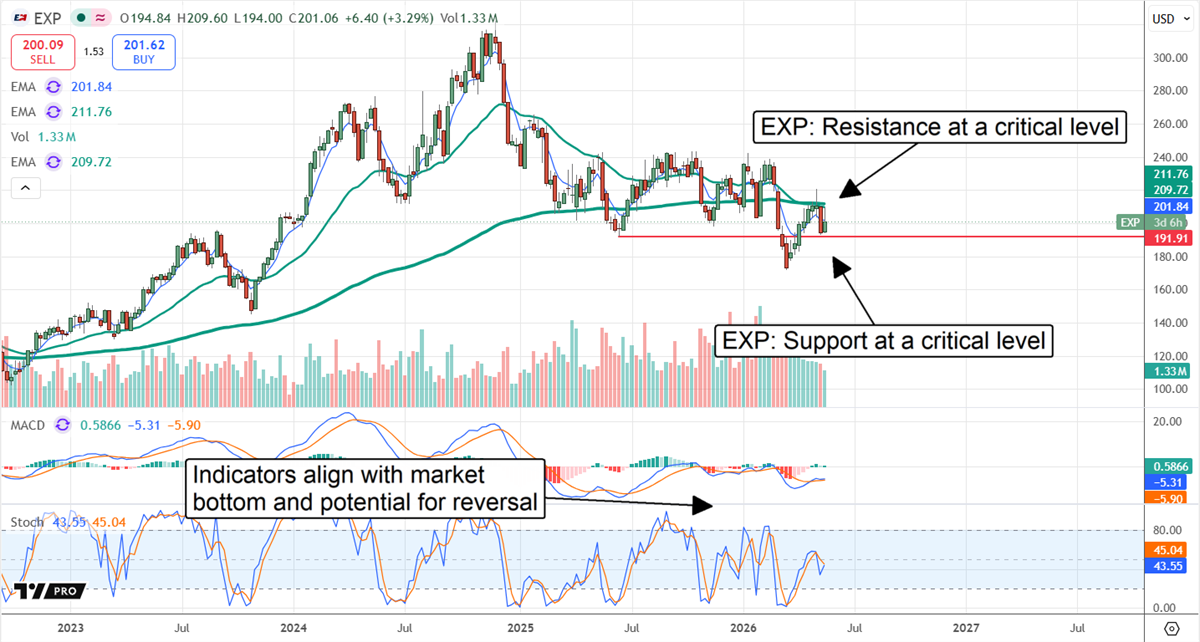
The post-release price action is favorable, although headwinds remain. The market jumped by several hundred basis points at the open, revealing support at the critical level, but resistance is present at the 150-day EMA. The likely outcome is that EXP shares continue to move sideways at or near May levels, allowing the market time to build a stronger support base. Upcoming catalysts include persistent market demand, regional bottlenecks, and pricing power. Pricing power is among EXP’s advantages, enabling the company to regularly outperform its peers and maintain a high margin.
The balance sheet provides no red flags. The company issued debt in its 2026 fiscal year, bolstering its cash position while repositioning with longer-dated maturities. The net impact was negligible, with equity relatively flat and leverage low, leaving the company in a healthy and flexible financial position.
The article "Eagle Materials: A Dividend-Paying Brick & Mortar AI Play" first appeared on MarketBeat.