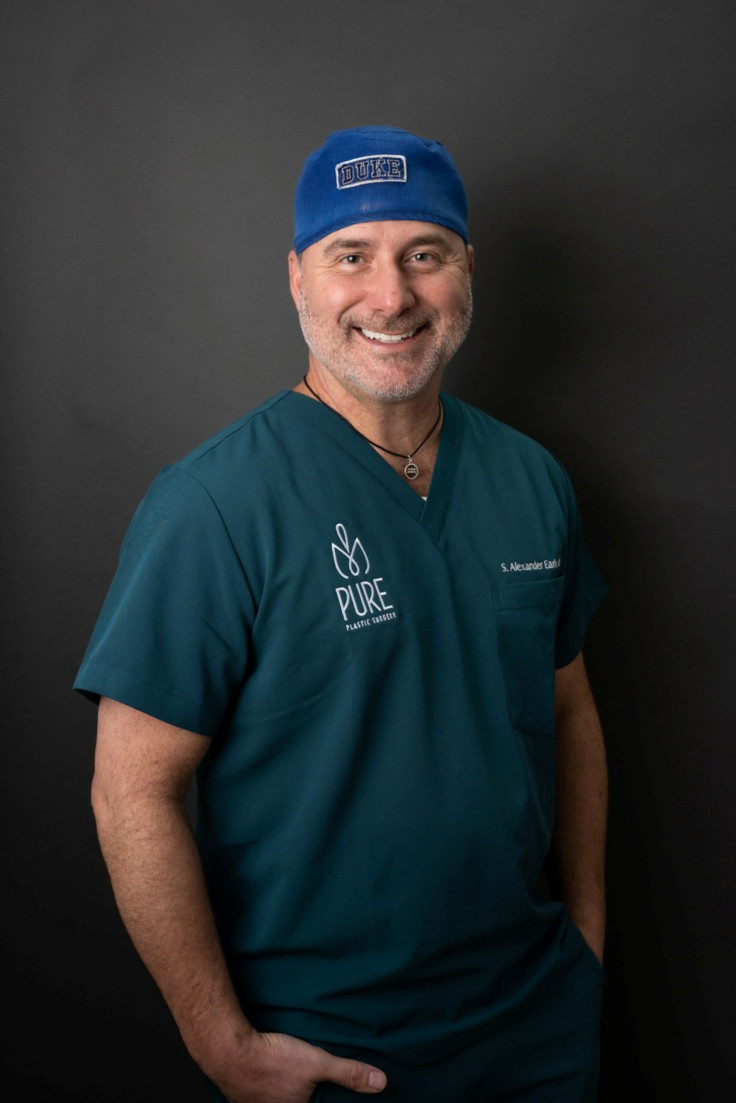
The best surgeons are innovators, and plastic surgeon Dr. Alexander Earle has been an innovator from the very beginning of his career. When he founded Pure Plastic Surgery in Miami, an area that's considered one of the main plastic surgery hubs in the United States, he knew it would be a challenge to distinguish himself and his practice.
Dr. Earle, who is a double board-certified plastic surgeon, soon became known for achieving beautiful, natural-looking results. However, his commitment to patient safety also set him apart.
In 2023, the Florida state legislature passed HB 1471, a law requiring physicians to use ultrasound guidance during gluteal fat grafting, a procedure commonly known as a Brazilian butt lift (BBL).
In a BBL, a plastic surgeon transfers fat from other parts of the body, such as the abdomen, stomach, flanks, and, if needed, the arms and thighs, to the buttocks. The fat must be placed in the subcutaneous space, which is the region between the skin and muscle.
Accidentally placing the fat too deep might seem like a minor error, but it can be fatal. If the transplanted fat is injected into the gluteal muscles, it can form a fat embolism. This is when a piece of fat enters the bloodstream and blocks a blood vessel in the lung or brain.
Ultrasound guidance makes it possible for the surgeon to see what they're doing, and it dramatically lowers the risk of fat embolisms and other complications. Notably, Dr. Earle was relying on ultrasound guidance long before Florida law made it an imperative.
"Patient safety has always been my top priority. For me, patient safety means finding a better and safer way to do things, not to avoid doing them," he explains. "With the BBL, I understood the risks of placing fat 'blindly' and thought to myself, 'There must be a better way.'"
"The ultrasound gives me real-time visualization. It's a tool that made me feel more in control in the operating room. I always found it shocking that other surgeons did not embrace this until Florida law mandated it."
So, what actually changes in the operating room when a plastic surgeon performs an ultrasound-guided BBL?
"With the ultrasound, you are no longer only relying on feel or experience. The ultrasound allows you to see the tissue planes in real time, along with the cannula used to place the fat. No more guessing," says Dr. Earle. "Now the surgeon can confirm precisely where the fat is being grafted and avoid any of the 'danger zones,' like placing it in the muscle."
Dr. Earle is insistent that once a surgeon learns how to use ultrasound technology in the operating room, it doesn't add significant time to a procedure. Compared to many of the state-of-the-art tools used in plastic surgery, ultrasound machines are relatively inexpensive. In terms of both time and money, it's a small price to pay for possibly saving a patient's life.
Some might think that using ultrasound guidance makes a minimal difference in patient outcomes, but Dr. Earle's experience and research indicate that that's not the case.
"In 2017, the BBL was said to have a mortality rate of one in 3,000," he says. "With the use of the ultrasound, I published a study where we performed nearly 2,000 ultrasound-guided BBLs with zero incidence of fat embolism and zero mortality."
Ultrasound guidance can dramatically improve patient safety, but Dr. Earle is quick to note that a safe BBL involves more than just an ultrasound machine.
"Ultrasound guidance makes a huge difference, but it isn't a replacement for training, technique, or good judgment," he warns. "It doesn't make the operation risk-free, but it does give the surgeon much better information in real time. What it does is add another layer of safety because the surgeon can verify the cannula is positioned and placed in the proper plane."
Given the potentially fatal consequences of misplacing fat during a BBL, one might think that most states would be in a hurry to adopt laws like HB 1471. Unfortunately, that's not the case. Legal regulations tend to move slowly, and many people still aren't aware of the risks that can come with a BBL.
That doesn't mean that surgeons and patients need to sit idly by while waiting for state legislators to make changes. Dr. Earle is hopeful that with enough education, data, and pressure, legislators and plastic surgeons alike will see the importance of this new safety standard.
"Pressure comes from both the medical community and the general public," he says. "Once patients demand it consistently, it's harder to ignore."