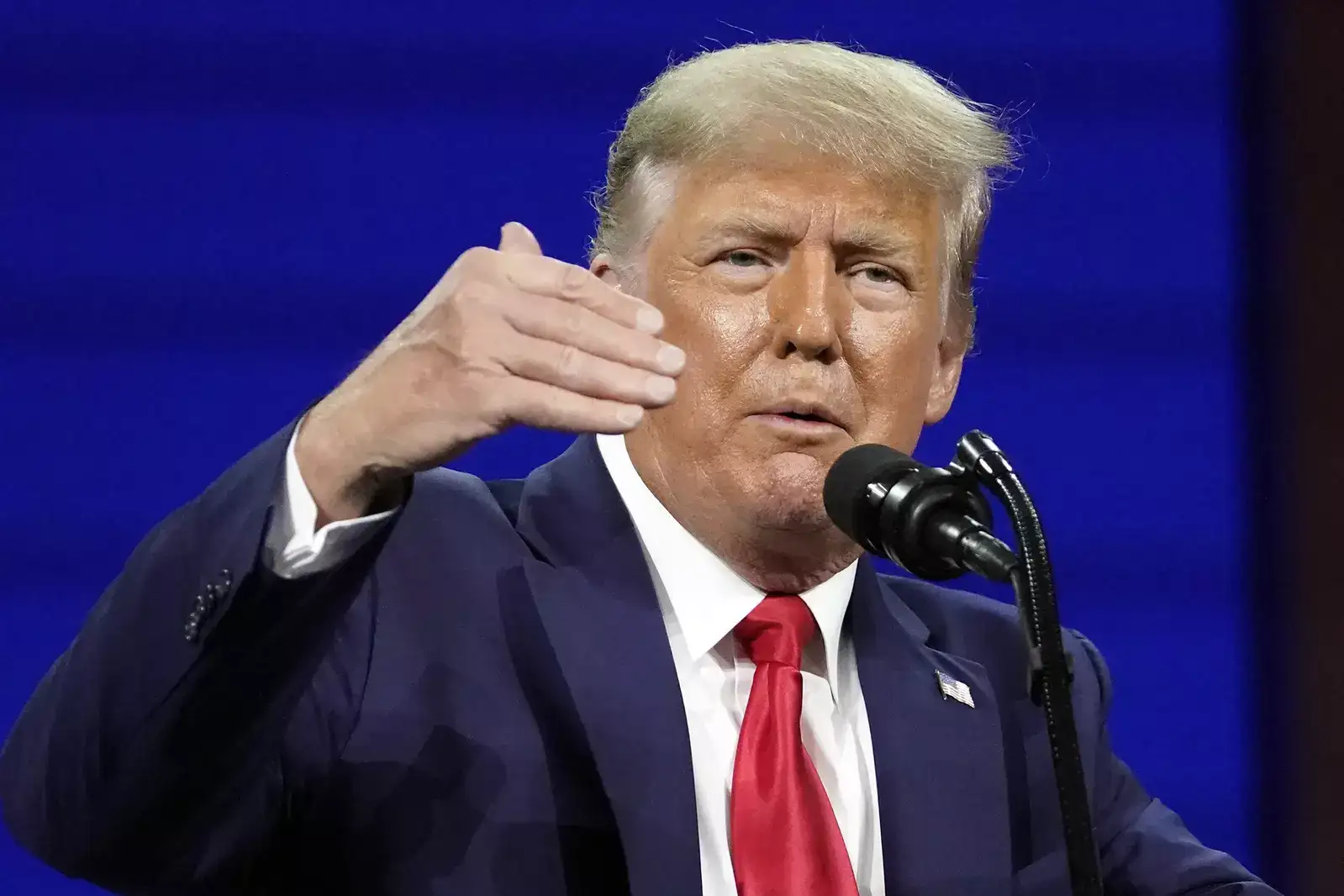
U.S. President Donald Trump defended himself against allegations of insider trading and using the presidency to enrich himself and his family, saying he has no role in managing his business interests and that his focus is on running the country rather than making money.
His remarks came during an interview with CNBC's Joe Kernen at the Oval Office, days after Trump's latest mandatory financial disclosure reignited debate over his business interests, particularly his family's rapidly expanding cryptocurrency ventures.
The 927-page disclosure filed with the U.S. Office of Government Ethics showed Trump earned at least $2 billion in revenue during 2025. According to the filing, businesses linked to digital assets generated an estimated $1.4 billion in revenue, exceeding earnings from much of the real estate empire that first made his fortune.
The disclosure also highlighted businesses with connections to Pakistan, drawing renewed attention to the intersection of Trump's crypto interests and his role as president. Responding to criticism during the interview, Trump repeatedly maintained that he does not manage his businesses and said his financial interests play no role in his decisions as president.
Trump aloof from personal business
Trump entered politics as a billionaire businessman, something he described as unprecedented among U.S. presidents. Kernen suggested that many people believe business experience is valuable in government and pointed to the stock market's performance under Trump's presidency.
"The stock market today, it's up 500 points, it's up to almost 53,000," he said, recalling that analysts had earlier suggested reaching the 50,000 mark by the end of a four-year term would have been an extraordinary achievement. He said the index had crossed that level in just over a year. Turning to questions about his business interests, Trump said he is not involved in running them.
Also read: The Pakistan connection that helped Donald Trump make $1.4 billion crypto jackpot
"I don't have anything to do with my business. My kids run it," he said. Trump described himself as "a really good business person" who had made "a tremendous amount of money," but said he leaves investment decisions to professional firms. He said his son Eric Trump oversees those arrangements and that he does not discuss investment decisions with him. "I don't talk to him about things such as this," Trump said.
According to Trump, his investments are placed with large financial firms through what he described as "semi-blind trusts, or blind trusts," where others make investment decisions on his behalf.
Trump also addressed reports that he held investments in Nvidia after referring to a news story involving the chipmaker. Trump acknowledged that he believed he owned some shares but suggested the holding was relatively small and was simply one of many investments made by firms managing his money.
"I don't care about that," he said. Explaining why, Trump said serving as president outweighed any financial considerations, he added, "Because I have a much bigger purpose. You know, this is the Oval Office. It's a much bigger purpose than whether or not I make money."
‘Feel bad for my kids’
Presidents and Vice Presidents are generally not subject to the same conflict-of-interest laws as other federal officials, but said there remains an expectation that they should avoid situations that create perceived conflicts.
Trump responded by saying that almost any business activity undertaken by his children could be viewed through the lens of his presidency because of the influence attached to the office. "I feel bad for my kids," he said.
According to Trump, any investment or business decision made by his children can become the subject of conflict-of-interest questions because of his position. "If they invest in a stock, or they go and do a deal, anything they do because the presidency is so powerful," he said.
Trump said if his children bought a cupcake company, people could question whether his energy policies affected the business because bakeries use energy. Likewise, he suggested that purchasing an energy-efficient truck could invite allegations that they possessed inside information.
"So it's pretty tough in that sense," he said. Trump said he advises his children to avoid as many situations as possible that could create such questions, while acknowledging that they also have businesses and lives of their own. "I tell my kids, stay away from as much as you can stay away from," he said. "But they also have a life." He added that the Trump family had been conducting business long before he considered running for president.
"We were doing business long before I ever thought of running for president."
Read more: Donald Trump's $1.4 billion payday: How meme coins and a family venture built his fortune
Crypto questions and Trump's response
For Trump, cryptocurrency has been an area that has become central to both Trump's financial disclosure and public debate over potential conflicts of interest. Kernen pointed out that the disclosure showed Trump and his family had made a substantial amount of money from crypto-related businesses. He asked whether Trump knew that his family business would enter the crypto sector and whether he had any involvement in those decisions.
Trump replied that his family's business activities predated his return to office. He then broadened his response beyond his personal business interests to explain how he views cryptocurrency.
"The way I view crypto's a little differently," Trump said. He argued that the United States needs to remain the global leader in digital assets otherwise China's going to take it over. Trump made a similar argument regarding artificial intelligence, saying the United States was leading that sector as well.
He recalled meeting Chinese President Xi Jinping three weeks earlier and said Xi had praised the country's economic progress. According to Trump, Xi's first words were, "Wow, you've really done a great job." Trump said he believes both artificial intelligence and cryptocurrency are strategically important industries.
"Anything we do, I want to be number one in," he said. "We're number one in crypto, and we're also number one in AI." However, the amount of money generated from crypto is unusually large and begs a question: Whether Trump knew about the family's crypto ventures.
Trump answered, "No." He immediately added that even if he had known, there would have been nothing improper about it. "By the way, I could know about it," he said. "I didn't... there's nothing illegal, there's nothing wrong with it."
According to the disclosure, around $799 million in revenue came from Trump's interest in World Liberty Financial (WLF), the decentralised finance company that he co-founded, where he is listed as "co-founder emeritus."
The company is managed by his sons, Donald Trump Jr. and Eric Trump. The filing also attributed roughly $636 million to sales of the $TRUMP memecoin launched shortly before his inauguration. Together, these businesses account for the bulk of Trump's newly reported wealth.
The debate also extends into foreign policy. WLF has become closely associated with Pakistan's efforts to establish itself as a digital finance hub after years of strained ties with Washington.
Earlier this year, Pakistan's Ministry of Finance and the Pakistan Virtual Assets Regulatory Authority signed a memorandum of understanding with a WLF affiliate to explore integrating the company's dollar-backed stablecoin, USD1, into Pakistan's regulated payments infrastructure. The initiative aims to support billions of dollars worth of remittances and cross-border transactions.
(Disclaimer: Recommendations, suggestions, views and opinions given by the experts are their own. These do not represent the views of The Economic Times)