

Android Central Labs is a weekly column devoted to deep dives, experiments, and a focused look into the tech you use. It covers phones, tablets, and everything in between.
E Ink has long been considered the best display type if eye health is at the top of your needs list. But one E Ink alternative you've probably never heard of is making serious headway: RLCD. Short for Reflective Liquid Crystal Display, this technology takes the reflective nature of E Ink and applies it to a more traditional pixel-based display, resulting in substantially smoother performance than E Ink could ever hope to achieve.
Now, this isn't the first time I've used an RLCD device. I wrote about the Daylight Computer back in June, an Android-based tablet that uses a bespoke black & white RLCD with a backlight. That backlight makes it a rarity among RLCD devices, as the vast majority of them omit the back or frontlight to make them feel as "paperlike" as possible. The only other major RLCD tablet with a frontlight is the upcoming Eazeye Paper 2, scheduled to release in April 2026.
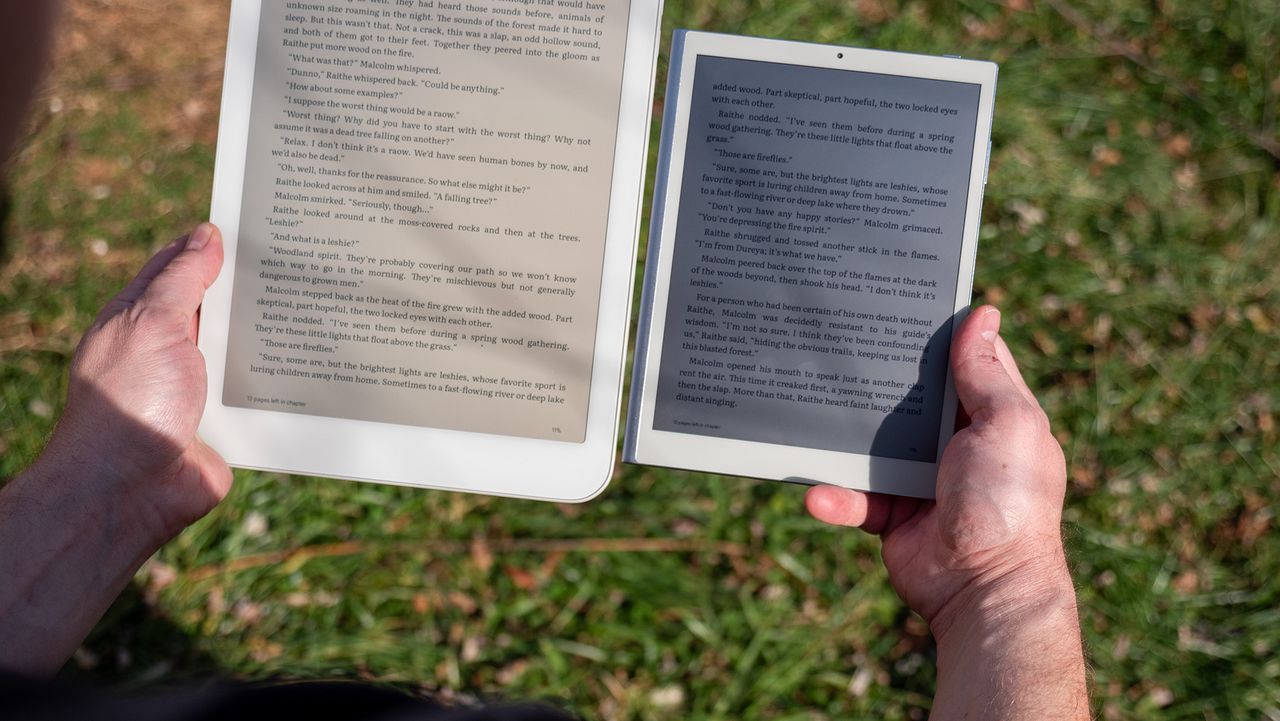
Today, I'm taking a look at three different RLCD tablets — Harbor Paper 7, Daylight Computer, and Hisense Q5 — to showcase the evolution of RLCD into a true E Ink competitor, from one of the first RLCD tablets ever made to the latest in color RLCD that looks like a screen printed on metal.
Enjoy our content? Make sure to set Android Central as a preferred source in Google Search, and find out why you should so that you can stay up-to-date on the latest news, reviews, features, and more.
Five years of RLCD evolution
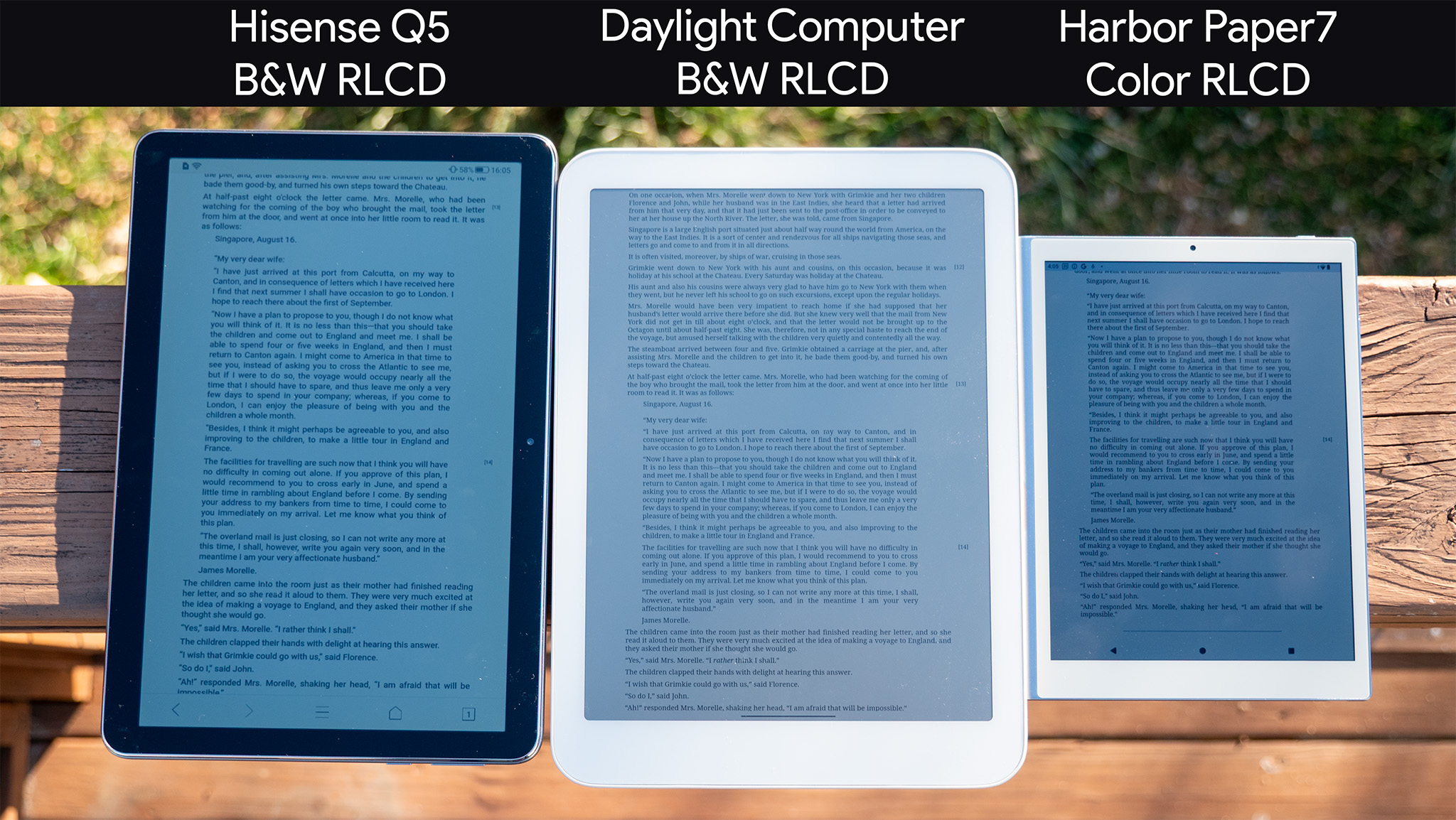
Most e-readers feature an anti-glare coating to reduce reflections and make reading as paperlike as possible, but the first RLCD tablet did not. The Hisense Q5 was a novel, ill-fated product when it debuted in 2020. Discontinued just weeks after the initial production run, Hisense later made a second batch in 2020, as COVID disrupted supply chains and likely ultimately led to this unique tablet's early demise.
Up until this product, all LCDs featured transparent layers that allowed a backlight to shine through a layer of colored pixels, creating the images we see on screens. The Hisense Q5 swapped out that transparent layer for a reflective one and removed everything but a black hue, allowing as much light to reflect back to the user as possible.
This tablet was mind-blowing when it came out, and while the lack of a backlight and a black-and-white display limited its potential, its impact on the display industry was impressively monumental. Years later, companies like Daylight and Eazeye would pick up Hisense's mantle, further developing RLCD with products like the Eazeye Monitor and Daylight Computer.
Those companies took RLCD one step further, creating true 8-bit displays that no longer relied on temporal dithering to fake bit depth, ushering in a new wave of truly flicker-free displays. These are still niche products, but it's clear that RLCD is catching on because it can deliver substantially faster refresh rates and deeper colors than E Ink.
The best E Ink displays often top out at 40Hz, while RLCD is capable of 120Hz. Similarly, color E Ink displays can typically show 4096 colors, while the 8-bit depth of color RLCDs can show up to 16.8 million colors. Unfortunately, the Harbor Paper 7 color RLCD tablet I have here uses dithering, meaning it can't be considered truly flicker-free.

Of course, nothing is without its limitations. As I covered in my article about the Daylight Computer in June, RLCD requires a constant power source to produce an image. That's because it's still built on a traditional LCD pixel structure, which must provide power to pixels and constantly refresh them.
E Ink is a completely passive technology that only requires power when the images on the screen are changed. That means that if you're reading something, E Ink requires no power at all to display what's on the screen because the pigments stay there after being "placed." LCDs constantly refresh the screen 60 to 120 times per second, no matter what's going on.
Color or black & white?
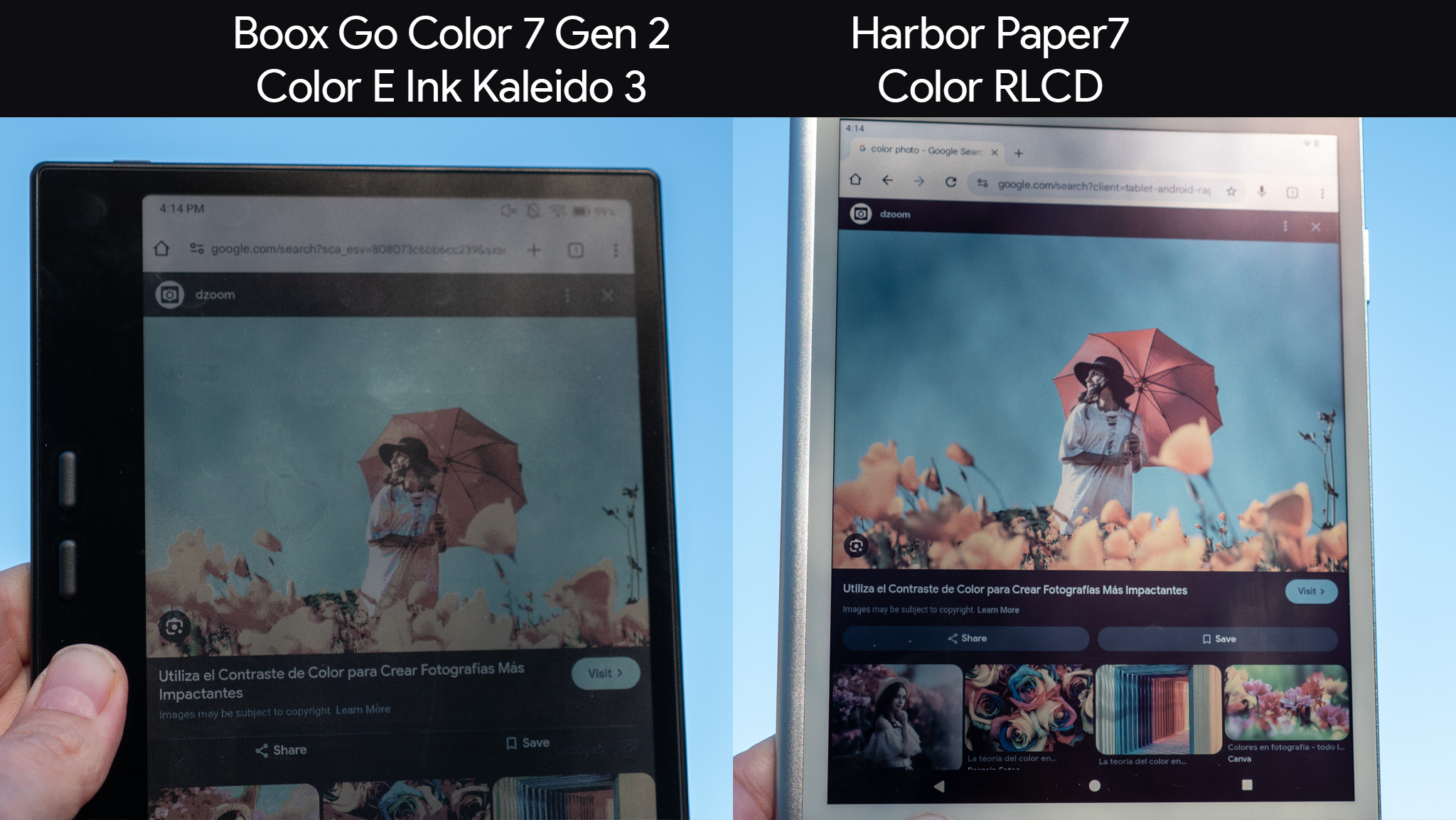
In the world of reflective displays, something strange happens when color is added: the displays dim. It doesn't matter if you're using a built-in frontlight or taking them out in the sunlight, a color RLCD or color E Ink display will always be darker than a black-and-white one. At least, that's the case until someone figures out a novel new way to reflect light off the colored pixels.
That's because black-and-white displays have only one pigment: black. Color displays must filter light through several colors — typically red, green, and blue — before the light is visible to the user again. Because each pixel or pigment is now separated into colored bins, there's less physical space for light to reflect off the display.
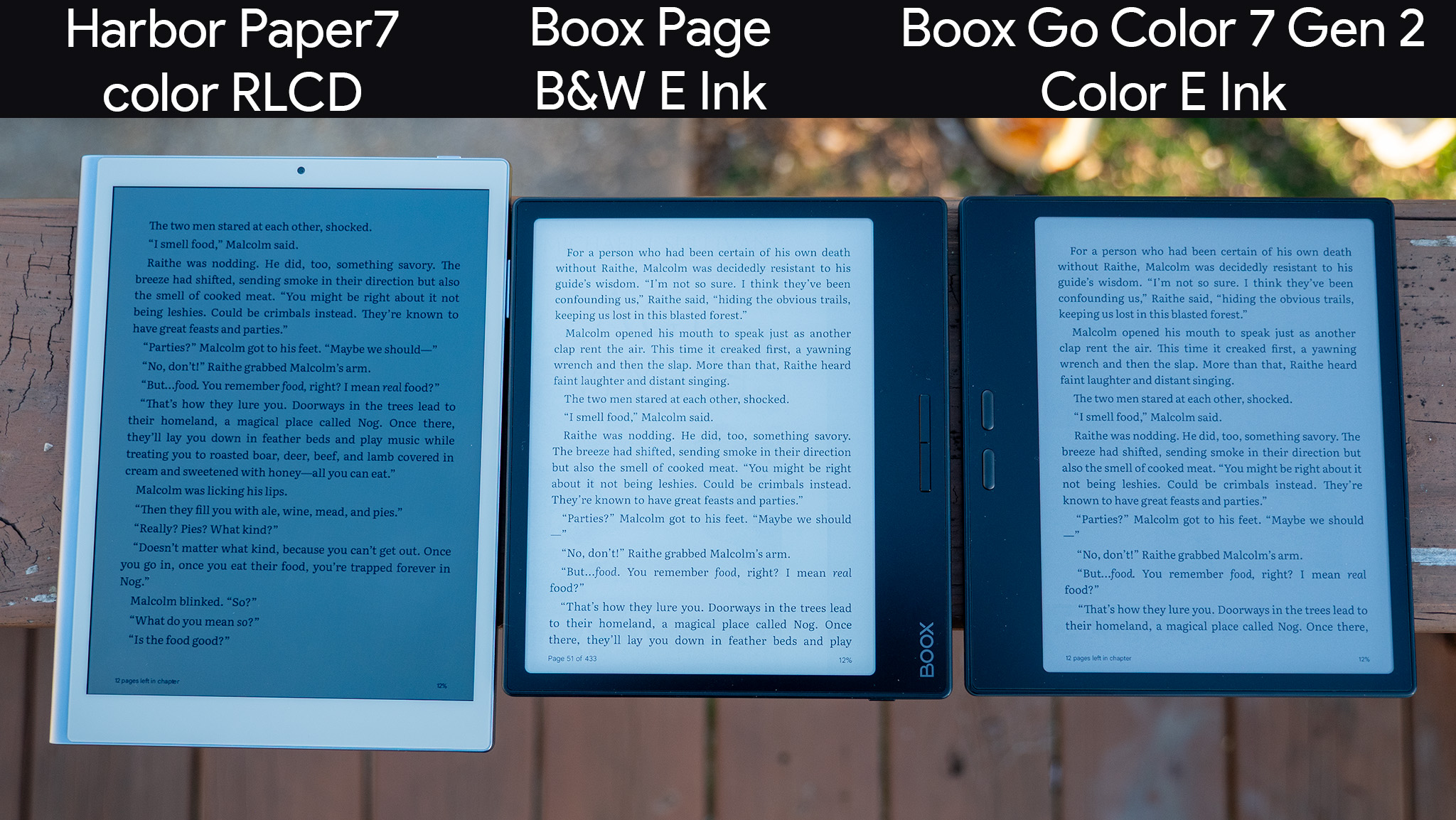
It's a similar concept to how camera sensors work, and while a "giant" digital camera will still take better photos than your smartphone could ever hope to. It's hard to beat physics, especially when light is required to create the image you want. Whether it's a display or a camera sensor, a larger area means more light, which inherently results in a better, brighter image.
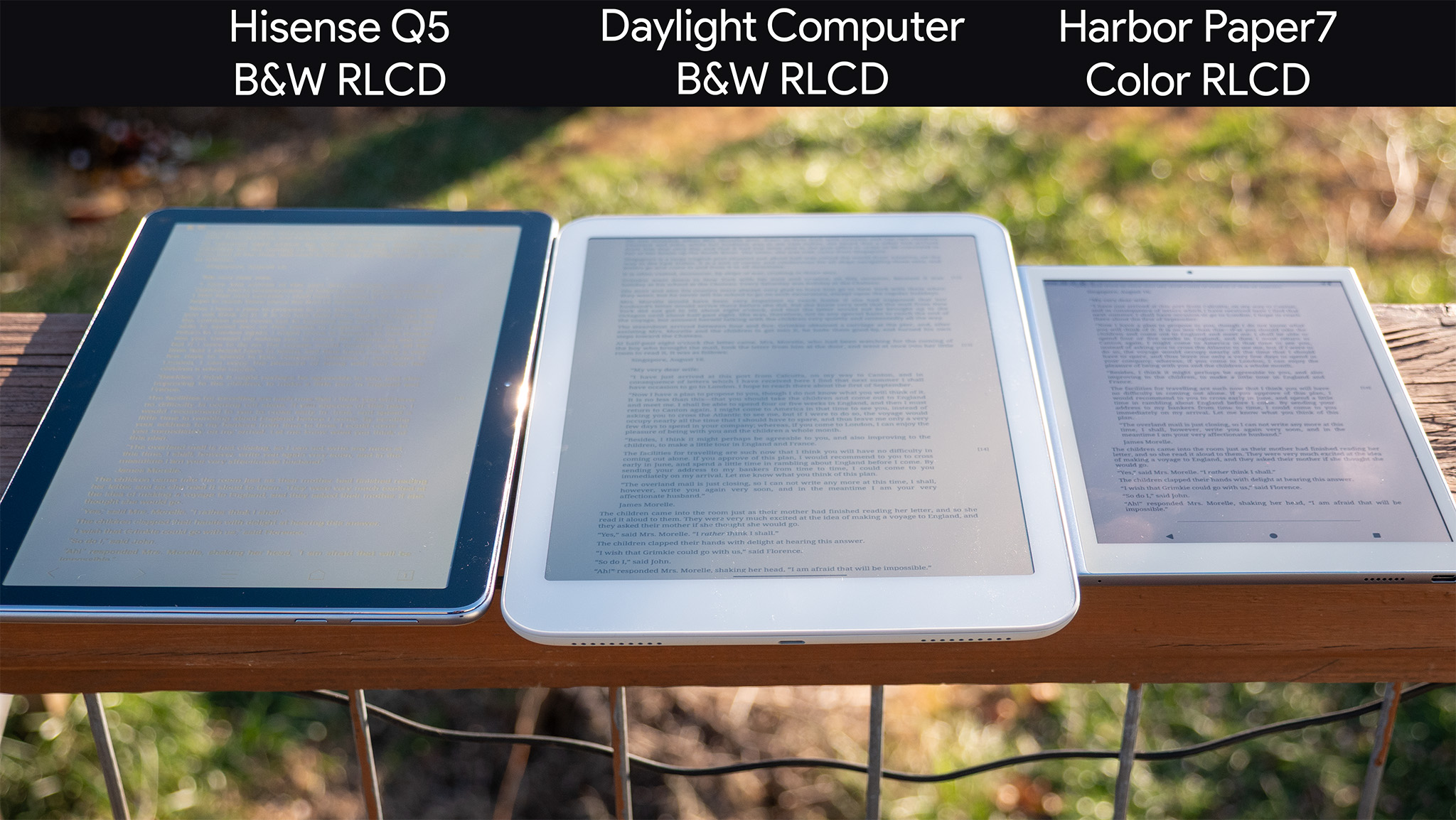
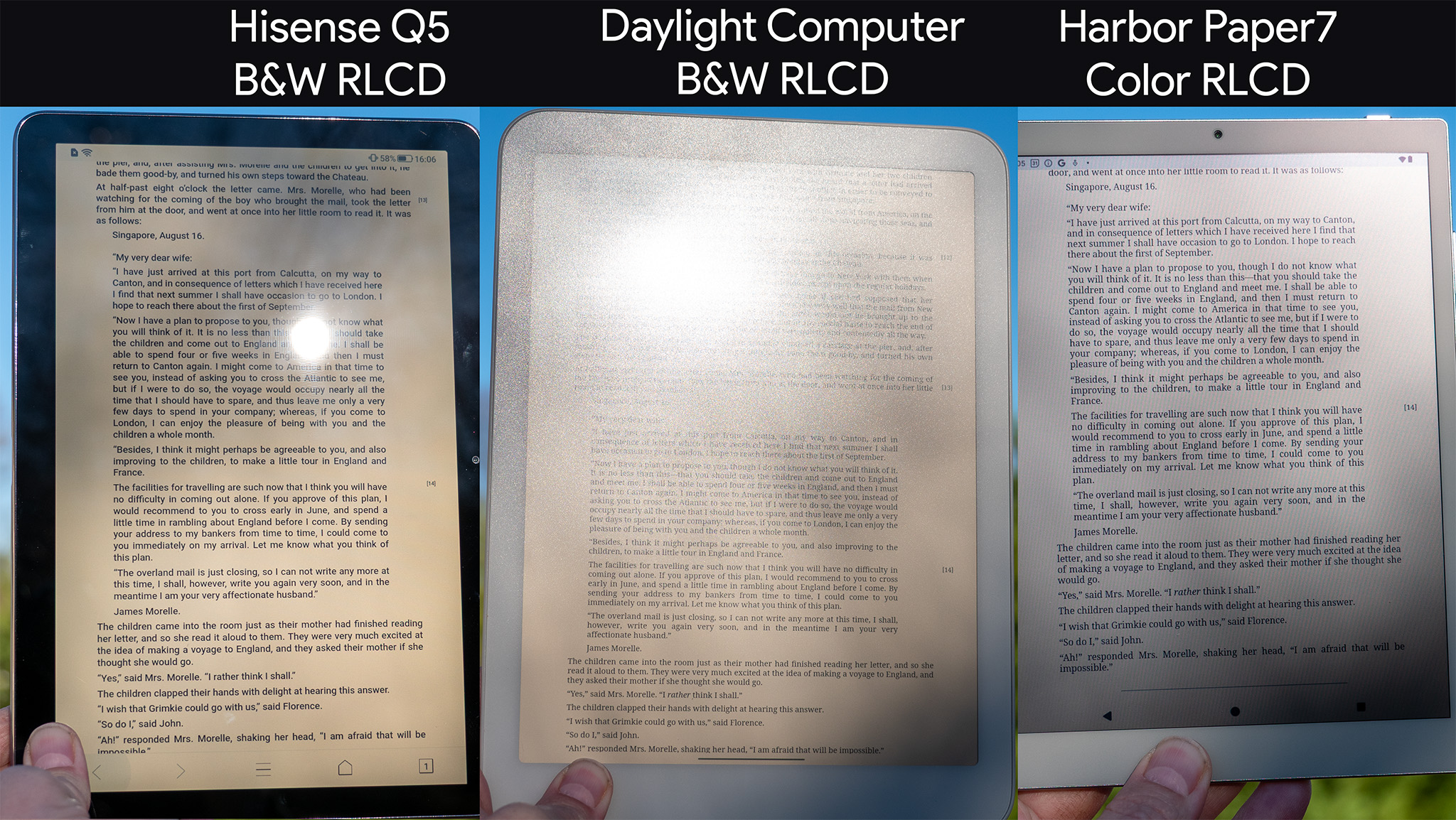
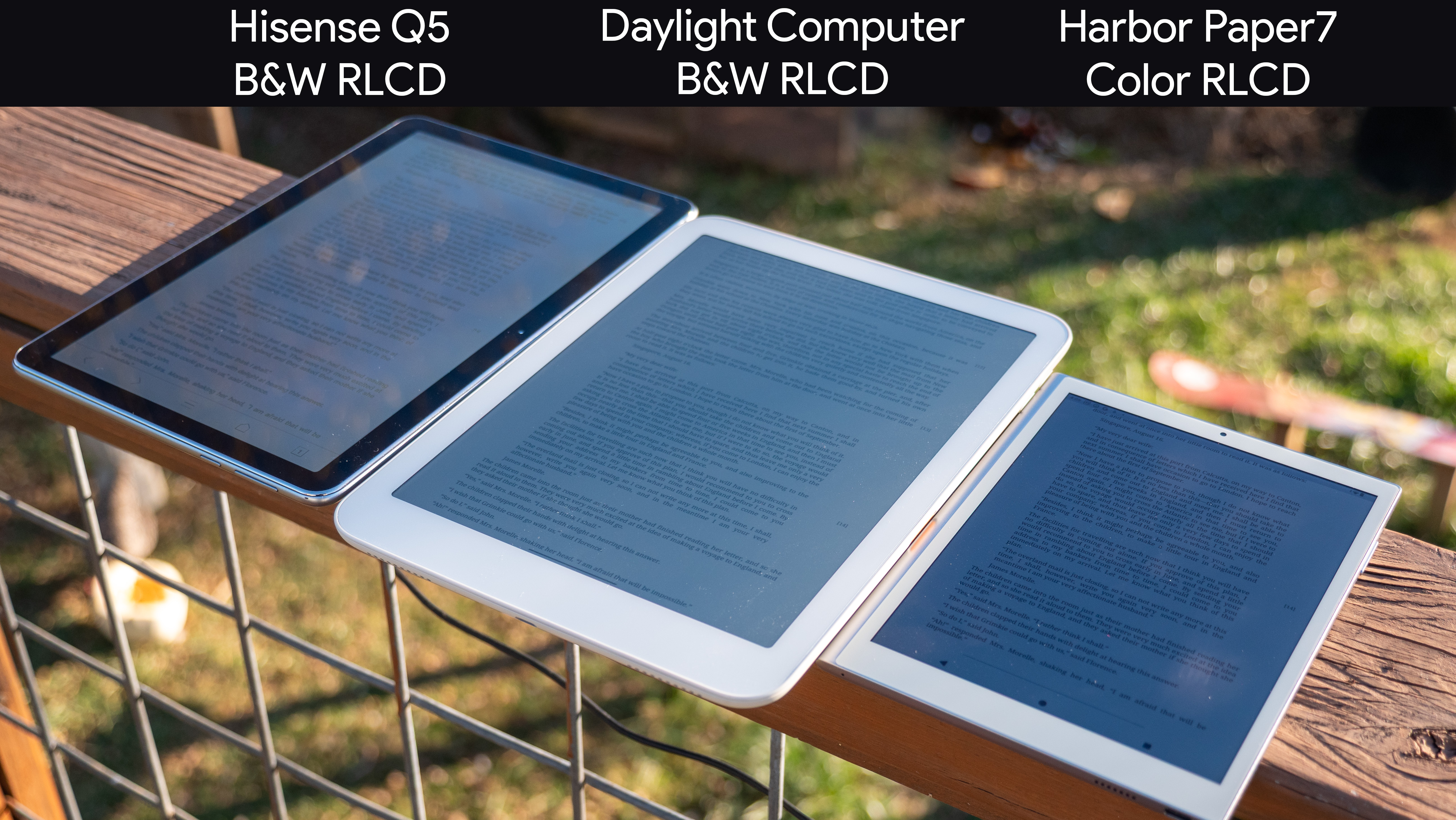
It's actually pretty wild to see the difference. Black-and-white E Ink seems to be the brightest of all the technologies, while Daylight Computer's black-and-white RLCD is the runner-up. The Harbor Paper 7 color RLCD is the dimmest display in a crop of five devices I have here, with any Kaleido 3 color E Ink display managing to get just a bit brighter than it. These images are using just reflected sunlight, no back or front light to help illuminate things.
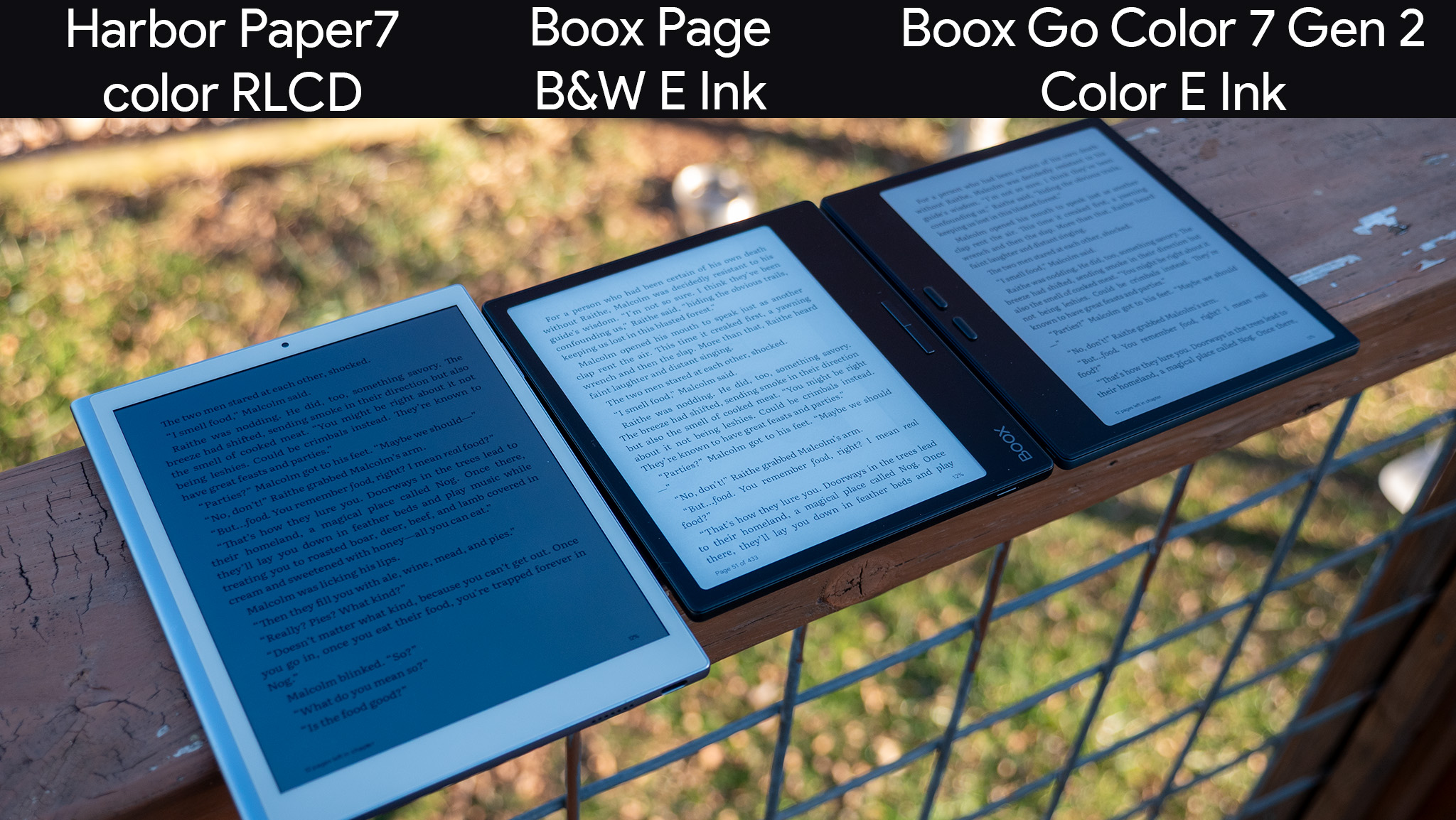

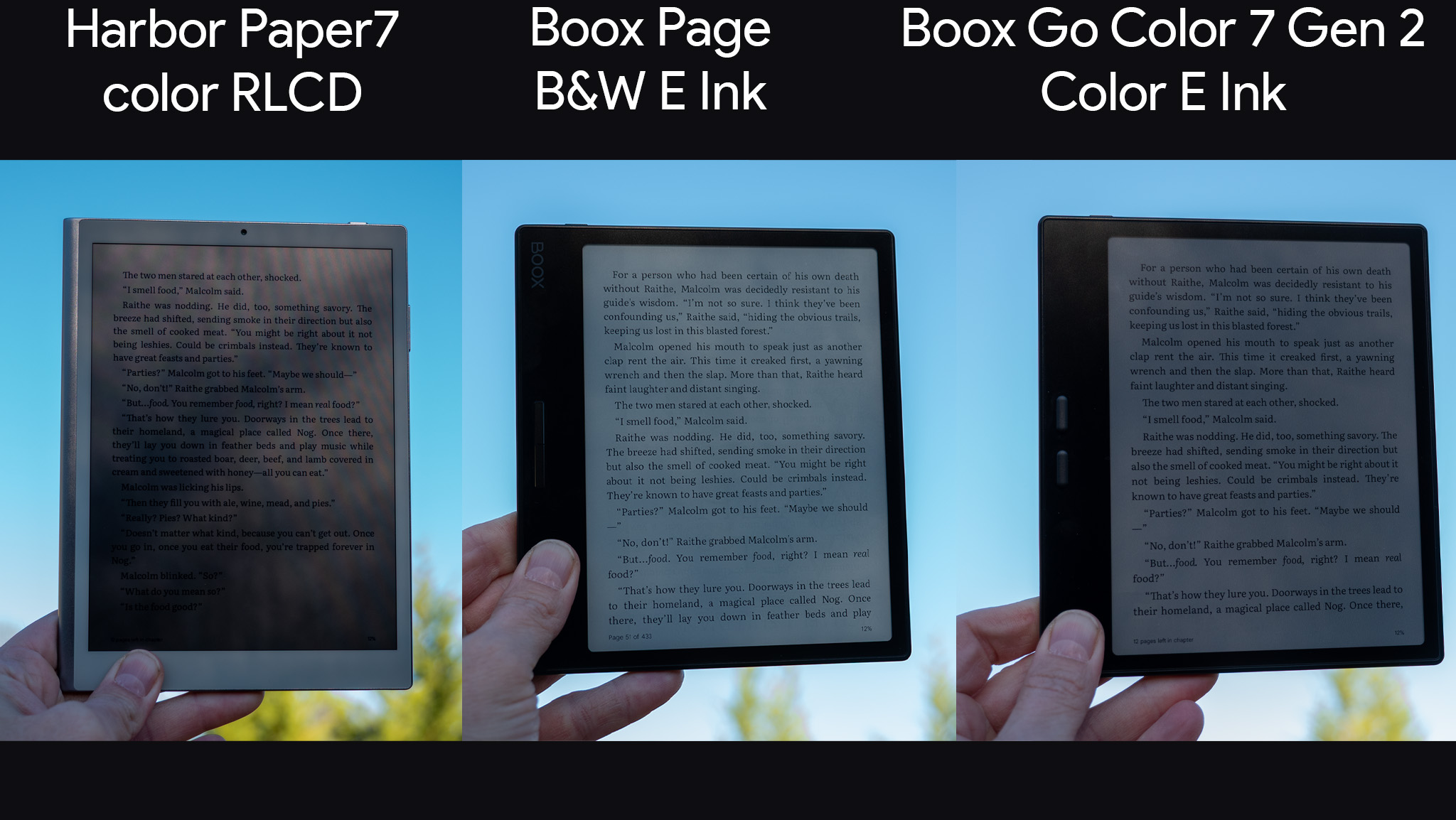
Those devices with artificial lights will see improvement in any lighting condition, sometimes even in sunlight. The anti-glare layer on top is also worth considering. Daylight's RLCD and TCL NXTPAPER seem to use a similar anti-reflection layer on their displays, and it results in an inability to see the display at all if held at a specific angle to light glare.
The Boox E Ink devices I have don't have this issue, and neither does the Harbor Paper 7 color RLCD tablet. I wouldn't call this a debilitating problem for those other two technologies, but you'll need to hold them at a slight angle sometimes, and that may be a big annoyance for some users.
So, while there's no perfect reflective technology yet, it's clear that several different companies are working to be the first with that title, and that's truly excellent news for everyone focused on eye health over flashy, artificially ultrabright, and flicker-prone display tech like OLED.
FAQ
What's the difference between E Ink and RLCD?
RLCD uses a traditional pixel structure, meaning the display is made up of potentially millions of tiny pixels that must each be actively powered to display an image. Because of this, RLCD can refresh up to 120Hz, or 120 times per second.
E Ink displays are made up of millions of tiny magnetically charged white or black pigments. When text is displayed, black pigments are brought to the surface of the display and resemble ink from a pen. Because these displays are magnetically-driven, power is only required to create the initial image and, therefore, E Ink can permanently display an image as long as you'd like after it's been drawn, but refresh rates are currently limited to around 40Hz.
Does E Ink or RLCD have better battery life?
Because E Ink is magnetically-driven, E Ink devices with the same specs will have better battery life than RLCD devices. Commonly, E Ink devices may last weeks on a charge, while RLCD devices may last just days, at best. Devices without an active backlight or frontlight will last longer than those with a light built in when the light is used.
Do color E Ink or RLCD e-readers exist?
This year, we've seen the debut of dozens of new color ePaper devices. Most use E Ink technology, but a few have opted for RLCD. Color E Ink can display around 4096 colors, while color RLCD can display up to 16.8 million colors.
Can E Ink or RLCD tablets run Android apps?
Most E Ink and RLCD tablets released in 2025 run Android, which means they generally support all Android apps found on the Google Play Store. Brands like Bigme, Onyx Boox, Harbor, Daylight, and Hannspree are a few examples of Android-powered ePaper tablets that double as e-readers. Amazon Kindles do not run Android apps.
Is RLCD good for your eyes?
RLCD is considered a very eye-friendly alternative to traditional LCD or OLED. Since RLCD is engineered to work without a backlight, it can avoid some of the pitfalls that artificial backlights present, like light flickering or PWM dimming. RLCD, like E Ink, is made to be used with ambient light, and manufacturers often encourage the use of these devices outdoors.