After Donald Trump sued his own administration for $10 billion, pitting his personal lawyers against the Department of Justice, the president was gifted a broad, single-page document that gives him sweeping immunity from tax crimes.
Under the guise of a “settlement” between his lawyers and his administration, the president and his allies will both receive government handouts potentially worth tens of millions of dollars. Alleged “victims” of government “weaponization” can file for a piece of a nearly $1.8 billion compensation fund, while the president, his family and their businesses escape government scrutiny for tax debts over which they have been under investigation for more than a decade.
Legal experts tell The Independent that the agreement is a blatant and illegal act of self-dealing by the administration.
“There is a federal crime that prohibits exactly what the president did, and for exactly this reason, to prevent a corrupt president from using the IRS to their own advantage,” according to UC Berkeley Law professor Brian Galle, a former federal prosecutor with the Justice Department’s Tax Division.
“This is an episode that would have brought down any other presidency in American history,” he told The Independent.
The one-page agreement — printed on the Office of the Attorney General letterhead and signed by Trump’s former criminal defense lawyer and now Acting Attorney General Todd Blanche — “forever” blocks the federal government from “prosecuting or pursuing” any tax claims against the president, members of his family and their businesses.
Meanwhile, a five-member board made up of Blanche’s appointees will arrange payments from a $1.776 billion fund to recipients whose identities will remain secret. Blanche has publicly stated that Trump and his family are not eligible, but Blanche has not ruled out payments to the president’s donors and allies, raising questions about the process and who stands to benefit.
Top Democrats on the House Judiciary and Ways and Means committees are pressing the administration for answers.
“Never in American history has a president pursued corruption this brazenly or on such a colossal scale,” Reps. Jamie Raskin and Richard Neal wrote to Blanche, Treasury Secretary Scott Bessent and IRS CEO Frank Bisignano.
“Essentially, the federal government threw in a Super-Pardon for the president, his family, and related and affiliated entities, freeing them not only from any accountability for any taxes they may have dodged, but other pending federal criminal or civil investigations like insider trading, antitrust violations, false statements, or even sexual harassment,” they wrote Wednesday.
It’s unclear whether Trump’s attempts to evade the IRS and will survive in Congress or against a Democratically controlled White House.
IRS deal ‘crosses the line into illegality’
Trump’s agreement, which applies only to existing audits, could spare the president and his family from a more than $100 million tax penalty.
An audit centered on a nearly $73 million tax refund Trump claimed around 2010, which the former real estate developer and reality TV host justified by reporting steep business losses, largely tied to his casino holdings and his Chicago skyscraper.
The IRS contended that Trump improperly claimed the same losses twice for the Chicago tower, where he reported losses of up to $651 million.
Trump, who has been fighting the audit for years, accused the IRS of failing to prevent the leak of his tax returns.
“The deal that Trump extracted from the government he leads is really a spectacular demonstration of the fact that there really are two sets of tax rules, one for those at the top, and another for the rest of us,” according to Steve Wamhoff, federal policy director with the Institute on Taxation and Economic Policy, a nonpartisan tax policy group.
“Trump and his officials view themselves as untethered from the tax laws that apply to normal Americans,” he told The Independent.
Tax schemes to support wealthy figures typically play out in obscure policy debates, but “this week is different because Trump distorted the tax system to blatantly help himself without even trying to hide the fact,” he said.
Federal law prohibits the executive branch from requesting — “directly or indirectly” — that the IRS terminate investigations into any taxpayer, let alone the president. “It says what the president did this week was a crime,” said Galle, the UC Berkeley Law professor.
That statute also requires IRS officers and officials who receive those requests to report them to the Treasury Department's inspector general, the agency’s independent watchdog. Failure to do so can result in criminal prosecution.
“Trump’s dirty deal has crossed the line into illegality,” according to Robert Weissman and Lisa Gilbert, co-presidents of nonprofit consumer advocacy group Public Citizen.
“If Acting AG Todd Blanche tries to effectuate this settlement by directing the IRS to end audits underway or not to conduct audits it would normally undertake, both he and Donald Trump will be violating the law and putting IRS officers at risk,” they said.
A spokesperson for the Trump Organization said the settlement “seeks to provide meaningful accountability for the IRS’s prolonged and systemic failure to safeguard sensitive taxpayer data,” including the “unlawful disclosure” of tax information connected to Trump-affiliated entities.
The Supreme Court has ruled that the president is immune from criminal prosecution for official acts in office, a landmark decision that has tossed a grenade into Trump’s legal battles and could emerge as a defense in upcoming lawsuits over the IRS agreement.
“I guess we could debate until the cows come home whether canceling an audit for your family forever is an official act of the president,” Galle said. “I find that hard to swallow, but I’m sure his lawyers will be making it at some point, or his children's lawyers will be making it.”
Anyone signing ‘slush fund’ checks should ‘talk to a lawyer’
The Justice Department is tapping into the long-standing Judgment Fund to settle claims brought by Trump’s allies, an arrangement that critics have called a “slush fund” for his supporters.
The administration is relying on a federal statute that sets out how the government pays final court judgments and settlements. That statute, 31 U.S. Code § 1304, says the attorney general can pay funds to settle “imminent litigation.”
Democratic congressmen Raskin and Neal argue that the administration is trying to circumvent Congress by using the Judgment Fund “for a scam Congress never contemplated: rewarding the president’s political allies at the expense of American taxpayers.”
“I think there’s a powerful argument that the slush fund has no legal authorization [and] doesn’t fall within the existing open appropriation for payments of settlements,” UC Berkeley’s Galle told The Independent.
“I think you are creating legal risk for yourself, and because that particular prohibition carries criminal penalties,” he said. “I think anybody who’s going to cut that check or sign that check should probably talk to a lawyer.”
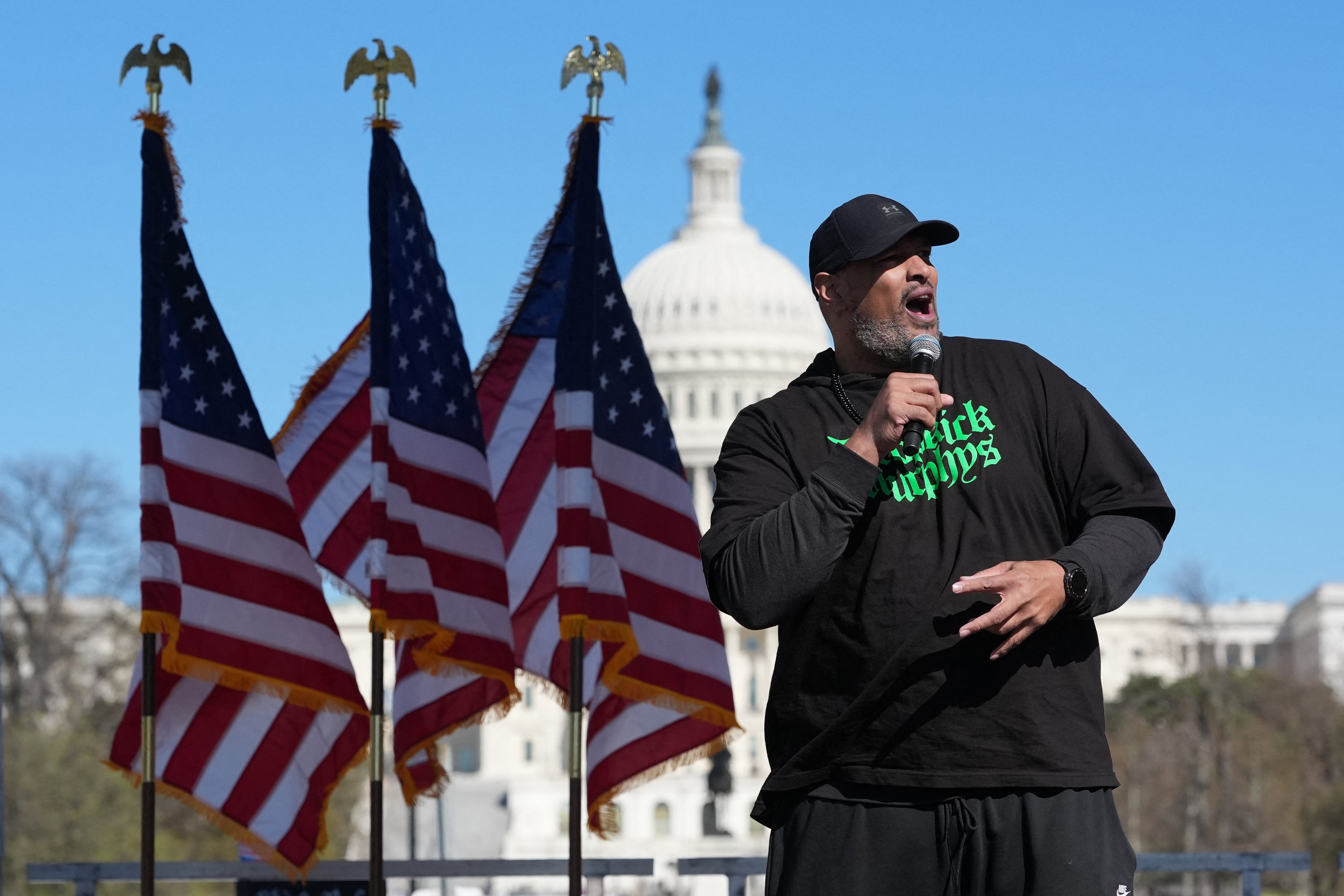
The White House referred The Independent’s request for comment about potential legal exposure to Trump’s statements on Wednesday.
“I guess they made a settlement of some kind. I wasn’t involved in the settlement, I could have been involved, but I didn't choose to be, so they made a settlement,” he told reporters.
Trump said the victims of “weaponization” under the Obama and Biden administrations — an apparent reference to his allies who were investigated in connection with his 2016 and 2020 campaigns and the attack on the Capitol — were “destroyed, they went to jail, their families were ruined, they committed suicide.”
“We’re reimbursing those people for their legal fees and for their costs, and for anybody involved,” he said. “It was the most violent thing I’ve ever seen in politics.”
Blanche has not ruled out millions of taxpayer dollars going to people who assaulted law enforcement officers during the Capitol attack on January 6, 2021. The first of what is expected to be several lawsuits against the “weaponization” fund came from two law enforcement officers who were beaten and bloodied by a mob of Trump’s supporters that day.
Trump’s IRS lawsuit was a “Potemkin lawsuit, a sham brought about only so that it could be settled,” according to the complaint from Harry Dunn and Daniel Hodges.
The administration is also accused of violating the 14th Amendment’s clause prohibiting the government from paying debts and other obligations “incurred in aid of insurrection or rebellion against the United States” by effectively creating a roundabout payment system to aggrieved rioters.
“The fund’s mere existence sends a clear and chilling message: those who enact violence in President Trump’s name will not just avoid punishment,” according to the lawsuit, “they will be rewarded with riches.”