Using Direct Action to achieve an Australian greenhouse gas reduction target for 2025 which would match new US promises could cost as much as $30bn, The Climate Institute think tank has calculated.
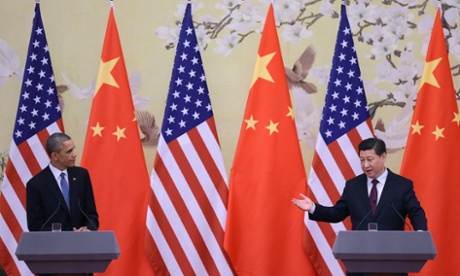
The Abbott government has welcomed the surprise announcement by the world’s two biggest greenhouse emitters – China and the US – of new targets to reduce emissions after 2020.
The environment minister, Greg Hunt, said Australia would announce its post-2020 target in the first half of next year, ahead of the United Nations conference in December where it is hoped an international climate deal will be clinched.
Hunt said Australia’s existing target to reduce emissions by 5% by 2020 was very close to the emissions reduction the US would achieve by that date, but neither he nor the treasurer, Joe Hockey, would say whether the new US post-2025 target would also be a benchmark for Australia’s longer-term pledge.
Obama has promised to cut US emissions by between 26% and 28% by 2025, compared with 2005 levels. Australia measures emissions cuts against 2000 levels, and calculated in that way an equivalent 2025 target for Australia would be around 30%.
Calculating the cuts necessary to achieve that target from Australia’s current emissions trajectory, The Climate Institute says it would cost $9bn in 2025 to buy the necessary abatement at a very low $8 to $9 a tonne, or $30bn if carbon abatement costs closer to $30 a tonne in 2025, as projected by Treasury.
The current $2.5bn emissions reduction fund is designed only to meet the 2020 target, which is set to become an easier objective because Australia’s emissions have fallen with the closure of heavy industry and the rapid take-up of rooftop solar and other renewables.
Hunt said Australia was “currently reviewing” its post-2020 climate policy. The government has not said how the post-2020 target will be set or whether it will draw on the advice of the expert Climate Change Authority, which it has so far been unable to abolish.
It is understood officials from the departments of foreign affairs and environment are working on policy options.
But according to the Climate Institute chief executive, John Connor, an emissions reduction fund on its own is not going to be able to reach a deeper target. He says the government would need to vary its policy in ways it has so far ruled out – including setting tough “safeguards” to effectively create a baseline and credit emissions trading scheme for industry, or allowing the purchase of less expensive international carbon credits.
“Plainly, the ERF by itself does not add up to credible climate policy. It needs to be replaced or significantly boosted with policies that put the responsibility back on the polluter. This means adding super strong safeguard measures and regulatory limits on major emitters and access to international markets,” Connor said.
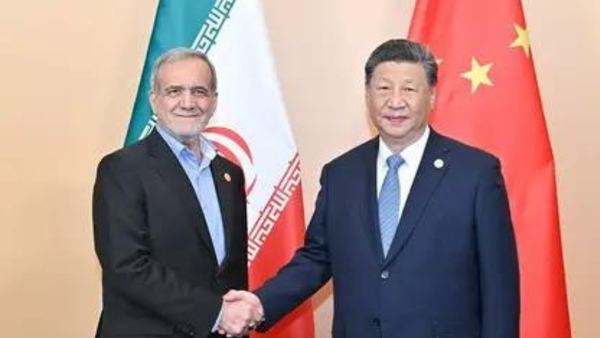
The Chinese president, Xi Jinping, announced his country’s emissions would “peak” in 2030 at the latest. Hunt said this was “a very important thing” but meant Chinese emissions would continue to grow significantly for many years.
According to the Climate Analytics Climate Action Tracker, Chinese emissions are now around 10 gigatonnes a year and could reach 15 to 16 gigatonnes in 2020. China has not said at what level it expects emissions to peak.
Hunt pointed out that even a peak at around 13 or 14 gigatonnes would still mean substantial continued rises in emissions.
The Minerals Council of Australia’s chief executive, Brendan Pearson, said the China/US announcement was good news for Australian coal and uranium exports.
“The target of China’s efforts will be to reduce the use of low-quality coal in boilers in buildings and small manufacturing and shift the emphasis to modern, highly efficient centralised supercritical coal-fired power generation. That will require high-quality coal, which Australia is well-placed to supply,” he said.
Frank Jotzo, the director of the centre for climate economics and policy at the Australian National University’s Crawford School, said China’s coal use will start to decline in absolute terms “relatively soon” as will its reliance on coal imports. But he said China was looking for higher-quality coal and some Australian producers may be well placed to supply it.