This is the fifth and final installment of a series examining the issues the Japan-U.S. alliance will face in the years ahead.
Working-level negotiations on the so-called "sympathy budget" that Japan pays to support U.S. forces stationed in Japan were held on Oct. 15 for the first time in five years.
The talks, held among foreign affairs and defense authorities via online methods amid the novel coronavirus pandemic, made a quiet start, with the U.S. side not presenting any specific amount in its request to Japan.
The U.S. presidential election on Nov. 3 is said to have made Washington unable to seek a decision in advance from U.S. President Donald Trump. As the special measures agreement, which stipulates part of the funding assumed by Japan, will expire at the end of March, both sides cannot be allowed to put off holding their talks until next year.
"Japan needs to conclude the negotiations with the Trump administration," said a Japanese government source close to the negotiations. "Unless Japan increases its contribution, the U.S. side will not agree."
The source expected a tough road ahead in the negotiations.
-- Trump-style premium
The content of the current bilateral accord stipulates that Japan will assume the sum of 946.5 billion yen over five years, starting from fiscal 2016. Under this fiscal year's budget, Japan bears a total of 199.3 billion yen: the salaries of Japanese working at U.S. bases (128.7 billion yen), the utility costs such as electricity, gas and water (22.3 billion yen), the training relocation costs (1 billion yen), the maintenance costs for the facilities Japan provides to the U.S. forces (20.7 billion yen), and welfare expenses for Japanese working at U.S. bases (26.6 billion yen). The first three are borne under the special measures accord.
Former White House official John Bolton revealed in his book released in June that, when he visited Japan in the summer of 2019 as Trump's national security adviser, he had informed Japan's then National Security Secretariat Secretary-General Shotaro Yachi of a tentative U.S. estimate for the yearly financial burden to have U.S. military bases in Japan at 8 billion dollars (about 840 billion yen). It was over four times more than the amount contained in the current sympathy budget.
The U.S. government had estimated in its 2018 fiscal year that expenses for U.S. forces stationed in Japan on the U.S. side totaled about 5.3 billion dollars (about 556.5 billion yen), which included the personnel costs of U.S. service members, the operation and maintenance costs of military forces on the bases, the facility construction costs on the bases and the costs related to the families of U.S. service members.
Bolton's annual 8 billion dollars is reckoned by some as the result of the 5.3 billion dollars plus a Trump-style 50% premium.
The Japanese side rejected this estimate. As a senior Foreign Ministry official has put it, "This is an attempt at changing the denominator in the conventional calculation, leaving no way for the Japanese government to accept it."
According to the U.S. Defense Department's 2004 statistical compendium's report on allied contributions to the common defense, Japan's share is 75% of the cost of stationing U.S. forces, exceeding by far that of South Korea at 40% and Germany at 33%.
The U.S. has not released any similar statistics in recent years, but the administration has explained to the U.S. Congress that Japan's share of the costs to station U.S. forces totals over 30%.
As to what should be included in the content of U.S. stationing costs in Japan, there are various estimates, giving rise to an argument at cross-purposes.
-- Defense spending to GDP
Yasuhiro Takeda, a professor at the National Defense Academy, has attempted to more comprehensively evaluate the cost-effectiveness of the alliance.
According to his evaluation, the asset values of U.S. military bases in Japan totals 98.2 billion dollars (about 10.3 trillion yen). As the United States is granted the right for its forces to use the base facilities and areas around them for free, the U.S. side enjoys a benefit over 18 times greater than the 5.3 billion dollars in expenses borne by Washington.
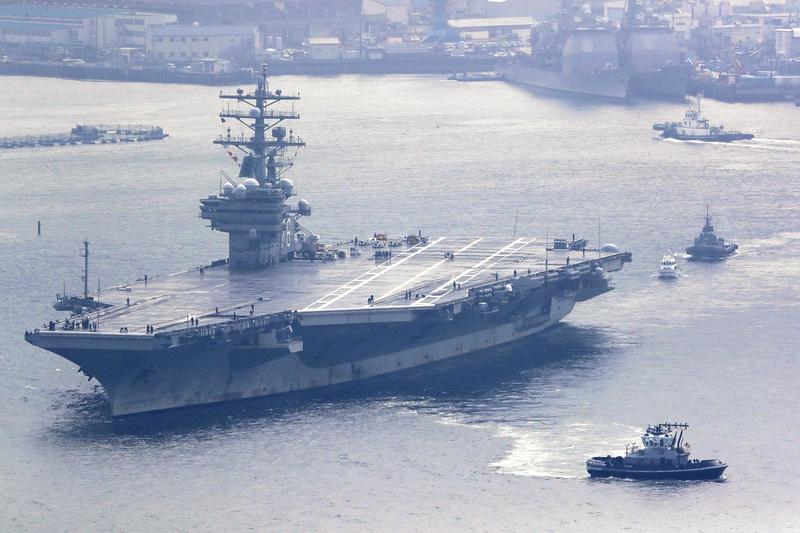
Besides this, the U.S. naval base in Yokosuka, which is a home port for one of its carrier strike groups, is said to have an operational value worth about 14.4 billion dollars (or 1.5 trillion yen), an amount needed for carrying out the forward deployment of its troops on the same scale without the base.
On the other hand, Japan has been able to save on its defense expenditures considerably, thanks to the U.S. bases stationed in Japan. As major contributions made by the U.S. forces in Japan, Takeda has cited missile defense, including the capability to strike enemy military bases, defense of sea-lanes by mobile forces on aircraft carriers, and the defense of islands by the U.S. Marine Corps.
If the Self-Defense Forces were to replace the U.S. forces in these tasks, Takeda has pointed out, Japan would need additional defense spending of about 1.7 trillion yen a year, or more than 30% of the annual defense outlays of 5.3 trillion yen.
As a percentage of gross domestic product, Japan's defense outlays stand at only 0.9%, while that of the United States is at 3.1%.
"We urge you [all U.S. allies and partners] to increase your defense spending to at least 2% of GDP," then-U.S. Defense Secretary Mark Esper said during a lecture on Sept. 16.
He then pointed out the need to prepare for China's further military buildup, saying U.S. allies and partners "must recognize the shifting landscape, otherwise we risk inviting greater aggression and further challenges to our values and security."
Within the Japanese government, some say that if Tokyo does not increase its defense spending amid Beijing's growing threat, it cannot win Washington's understanding. Such ideas have also emerged that Japan and the United States should explore a new horizon of cooperation, including the development of a satellite constellation useful for reinforcing missile defense or cyber-defense.
Contributions to the Japan-U.S. alliance cannot be calculated by the amount paid for stationing U.S. forces or the amount of defense spending. At the same time, however, it is hardly possible, even though Japan's financial situation is tight, that Tokyo can remain the same as it has been when the true value of the alliance is being questioned due to the challenge posed by China.
There has been no period like the present when the role of the Japan-U.S. alliance, which maintains the peace and stability of Asia and the Pacific region, has been sought so earnestly.
Read more from The Japan News at https://japannews.yomiuri.co.jp/