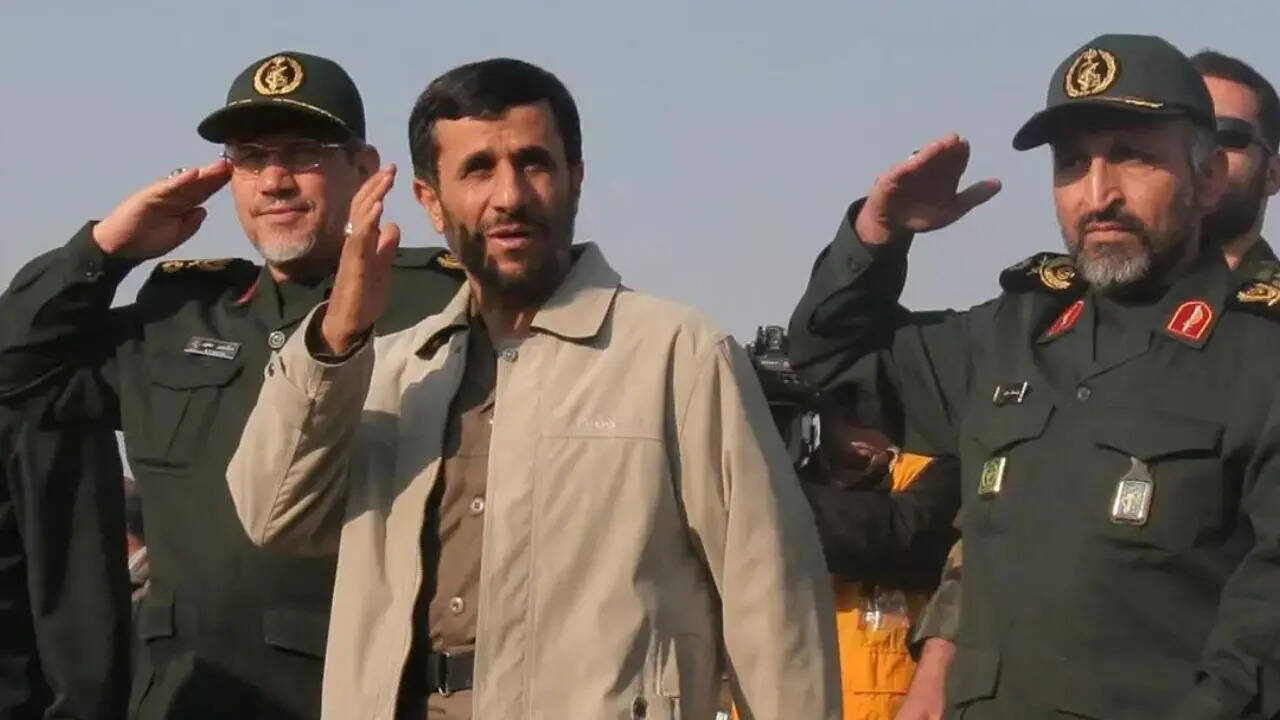
The United States and Israel reportedly explored a regime-change plan in Iran after Israeli strikes allegedly killed Supreme Leader Ali Khamenei and several top officials in the early days of the war, according to a report by The New York Times.
Days after the strikes, US President Donald Trump had also publicly suggested that it would be best if "someone from within" Iran took over the country.
The report claims that Washington and Tel Aviv had quietly considered a plan centred around former Iranian President Mahmoud Ahmadinejad, a hardline leader once known for his fierce anti-Israel and anti-American rhetoric.
He was also widely known for inflammatory remarks about Israel, including calls to "wipe Israel off the map."
Why Ahmadinejad was seen as a possible option
Ahmadinejad was long seen as one of Iran's most hardline leaders. During his presidency between 2005 and 2013, he repeatedly criticised US and Israel, strongly defended Iran’s nuclear programme and oversaw crackdowns on internal dissent.
However, in recent years Ahmadinejad had increasingly fallen out with Iran's clerical establishment and was reportedly placed under close surveillance and house arrest.
According to the report, US officials believed Ahmadinejad could potentially emerge as a figure capable of stabilising Iran during a political transition despite not being viewed as a moderate.
An associate quoted in the report claimed American officials believed Ahmadinejad could manage "Iran’s political, social and military situation" and "play a very important role" in a future administration.
The report also noted that Ahmadinejad had in recent years travelled to countries such as Hungary and Guatemala, both of which were viewed as maintaining close ties with Israel.
He had also praised Trump during a 2019 interview with The New York Times. "Trump is a man of action," Ahmadinejad had said at the time. "He is a businessman and therefore he is capable of calculating cost-benefits and making a decision," he added.
Israeli strike targeted Ahmadinejad’s residence
According to the report, the plan was allegedly developed by Israel's intelligence agency Mossad, and Ahmadinejad himself. But the effort quickly collapsed after an Israeli strike targeting his residence nearly killed him, leaving the former president disillusioned with the operation.
The report said Ahmadinejad was injured during an Israeli strike on his Tehran home on the first day of the conflict. American officials and one of Ahmadinejad's associates told the newspaper that the strike was allegedly intended to free him from house arrest by eliminating members of Iran’s Islamic Revolutionary Guard Corps (IRGC) stationed there.
Initial Iranian media reports had claimed that Ahmadinejad may have been killed in the strike. Later news agency reports clarified that he survived, though several IRGC personnel guarding the property were reportedly killed, according to NYT.
Satellite imagery cited in the report showed that while Ahmadinejad's house itself suffered limited damage, a nearby security outpost at the entrance of the street was destroyed.
How deeply Ahmadinejad was involved?
According to the report, White House spokeswoman Anna Kelly said, "From the outset, President Trump was clear about his goals for Operation Epic Fury: destroy Iran’s ballistic missiles, dismantle their production facilities, sink their navy, and weaken their proxy."
"The United States military met or exceeded all of its objectives, and now, our negotiators are working to make a deal that would end Iran’s nuclear capabilities for good," she added.
The strategy reportedly envisioned a three-stage collapse of Iran's government structure. However, despite the heavy strikes, the expected political breakdown reportedly never materialised.
Several aspects of the alleged operation remain unclear, including how exactly the United States and Israel intended to install Ahmadinejad in power.
The report said US officials maintained there were figures within the Iranian establishment willing to work with Washington, even if they could not be described as "moderates."
It also remains unclear how deeply Ahmadinejad was involved in the discussions or whether he had fully committed to the reported plan before the strike on his residence.
The report added that some people close to Ahmadinejad had previously faced accusations inside Iran of maintaining links with Western intelligence services or even Israel. Ahmadinejad’s former chief of staff, Esfandiar Rahim Mashai, was reportedly questioned in 2018 over alleged links to British and Israeli intelligence agencies.
What Mossad believed?
Despite the operation reportedly falling apart, David Barnea allegedly told associates that the plan still had "a very good chance of succeeding" had events unfolded as intended.
According to The New York Times, Barnea said in several discussions that Mossad’s strategy built on decades of intelligence gathering and covert operations inside Iran, could have succeeded if it had received approval to move forward fully.
The report also stated that the former Iranian President Mahmoud Ahmadinejad has not been seen publicly since the strike on his residence, and his current whereabouts remain unknown.