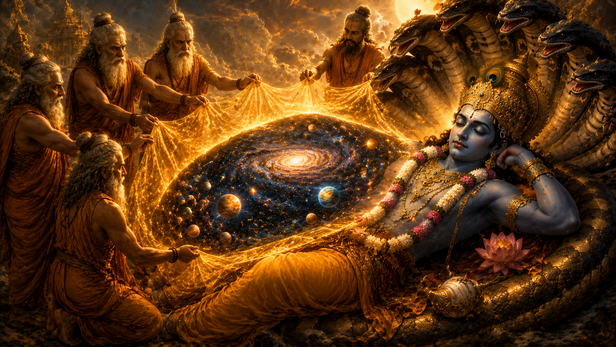
Why is Lord Vishnu shown resting on a giant serpent in an endless ocean? Why does a lotus bloom from His navel, and why does He hold a conch instead of a weapon? At first, these may look like beautiful artistic details. But many Hindu traditions interpret them as powerful spiritual symbols that explain creation, time, and the universe. Whether viewed through mythology, philosophy, or symbolism, Vishnu's divine form invites us to look beyond the image and discover a deeper meaning.
More Than a Divine Image
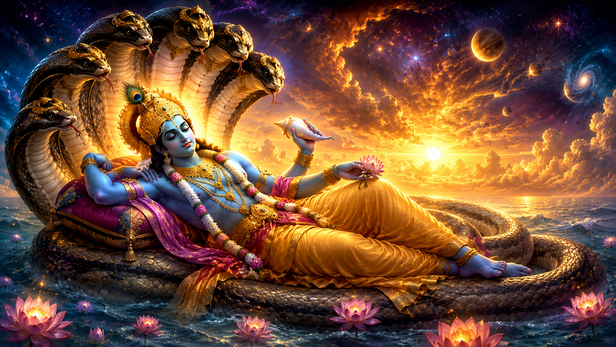
Every symbol in Lord Vishnu's form carries a deeper spiritual meaning.
The image of Lord Vishnu is not just meant for worship. In Hindu philosophy, every detail is symbolic. The ocean, serpent, lotus, and conch are often understood as representations of universal truths rather than ordinary objects. These symbols encourage devotees to think beyond appearances and reflect on the nature of existence, creation, and the eternal cycle of life.
The Ocean Beyond Water
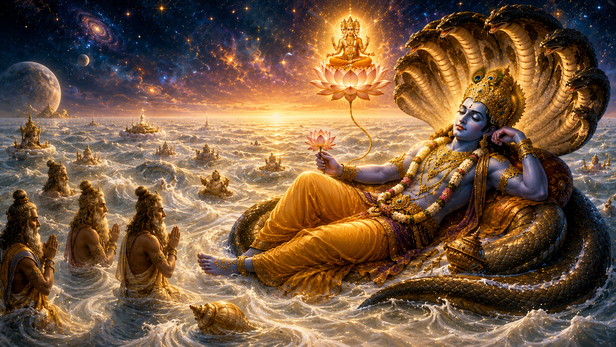
The conch symbolizes the sacred vibration associated with creation.
Hindu scriptures describe Lord Vishnu resting on the Ksheer Sagar, or Ocean of Milk. Many spiritual teachers interpret this as a symbol of the infinite cosmos rather than a physical sea. It represents the boundless source from which creation emerges and into which everything eventually returns. This symbolic ocean reminds us that the universe itself is vast, mysterious, and beyond ordinary human understanding.
The Sound That Begins Creation
The conch, or Shankh, is one of Lord Vishnu's most recognizable symbols. In Hindu tradition, it represents the sacred sound Om, which is regarded as the primordial vibration of creation. Rather than being viewed as an ordinary musical instrument, the conch reminds devotees that sound, prayer, and divine energy are deeply connected in spiritual teachings.
The Lotus of New Beginnings
The lotus growing from Lord Vishnu's navel is one of the most meaningful symbols in Hindu mythology. From this lotus appears Lord Brahma, the creator of the universe. The image represents the birth of creation from divine consciousness. Some modern interpretations compare it with the unfolding of the cosmos, but these comparisons are symbolic rather than established scientific facts.
The Meaning of Sheshnag
Sheshnag, the many-headed serpent on whom Lord Vishnu rests, represents eternity in Hindu philosophy. The Sanskrit word Shesha means "that which remains." It symbolizes endless time that continues through creation, preservation, and dissolution. The serpent reminds devotees that while worlds may appear and disappear, the eternal cosmic order continues without beginning or end.
Where Faith Meets Wonder
Some people draw symbolic parallels between ancient Hindu imagery and modern ideas about the universe. These interpretations can inspire curiosity, but they should not be taken as direct scientific evidence. The true value of these symbols lies in the timeless spiritual questions they raise about existence, creation, and humanity's place in the cosmos.
A Symbol That Still Inspires
Lord Vishnu's form reminds us that sacred images often carry layers of meaning beyond what we first see. Whether you approach them through devotion, philosophy, or curiosity, these symbols encourage reflection on life, time, and the universe. They continue to inspire millions because they invite us to explore not only the mysteries of creation but also the deeper truth within ourselves.
Unlock insightful tips and inspiration on personal growth, productivity, and well-being. Stay motivated and updated with the latest at My Life XP.