A special sensory room has been constructed at the Stadium of Light this summer. An example of the excellent community work undertaken by Sunderland AFC, it is designed to enable children – and some adults – suffering from auditory processing disorder to watch live football in a serene and quiet environment.
Already it is serving as a haven to anyone who cannot cope with the noise of match days, meaning those whose brains struggle to process appropriate responses to sensory signals such as sound are no longer excluded.
Sunderland’s often pioneering approach to this sort of issue has long proved exemplary. The only problem is that, when it comes to the product on the pitch, such meticulous attention to detail has an unfortunate habit of being conspicuous by its absence. If only the so-called “caring club’s” recruitment policy had been a bit more insightful and imaginative in recent years the horizon might not look quite so bleak for Dick Advocaat.
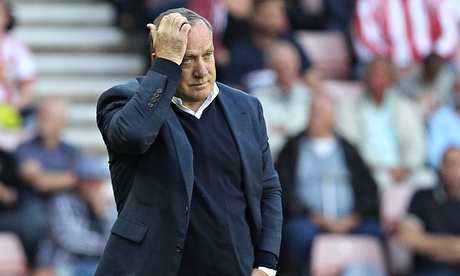
As 5pm approached last Saturday, Sunderland’s manager appeared a man in desperate need of his own place of sanctuary. For the second week in succession his team had been comprehensively beaten by supposedly inferior opposition. A 3-1 home defeat to Norwich followed the previous week’s 4-2 surrender at Leicester and the 67-year-old former Holland coach looked a man questioning the wisdom of his decision not to retire after all last spring.
After acknowledging “I cannot go on like this”, Advocaat talked about something being “wrong” at Sunderland. It was an uncanny echo of comments made, in turn, by Martin O’Neill, Paolo Di Canio and Gus Poyet. Curiously, none of the Dutchman’s three predecessors managed to complete a full season in charge on Wearside. The last man to achieve that feat was Steve Bruce in 2010-11.
Some supporters wonder if things might have panned out differently had Ellis Short, the owner, appointed Mark Hughes rather than O’Neill when the pair competed for the post in late 2011 but the way in which history keeps repeating itself at Sunderland suggests the problem runs deeper than the manager’s identity.
The recurring theme is that the team struggles horribly, the manager is sacked and the replacement presides over a miraculous escape from relegation. Last May Advocaat was the latest hero; three months on essentially the same group of players are no longer responding.
Two years ago some of them approached Margaret Byrne, the chief executive, and demanded Di Canio’s sacking. When, within hours, their wish was granted it arguably left certain senior professionals with an inflated sense of power. Controversially, Advocaat not only left John O’Shea, the captain, on the bench against Leicester and Norwich but swiftly substituted Lee Cattermole at Leicester. Maybe, just maybe, he was making political as much as tactical statements.
Both players are likely to start at home to Swansea on Saturday as Advocaat shuffles a limited pack refreshed only mildly by this summer’s introduction of Younès Kaboul, Sebastián Coates, Jeremain Lens, Adam Matthews and Yann M’Vila.
Lee Congerton, the sporting director, represents a significant upgrade on the previous football director, Roberto De Fanti, a former agent, but he has been forced to work to a strictly limited budget. After selling Connor Wickham to Crystal Palace, Sunderland have spent £6m net this window.
Assorted pundits have lined up to warn Short that relegation, and missing out on next season’s gargantuan new television deal, beckons if he neglects to invest heavily before Tuesday week.
It certainly seems the wrong moment for austerity but after rewarding too many players far too generously, Sunderland have the Premier League’s eighth highest wage bill.
By way of further complication, the de facto salary cap – some prefer to call it “cost control mechanism” – narrowly voted in by Premier League chairmen in February 2013 dictates that the “spending big” solution is not actually open to the American financier. Under this ruling – something actively endorsed by Short – clubs whose wage bills total £52m or more can use only a maximum £4m of television revenue per season to increase player remuneration.
According to their most recent accounts, Sunderland’s wage bill totalled £70m – an alarming 67% of the club’s turnover – and their latest balance sheet shows a £17m pre-tax loss, leaving the owner with strictly limited room for manoeuvre.
Admittedly, the new rules permit clubs to fund enhanced wages from alternative commercial sources such as sponsorships but Sunderland’s debt in effect negates that option.
Moreover, after injecting almost £130m of interest-free funding over the past six years, Short’s current circumspection is understandable. Sunderland has become a club at which £10m buys in the Jack Rodwell and Adam Johnson mould invariably regress.
A culture of mental laziness and arrogant complacency seems to have taken hold. The worldly wise Advocaat appears an ideal choice to address it but whether a man who turns 68 next month retains the enthusiasm for quite such a challenge remains unclear.
A Moody Blues fan, one of the Sunderland’ manager’s favourite tracks is Go Now. Short can only hope the Dutchman does not detect a hidden message in the lyrics.