The city that outlasted everything except being known
Dholavira has been standing, in one form or another, for five thousand years. It outlasted the civilisation that built it. It outlasted the river that fed it. It outlasted the scholarship that ignored it for decades while Mohenjo-daro and Harappa collected all the textbook space. What it has not yet outlasted is anonymity, and that window is closing.
The site sits on Khadir Bet, a low island of rock in the middle of the Great Rann of Kutch in Gujarat. Getting there requires a drive across a road that feels like it was placed there as a suggestion. The nearest town of any size is Bhachau. There is no airport. There is no heritage hotel with a rooftop bar and a curated sunrise experience. There is a government-run tourist complex and a silence so complete that you can hear the wind working its way through the stone.
This is not a complaint. This is the point.
What the UNESCO tag actually means for a place like this
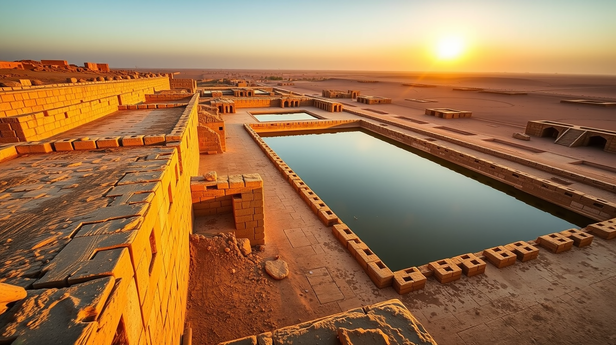
When the Archaeological Survey of India and the Indian government pushed Dholavira's UNESCO World Heritage nomination through in 2021, it was a correction of a long overdue kind. The site represents one of the five largest cities of the Indus Valley Civilisation, and its water conservation system, a network of reservoirs, channels, and dams carved from rock, is among the most sophisticated engineering of the ancient world. The Harappan people who built this city were managing seasonal rainfall and storing it across a system of at least sixteen reservoirs at a time when most of the world was still figuring out how to keep grain dry.
The UNESCO recognition was deserved. It was also a starting gun.
Angkor Wat received its World Heritage status in 1992. Within a decade, visitor numbers had climbed to a scale the site's stone could not absorb. Machu Picchu got its listing in 1983; it now has daily visitor caps and a queue culture that has turned a sacred Incan city into an Instagram checkpoint. These are not failures of the sites. They are what happens when a place becomes legible to the world all at once.
Dholavira is in the early hours of that process. The travel infrastructure around Kutch is still minimal. The roads are improving. The hotels are coming. The story is being told in more places every year. But right now, on a weekday morning, you can stand at the northern gate of this ancient city and be the only person there.
The thing you will not be able to explain when you come back
The ruins do not look like what most people expect ruins to look like. There are no soaring columns, no dramatic arches, no single photogenic structure you can frame against a sky and call done. Dholavira is a city of geometry. Rectangular reservoirs. Precisely measured streets. Walls built in a three-layered system of rubble, dressed stone, and mud brick that survived four millennia of Kutch's brutal climate better than most modern construction survives forty years.
The signboard at the site's entrance mentions the famous inscription, ten large Harappan signs carved in wood, found near the northern gate, believed to be the world's earliest signboard. The wood is gone. What remains is the understanding that someone, five thousand years ago, wanted people arriving at this city to read something. We still don't know what it said. The Harappan script has not been deciphered.
You stand in front of that signboard explanation and feel the specific discomfort of knowing that a sentence was written for you, across five millennia, and you cannot read it. That feeling is not available at a site that has been packaged for travel. It requires the quiet to actually land.
What Gujarat gives you that the heritage circuit doesn't
Most India travel itineraries that include Gujarat stop at Rann Utsav, do the white desert, eat the dhokla, buy the Kutchi embroidery, and leave. Dholavira sits at the edge of that circuit, close enough to be added and far enough that most people don't bother. The drive from Bhuj takes about four hours. The road passes through villages where the only signs of the twenty-first century are mobile towers and two-wheelers. The landscape flattens into something that looks like the edge of the world.
That distance is what has protected the site so far. The visitors who make the effort are, almost without exception, people who came specifically for this, archaeologists, historians, serious heritage travellers, the occasional school group from Ahmedabad. There is no casual footfall. No one ends up at Dholavira by accident.
When the road improves further, and it will, that changes. When the first boutique property opens within twenty kilometres, and one will, the visitor profile shifts. When the travel content machine fully discovers that the Harappan ruins of Gujarat are more photogenic than people assumed, the numbers will move. None of this is hypothetical. It is the pattern every site follows after UNESCO recognition lands.
The specific kind of loss that comes with being found
There is a version of Dholavira's future in which everything is better, more interpretive signage, better-maintained pathways, a proper museum on site, international scholars collaborating with ASI, school children from across India learning what their civilisation actually built. That version is good and worth wanting.
There is also a version in which the site becomes a managed experience. Where the silence is replaced by audio guides. Where the geometry of the ancient city is best appreciated from the designated viewpoint. Where the feeling of standing inside something that has no contemporary equivalent is replaced by the feeling of visiting a heritage attraction.
Both versions are coming. The question is only which one you arrive in time for.
The Harappan civilisation at its peak covered an area larger than ancient Egypt and Mesopotamia combined. It built cities with drainage systems that Europe wouldn't match for another two thousand years. And then, for reasons that archaeology is still working out, climate shift, river migration, trade collapse, it contracted, dispersed, and eventually became something that had to be excavated to be remembered. Dholavira is what it left behind in Kutch. Right now, you can walk through it alone, in the early morning, with the wind and the stone and the unanswered inscription. That combination has an expiry date.