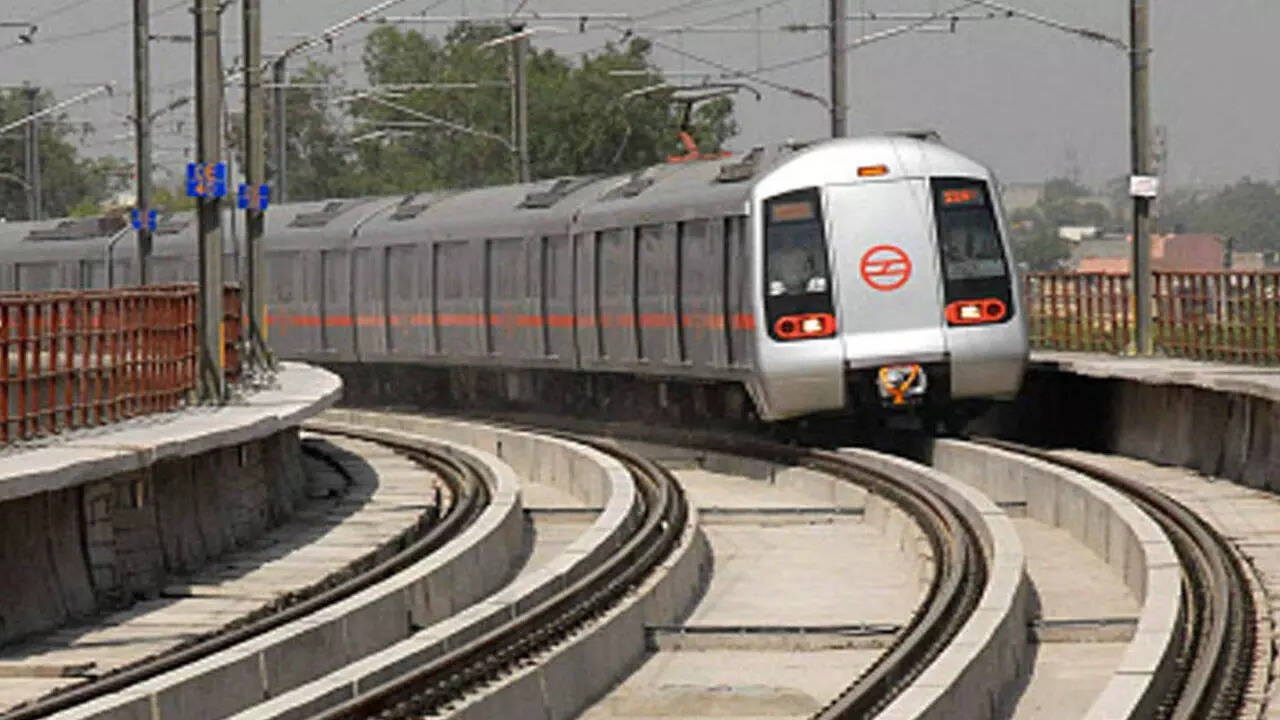
NEW DELHI: Having converted most services in its three major lines into eight-coach trains, Delhi Metro Rail Corporation has begun giving the remaining fleet of six-coach trains the new configuration since last year.
The train company expects to complete the transition by the end of this year with the addition of 78 coaches to the 39 six-coach trains operating on its oldest corridor, the Red Line ((Rithala-Shaheed Sthal New Bus Adda).
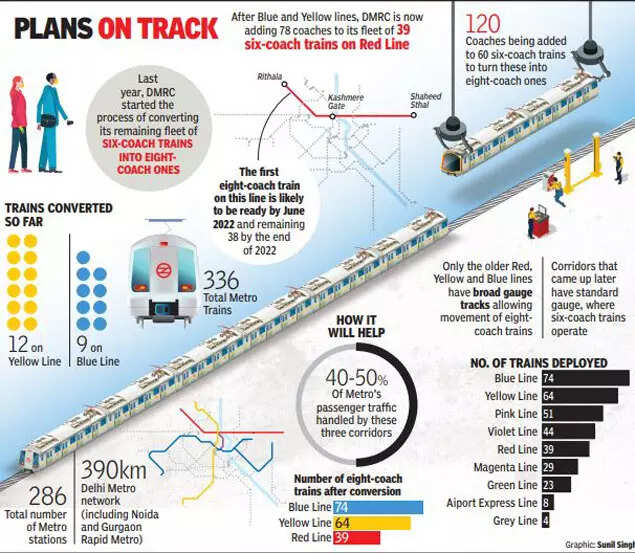
DMRC is incorporating a total of 120 coaches in its three oldest and busiest corridors — Red Line, Yellow Line (HUDA City Centre-Samaypur Badli) and Blue Line (Dwarka-Noida Electronic City/Vaishali) Lines — to increase passenger-carrying capacity. The conversion started last year with the change in 12 trains on the Yellow Line from six-coach to eight-coach formation, taking the number of such longer trains on the corridor to 64. This was followed by the addition of coaches to the remaining nine six-coach trains on the Blue Line and increasing the number of eight-coach trains on the corridor to 74 by the end of 2021.
A DMRC spokesperson said that the train company had started the process of adding 78 more coaches to its fleet of 39 six-coach trains on the Red Line at its Shastri Park depot. “The first eight-coach train on this line is likely to be ready by June 2022 and the remaining 38 by the end of 2022,” the spokesperson said. “This will significantly augment the carrying capacity on the corridor, which is around 35km with 29 stations. With this, the Red Line will also join the league of Blue and Yellow lines where the existing fleets already comprise eight coaches.”
Of the 120 coaches being deployed, 40 have been procured from Bombardier and 80 from Bharat Earth Movers Limited. The effort to raise carrying capacity of the trains comes at a time when ridership has dropped drastically due to the various restrictions due to Covid-19. Even now, the trains are allowed 100% seated passengers, but no standing ones. This when the trains were envisioned to carry a majority of standing passengers.
The Red Blue and Yellow lines are the major corridors of Delhi Metro and account for 40-50 % of the total passenger utilisation every day. These corridors, which were initially made operational under Phase-I, employ the broad gauge tracks with the provision of running trains of up to eight coaches.
All the corridors that have come up in the subsequent phases, including the high-speed Airport Express Line, have adopted the standard gauge tracks that allow sharper curves, but have the provision of running trains only in a six-coach formation.
While more eight-coach trains are required on busy corridors like the Blue and Yellow Lines, both to accommodate more commuters and allow social distancing, DMRC is inducting 36 coaches separately on the Airport Express Line. The standalone corridor is being extended from Dwarka Sector 21 to the upcoming International Convention Centre at Dwarka and more trains will be needed to ensure the frequency of services is not affected by this extension.