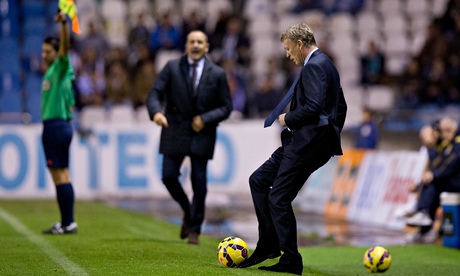
At the whistle, David Moyes emerged from the bench and applauded the two hundred or so Real Sociedad fans who had gathered high in the far corner at the Riazor. His new supporters applauded back. Twelve days after taking over, his debut ended with a 0-0 draw at Deportivo de La Coruna.
Asked if he was happy with the draw, Moyes said simply: “No.” But he admitted that he had enjoyed it too and the smile spoke of satisfaction. He has insisted often that this is a job that requires patience, and the supporters are prepared to grant him that. Besides, there were bright moments early on here, even if in the final minutes it was Deportivo who had the better of a largely dull game. Afterwards he jokingly offered his apologies for dragging journalists after midnight out for a 0-0.
“I thought we were the better side in the first half and had done enough to be in the lead, but it is true that I was disappointed with the second half,” Moyes said. “I really enjoyed it. I have seen some things that I want to improve but I am very happy. It is too soon [for conclusions] and I hope we can get results in the coming months.”
These are early days. Moyes described it as a busy week in which his feet had barely touched the ground. He said his Spanish has been limited to “come on” and “good work”, training ground staples, and he talked about the need to assess before acting. He said that it was too early to expect many changes in the lineup.
Some changes were unavoidable, though – including the airport they flew into. Bad weather forced la Real to land at the pilgrims’ destination of Santiago de Compostela, 70 kilometres away, rather than in La Coruña. And three of those who started against Atlético Madrid 13 days ago were not on board with them. Mikel González, Iñigo Martínez and Xabi Prieto, plus David Zurutuza who had come on, were all ruled out through injury or illness.
Ion Ansotegui and Gorka Elustondo in the middle of the defence is a partnership that would have convinced few but there was little real choice in the absence of González and Martínez. Behind them, where some expected a change of goalkeeper, Eñaut Zubikarai kept his place. Moyes’s first formation was a 4-2-3-1 with Carlos Vela behind Imanol Agirretxe up front. Sergio Canales began on the right and Chori Castro on the left.
One thing that Moyes did want to change was the attitude, the way that his players approach the game. Intensity was the word and it was much-repeated. It was in evidence here too, particularly on the counterattack. Real Sociedad made a mess of the first, three on one; another ended with Vela’s shot being turned over; the Mexican fired a third opportunity too high; and then Castro’s control let him down after a lovely scooped pass from Agirretxe.
The break that led to Castro’s opportunity also led to the first confrontation. Deportivo’s fitness coach, Roberto Cabellud, reacted furiously to what he presumably considered a foul in the buildup. As he approached the Real Sociedad bench, finger jabbing and the referee coming over, Moyes gestured for him to calm down. Which, perhaps inevitably, only wound him up even more. He was sent off and the referee, Eduardo Prieto Iglesias, had a quiet word with Moyes too. “I don’t know what happened: I was in my dugout and he was in his dugout,” Moyes said, smiling. “But he seemed a bit angry about something.”
Few chances followed in the second half; those that did were mostly Deportivo’s, but la Real’s defence responded well, Markel Bergara prominent among those blocking shots on the edge of the area. When the best opportunity fell to the Deportivo defender Pablo Insua, he did not make good connection with the header. And that was pretty much that. As Moyes had been insisting all week and would insist again after his first match as a manager in Spain: this is just the start.