How do our voices come out of our mouths? Ziggy, age 4, from Springwood NSW

Hi Ziggy, what a great question!
We can all communicate in lots of different ways – using our hands to gesture or sign, writing letters, typing text messages, drawing pictures or even sending emojis.
But if we want to communicate by speaking then we need to use our voice.
Our voice makes sound when we use air from our lungs to vibrate our vocal cords, which sit inside your voice box.
To find your voice box, feel for the bony lump at the front of your throat. We sometime call this an “Adam’s apple” in men.
The air from the lungs causes the vocal cords to move really quickly. This is called vibration and feels a bit like buzzing.
See if you can vibrate your vocal cords, like this boy in the photo. Try saying “ahh” – then, gently place your fingers on your throat.
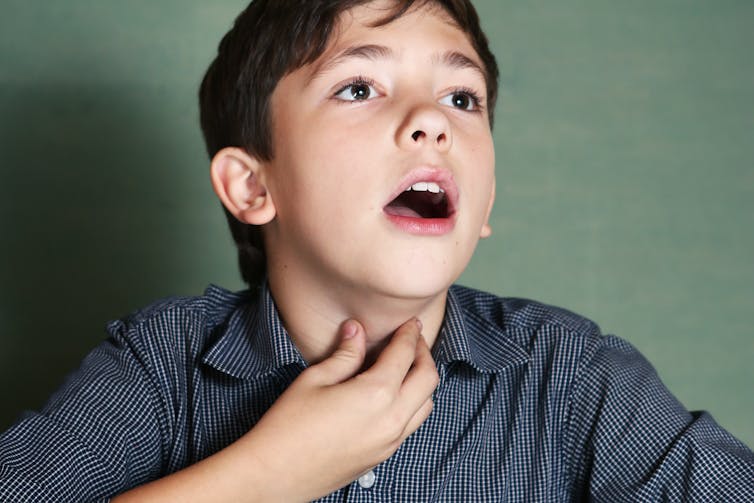
You should be able to feel the vibration of your vocal cords.
Picture this
Another way to think about this process is to imagine your lungs are a balloon, full of air.
Now imagine the opening of the balloon is your vocal cords.

When the balloon is tied up, vocal cords are closed and no air escapes.
When the balloon isn’t tied, the vocal cords are open, and all air comes out. That’s like breathing out.
But if you stretch the opening of a balloon sideways, you can control the amount of air that escapes. The opening vibrates, and it makes a noise.
That’s similar to what your vocal cords do when they vibrate.
Then what happens?
The voice continues to vibrate as it travels up through your throat and into your mouth and/or your nose.
You can then control the flow of air using your lips, tongue, teeth, and the roof of your mouth to make different sounds.
When you say “ahh”, for example, you’re making your vocal cords vibrate with your mouth wide open and using the roof of your mouth to stop air escaping out through your nose.
If you say “eee” or “ooo”, the air still vibrates in your mouth but because you change the shape of your mouth, you make a different sound.
Read more: Curious Kids: how do babies learn to talk?
Some sounds are different
Some sounds that we use to produce speech don’t use the voice from our vocal cords.
Compare the sounds “sssss” to “zzzzz”, for example.
The shape of the mouth and position of tongue, lips, teeth and roof of the mouth are the same but the “s” sound doesn’t use our voice, and the “z” sound does.
Try saying “sssss” and then “zzzzz” out loud and feel the difference in vibration on your throat.
We also use our voice differently when we whisper. We don’t vibrate our vocal cords at all, we just use air from our lungs and move our mouth, tongue and lips.
Read more: Curious Kids: how did spoken language start?

Sally Hewat receives research funding from NSW Ministry of Health. Sally is an Associate Professor in Speech Pathology at the Unievsrity of Newcastle, Australia, on the Boiard of Directors of Trinh Foundation Australia (a not-for-profit organisation supporting the development of speech therapy in Vietnam) and consults to Orient Speech Therapy in China. Sally is also an accreditor of speech pathology university training programs for Speech Pathology Australia.
This article was originally published on The Conversation. Read the original article.