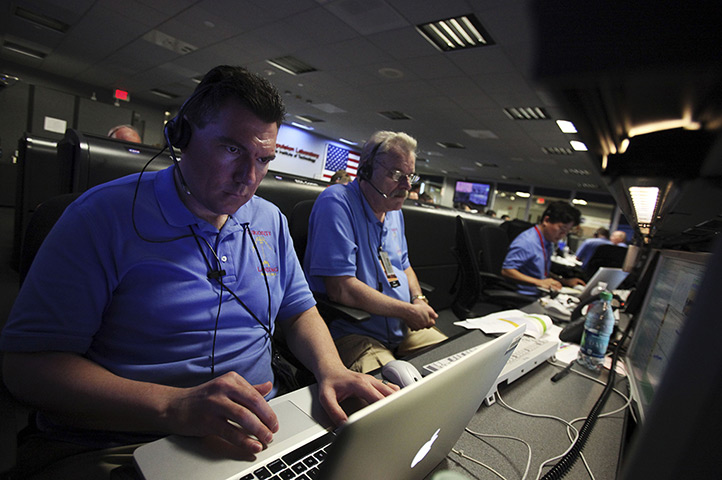
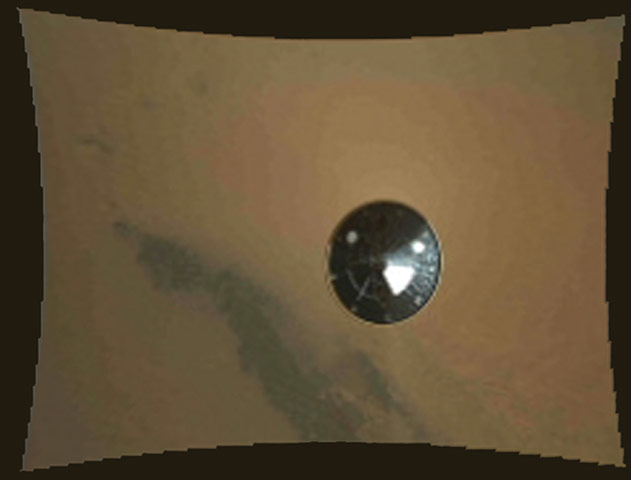
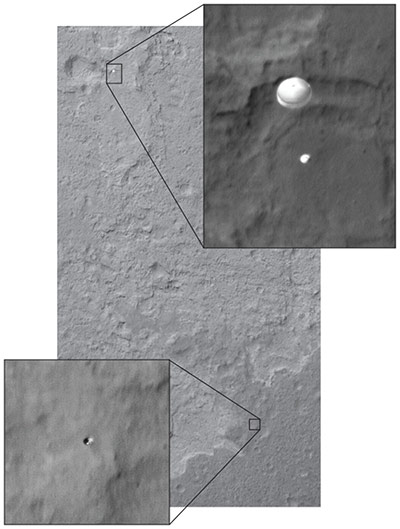
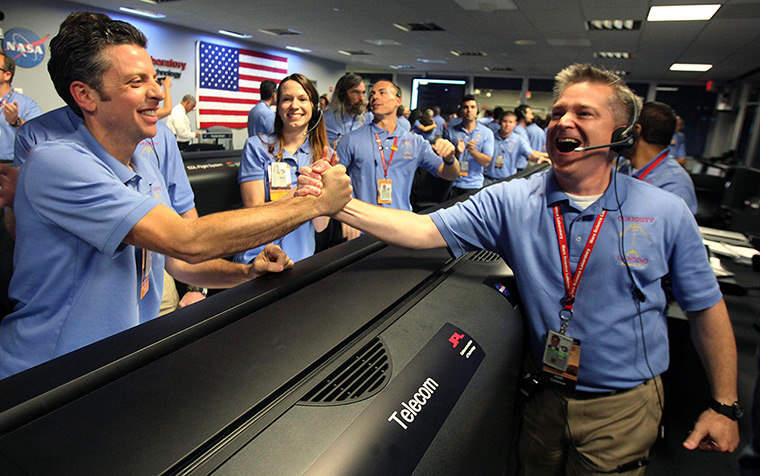
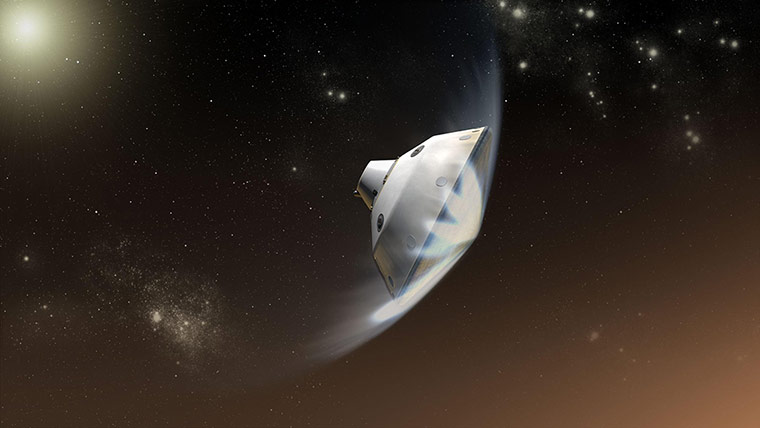
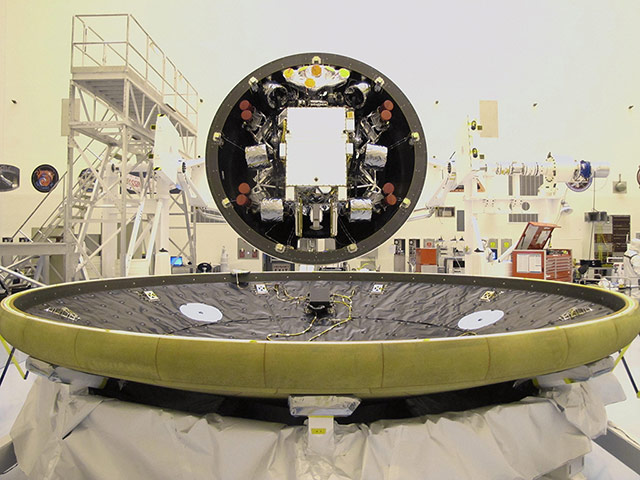
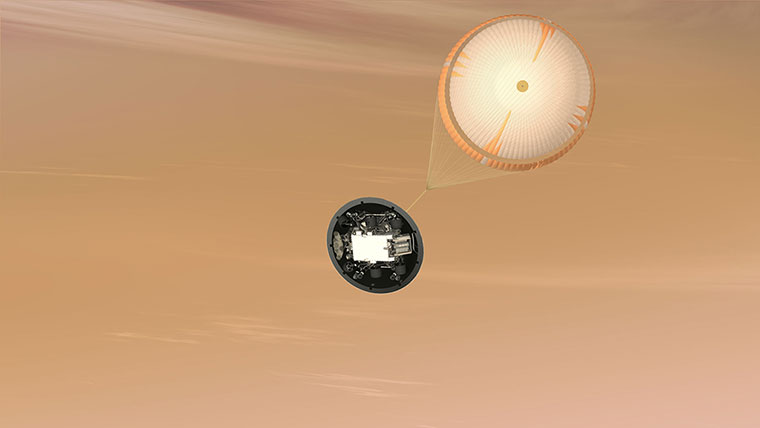
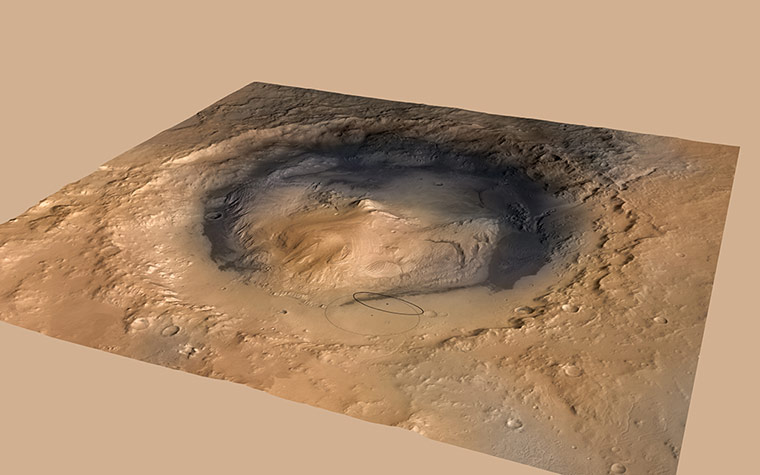
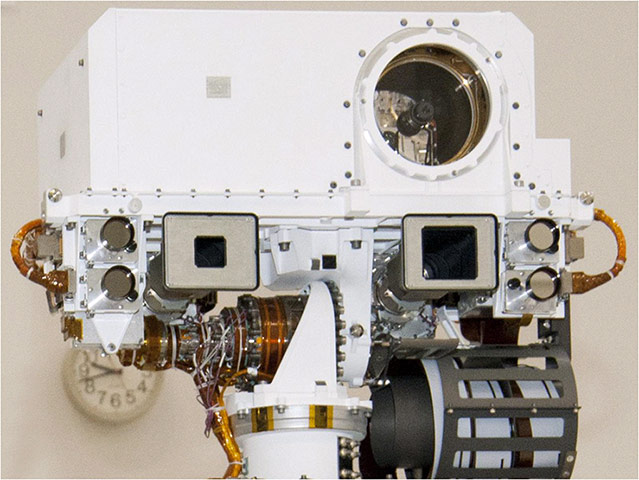
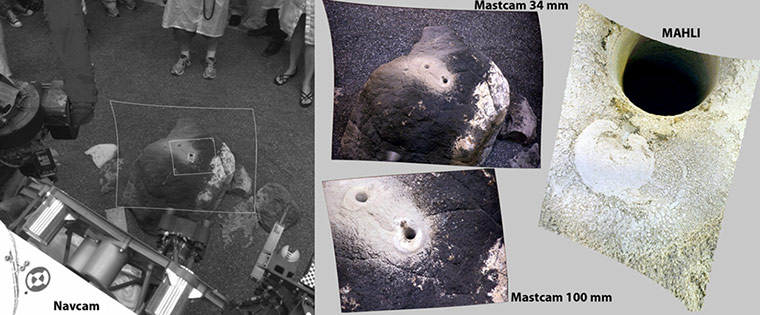
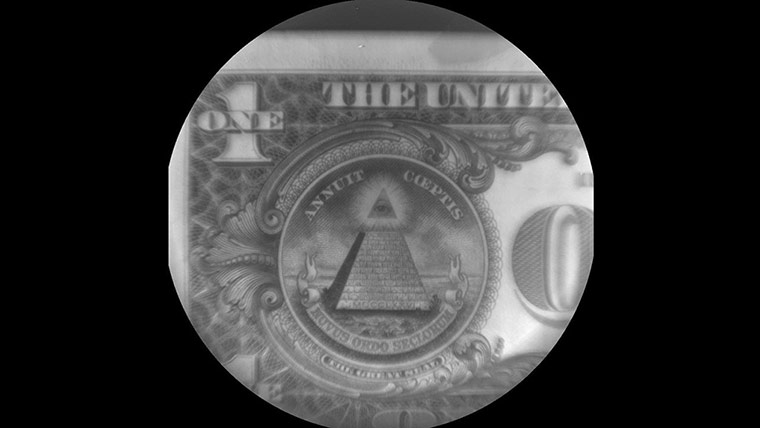
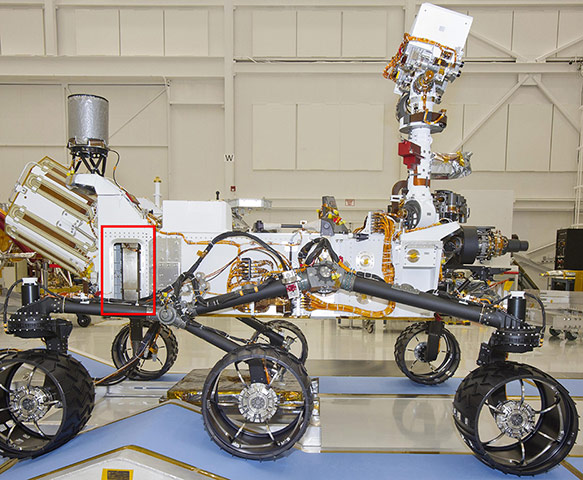
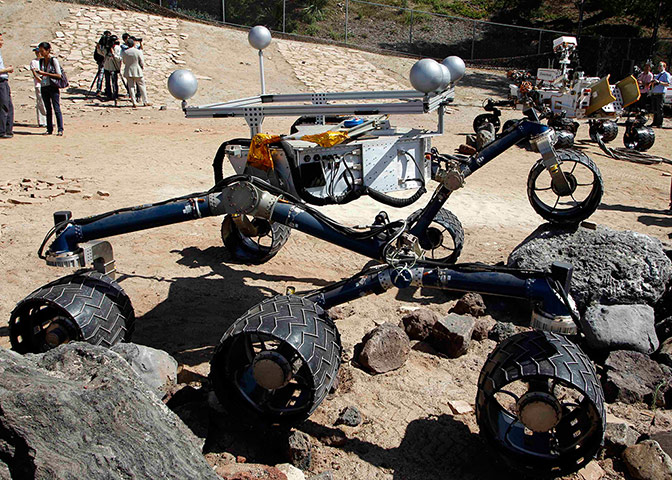
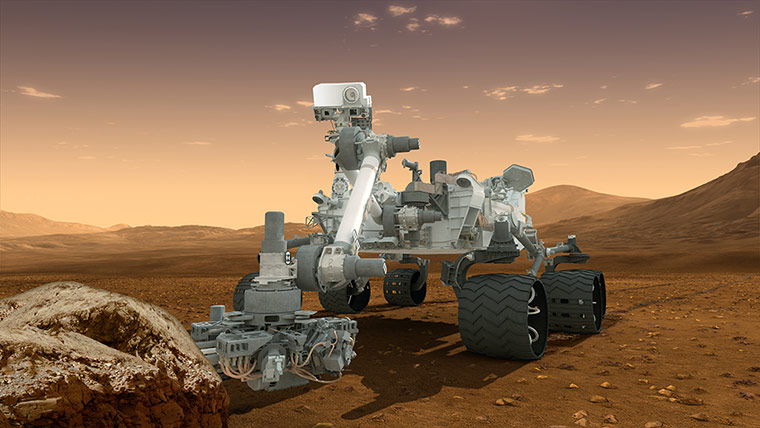
Engineers work inside the Spaceflight Operations Facility prior to the landing Photograph: Brian van der Brug/Getty ImagesCuriosity's heat shield about three seconds after it was released and two and half minutes before the rover touched down. The image was obtained by the Mars Descent Imager. The resolution has been reduced by a factor of eight to allow it to be received on Earth during this early phase of the mission. Full resolution images will take several months to be reach mission controlPhotograph: MSSS/JPL-Caltech/NASAThe HiRISE camera on the Mars Reconnaissance Orbiter captured this image of the Mars Science Laboratory descending on its parachute (top). The second image is thought to be the heat shield, which Nasa believes was still falling when the picture was takenPhotograph: JPL-Caltech/NASA
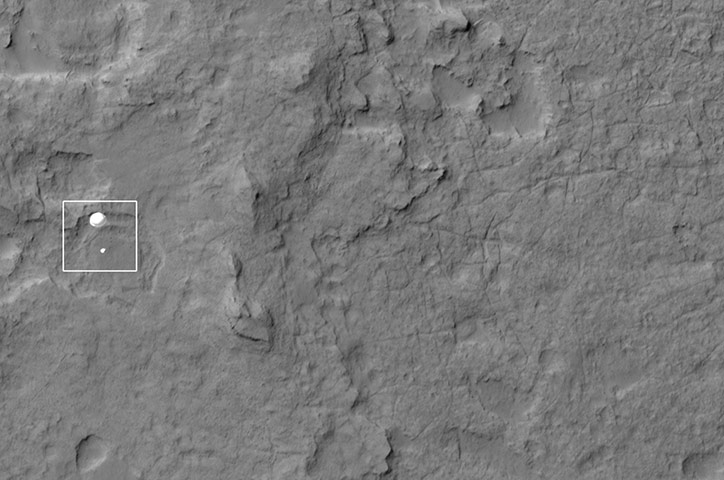
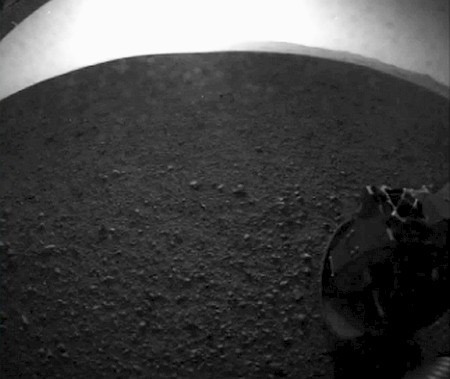
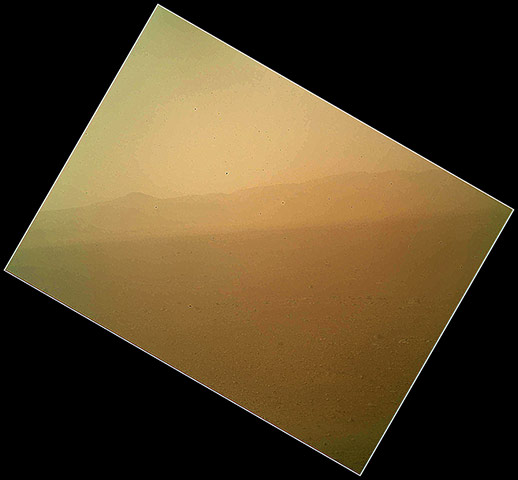
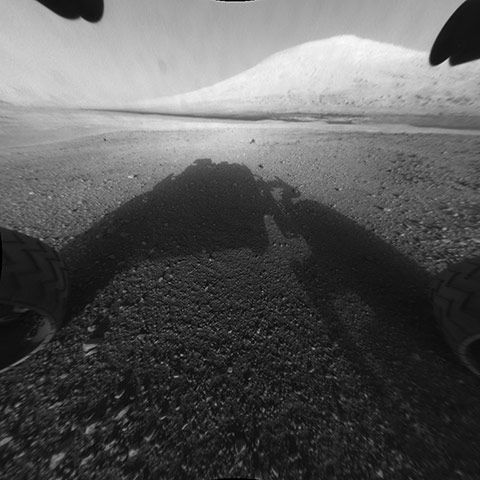
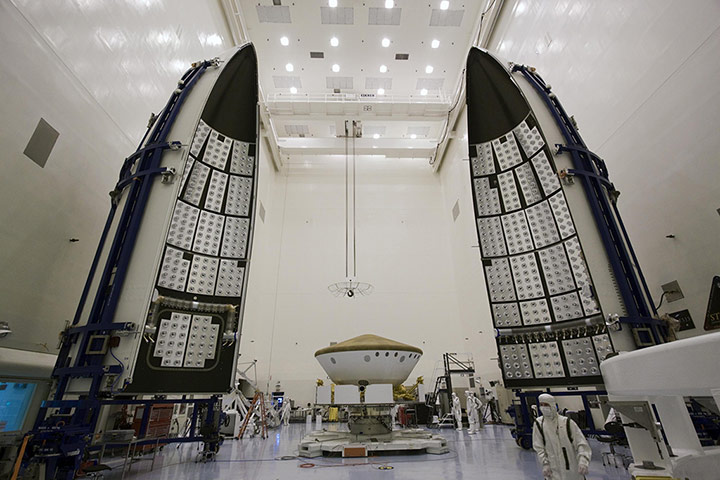
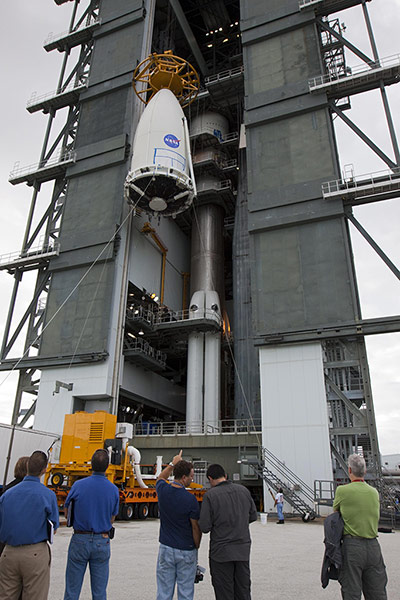
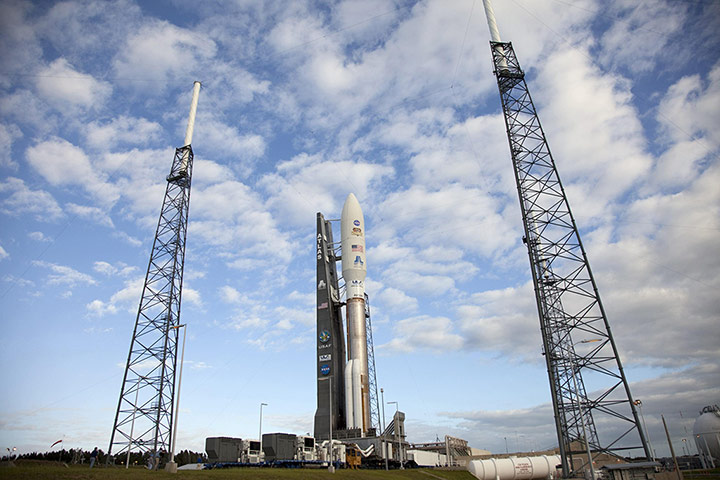
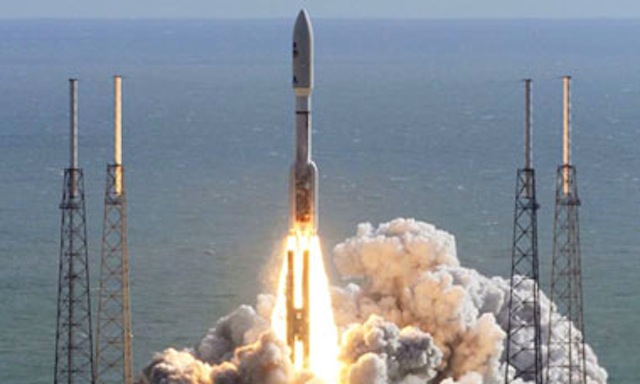
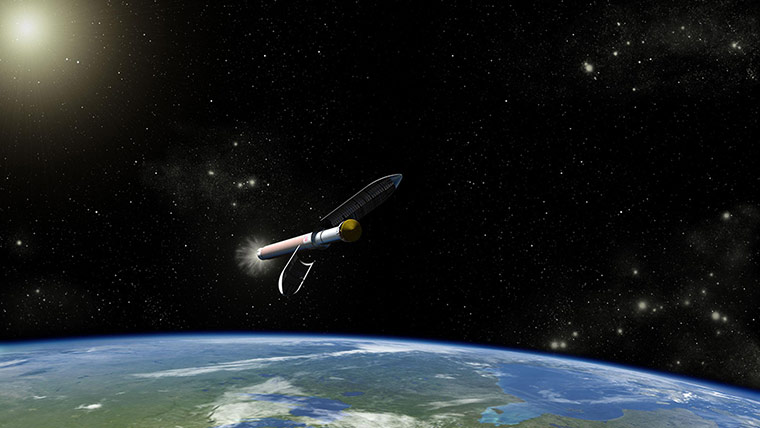
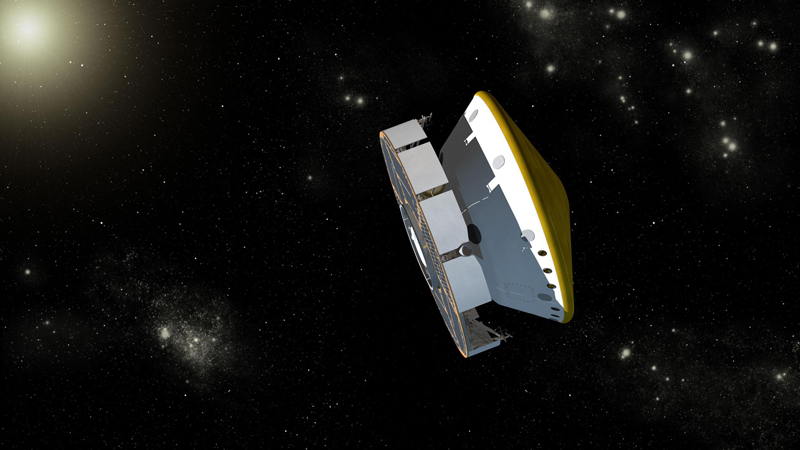
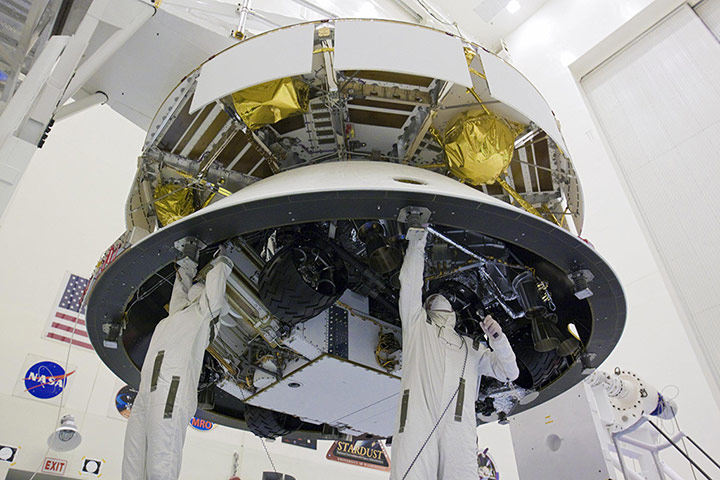
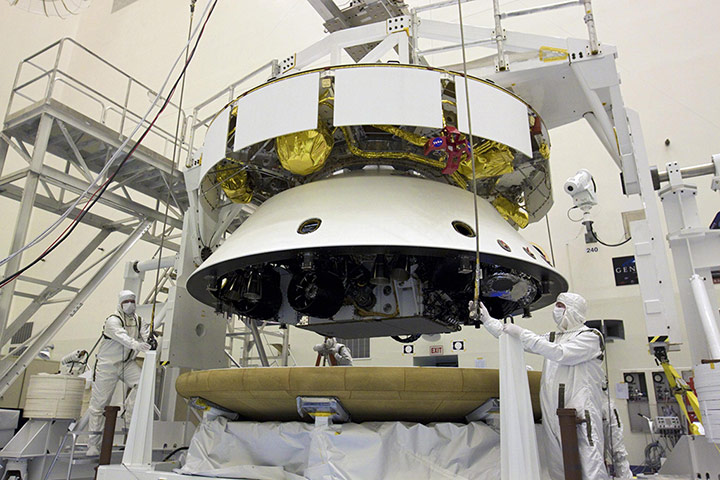
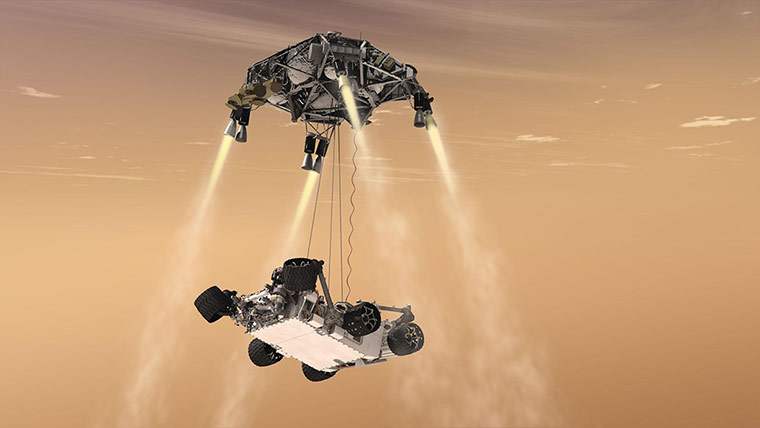
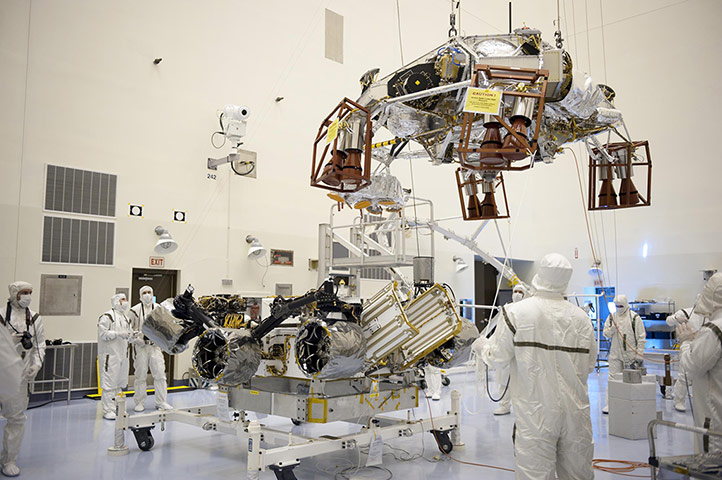
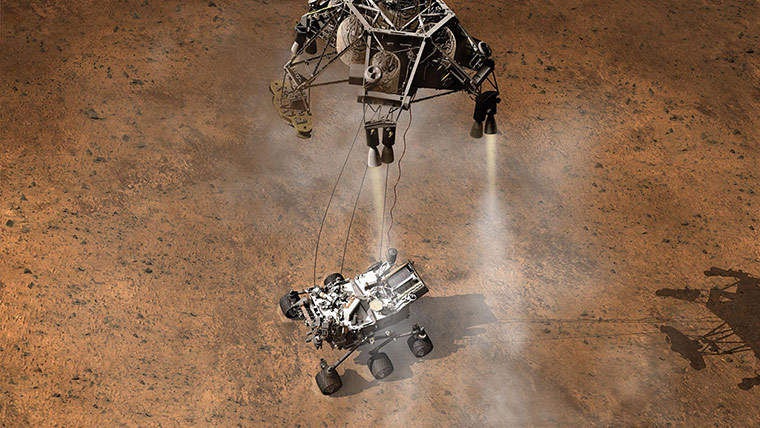
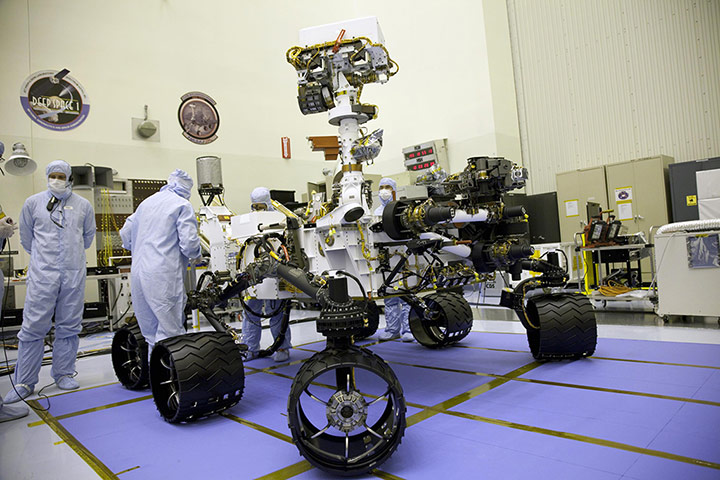
Curiosity parachutes to the surface in this image from Nasa's Mars Reconnaissance Orbiter. Curiosity and its parachute are in the center of the white box. The rover is descending toward the etched plains just north of the sand dunes that fringe Mount Sharp Photograph: Univ. of Arizona/JPL-Caltech/NASAThe first image from the rover Curiosity after it successfully touched downPhotograph: NASA/EPAMars Science Laboratory flight director Keith Comeaux, right, celebrates with Martin GrecoaPhotograph: Brian Van Der Brug/Getty ImagesOne of the first images from the Curiosity rover of its wheel after it successfully landed on MarsPhotograph: NASACuriosity's first colour image of the Martian landscape, acquired by the Mars Hand Lens Imager (MAHLI) on the afternoon of the first day after landing. In the distance is the north wall and rim of Gale Crater. The image is murky because the MAHLI's removable dust cover is apparently coated with dust blown onto the camera during the rover's descent. Images taken without the dust cover in place are expected in the coming weeksPhotograph: JPL-Caltech/NASAMount Sharp with the rover's shadow in the foreground. In the distance is the peak of Mount Sharp at a height of about 3.4 miles. The Curiosity team hopes to drive the rover to the mountain to investigate its lower layers, which scientists think hold clues to past environmental change. This image was captured by the rover's front left Hazard-Avoidance camera at full resolution shortly after it landedPhotograph: JPL-Caltech/NASAGale Crater – Curiosity's final destination – was created when an asteroid or comet slammed into the planet between 3.5bn and 3.8bn years ago. Rising 5km from the floor of the crater is a mound of rock called Mount Sharp which appears to be made from ancient sediments deposited when Mars still had water on its surfacePhotograph: JPL-Caltech/NASABack to where it all started: The Mars Science Laboratory is enclosed in its protective fairing last year at the Kennedy Space Centre in Florida. The blocks on the fairing's interior helped shield the payload during liftoff by dampening pressure waves from the Atlas V rocket Photograph: Jim Grossmann/NASAThe payload fairing is lifted for attachment to the Atlas V rocket at Space Launch Complex 41 in Cape Canaveral, Florida, on 3 November Photograph: Kim Shiflett/NASASurrounded by four lightning masts, the Atlas V rocket is rolled out to the launch pad on 25 NovemberPhotograph: Frankie Martin/NASALiftoff on 26 NovemberPhotograph: NasaThe payload fairing was jettisoned once the rocket was clear of the Earth's atmosphere Illustration: JPL-Caltech/NASAThe disc-shaped cruise stage is on the left, attached to the conical aeroshell, shown in this artist's impression during the 300m mile journey to Mars. Inside the aeroshell are tucked the Curiosity rover and descent stage Illustration: JPL-Caltech/NASATechnicians work beneath the aeroshell in October 2011Photograph: Glenn Benson/NASAThe heat shield before it was attached to the aeroshell in October 2011. The Curiosity rover can be seen inside the aeroshellPhotograph: Glenn Benson/NASATen minutes before the spacecraft arrived at the surface, it jettisoned its cruise stage and fired thrusters to swing the probe's heat shield into a forward position. At this point the probe was hurtling towards the ground at more than 8,000mph. Friction with the Martian atmosphere slowed its descent, achieving nine-tenths of the required deceleration and in the process heating the shield to more than 2,000C Illustration: JPL-Caltech/NASAA close-up of the heat shield at Nasa's Kennedy Space Center in Florida before attachment to the 'back shell' (in the background), which comprises the powered descent vehicle and roverPhotograph: JPL-Caltech/NASAAfter entering the atmosphere the spacecraft used the largest parachute ever built for a planetary mission – with a diameter of nearly 16 metres – to further slow its descent. The parachute was designed to survive deployment at Mach 2.2, generating up to 65,000 pounds of dragPhotograph: JPL-Caltech/NASAThe smaller ellipse marks the target landing area, about 20 kilometres by 7 kilometres, close to Mount Sharp in Gale Crater, which is about 154 kilometres across. Mount Sharp contains geological layers that Curiosity will study to reveal the planet's history and provide clues about whether it has ever been habitable Photograph: JPL-Caltech/NASAAfter cutting loose the parachute, the craft began controlling its own descent with four of its eight rocket engines, then lowered Curiosity on a bridle. The rover dangled from the descent stage by three nylon tethers and an umbilical provided a power and communication connection. The bridle extended to about 7.5 metresPhotograph: JPL-Caltech/NASACuriosity is hooked up to the descent stage at Kennedy Space Centre in September 2011Photograph: Kim Shiflett/NASAWhen touchdown had been detected, the bridle was cut at the rover end and the descent stage flew off to crash-land at a safe distancePhotograph: JPL-Caltech/NASATechnicians at Kennedy's Payload Hazardous Servicing Facility put Curiosity's instrument mast and science boom through a series of deployment tests in July 2011. Curiosity has 10 science instruments to search for evidence of whether Mars has ever had environments favorable for microbial life Photograph: Frankie Martin/NASAThis view of the head of Curiosity's remote-sensing mast shows seven of the 17 cameras on the rover. On either side of the head are two pairs of Navigation Cameras (Navcams), which serve as the rover's 'eyes' for stereo colour viewing of surrounding terrain and material collected by the arm. On the top are the optics of the Chemistry and Camera (ChemCam) instrument, which includes a telescopic camera and a laser to vaporise material on rocks up to 7 metres away. The Mast Camera (MastCam) instrument includes a 100mm camera (square aperture, right) and a 34mm camera (left)Photograph: JPL-Caltech/NASAThese are test images of the same boulder taken by four cameras on Curiosity at Nasa's Jet Propulsion Laboratory before launch. The image on the left shows a view from one of the black-and-white navigation cameras, looking down at the ground. The Navcams have a wider field of view (about 45 degrees) than the mast cameras (15 and 5 degrees) (centre), and Mars Hand Lens Imager (23 degrees) (MAHLI, right). The outlines of the Mastcam and MAHLI images have been superimposed on the Navcam image Photograph: JPL-Caltech/NASAA dollar bill photographed from 3 metres away using Curiosity's ChemCam. The instrument uses a telescope for spectroscopic analysis of chemical elements in targets such as rocks or soil. The same telescope serves the instrument's cameraPhotograph: LANL/JPL-Caltech/NASACuriosity will check for water-bearing minerals in the ground beneath the rover using the Dynamic Albedo of Neutrons instrument (DAN), which has two major components: a Russian-built 'neutron gun' or pulsed neutron generator (marked with a red outline) on the starboard side of the rover, and the detector and electronics module on the port side. The pulsed neutron generator will shoot high-energy neutrons into the ground. If there are hydrogen atoms beneath the surface, the injected neutrons will bounce off them with a characteristic decrease in energyPhotograph: JPL-Caltech/NASAThe Scarecrow Mars Rover, an engineering model of Curiosity, and another working model (rear right) in the sandy, Mars-like environment of Mars Yard at Nasa's Jet Propulsion Laboratory in Pasadena, California, last month. The Scarecrow was designed to be lighter than Curiosity to compensate for the reduced gravity on Mars Photograph: Danny Moloshok/ReutersAn artist's impression of Curiosity examining a rock with a set of tools at the end of its arm, which extends about 2 metres. A drill collects sample material and a scoop picks up samples of soil. The arm can sieve the samples and deliver them as a fine powder to instruments inside the rover for analysis. The mast rises to about 2.1 metres above ground level ('about as tall as a basketball player', says Nasa on its website) Photograph: JPL-Caltech/NASA
Sign up to read this article
Read news from 100’s of titles, curated specifically for you.