Stood in front of a judge with her whole world at stake, Sarah* remembers “stumbling” over her words, desperately trying to understand what was unfolding in front of her.
Across the room, her ex-husband Al*’s experienced barrister spoke to the judge in jargon she could not understand. It was two years into the pair’s dispute over custody of their young daughter, Elsie* – something she was terrified would put the four-year-old at risk because of his heavy drug use.
But despite her best efforts to keep Elsie safe, Sarah knew she would be left unable to protect her. A broken legal aid system left her forced to represent herself in family court, “too poor” to properly advocate for her child.
Sarah met Al at work 15 years prior, and the pair were happily married when Elsie came along. But when Al’s health worsened, he began to lean heavily on marijuana, often smoking “a joint every hour”, according to Sarah. When he didn’t smoke, he would become angry and rude, a “different person – like Jekyll and Hyde,” she said.
He stopped allowing Sarah to have anyone else in the house, cutting her off from family and friends, and racked up around £11,000 worth of debt, much of which was in her name.
Eventually, she left the relationship and managed to move into a housing association property with Elsie. She says she never prevented her ex-husband from spending time with their daughter, but drew the line at overnight stays “until he could prove he could keep her safe”.

“I knew from the marijuana smoking how hard it was to wake him up at times,” she explained. “How can I leave a four-year-old with him overnight? It felt irresponsible.”
But Al insisted on equal access to Elsie, often refusing to leave Sarah’s house after dropping her off or wedging his foot in the door to keep it open. On more than one occasion, she says he launched into a tirade of “verbal abuse” in front of their child.
Sarah recorded multiple instances and took the videos to the police, fearing for their safety. But she says she was advised not to pursue the allegations because a conviction was unlikely, without police even asking to see the footage.
Al later took Sarah to court, applying for a child arrangement order, a legally binding family court order that details how a child will live, spend time, and have contact with both parents.
“It was just quite surreal really,” she said. “I felt betrayed. I couldn’t believe it had come to that.”
She had no financial means to afford a lawyer to represent her and began looking into whether she would be eligible for legal aid, a service that can be granted in cases where someone is considered to be protecting themselves or their child from abuse or harassment, for example, domestic abuse or forced marriage.
She reached out to dozens of solicitors in her area, but struggled to find one that provided legal aid.
Eventually, she tracked one down – but months later was told she had no proof of Al’s abuse, and therefore wouldn’t qualify.
I replied saying, “So, what am I supposed to do? Represent myself?” Sarah said. “And she said, ‘Yes, you need to represent yourself.’
“It blew my mind,” she continued. “I couldn’t believe that criminals get access to help automatically, whereas someone trying to fight for their daughter got nothing.”
With a court date fast approaching and no money to pay for advice, Sarah was forced to appear in court by herself. Across the aisle, Al had hired a top barrister.
“It made me feel so small – it was one of the worst times of my life,” she said. “It was little old me against someone who does this every day for a living.
“How can you call that fair?”
The experience ground her down, and eventually, Sarah says she agreed to things she “wasn’t ready for” – including giving Al overnight access to Elsie.
She isn’t the only one who has struggled to access help. In 2013, the government introduced the Legal Aid, Sentencing, and Punishment of Offenders Act (LASPO), which axed large areas of law from legal aid budgets.
Government data highlights how, since the introduction of LASPO, the number of family cases where neither party has a legal representative has tripled from 13 per cent to 39 per cent.
Richard Miller, head of justice at the Law Society, told The Independent a huge drop in legal aid providers has left the “poorest members of society” abandoned and forced to represent themselves in court.
“Legal aid is a vital public service and it is under extreme pressure at the moment,” he explained. “What we’ve seen over the past few years is the number of firms working in this area and the number of lawyers working in this area has been falling year after year to the extent that there is now nowhere near enough coverage across the country to meet the needs of the public.”
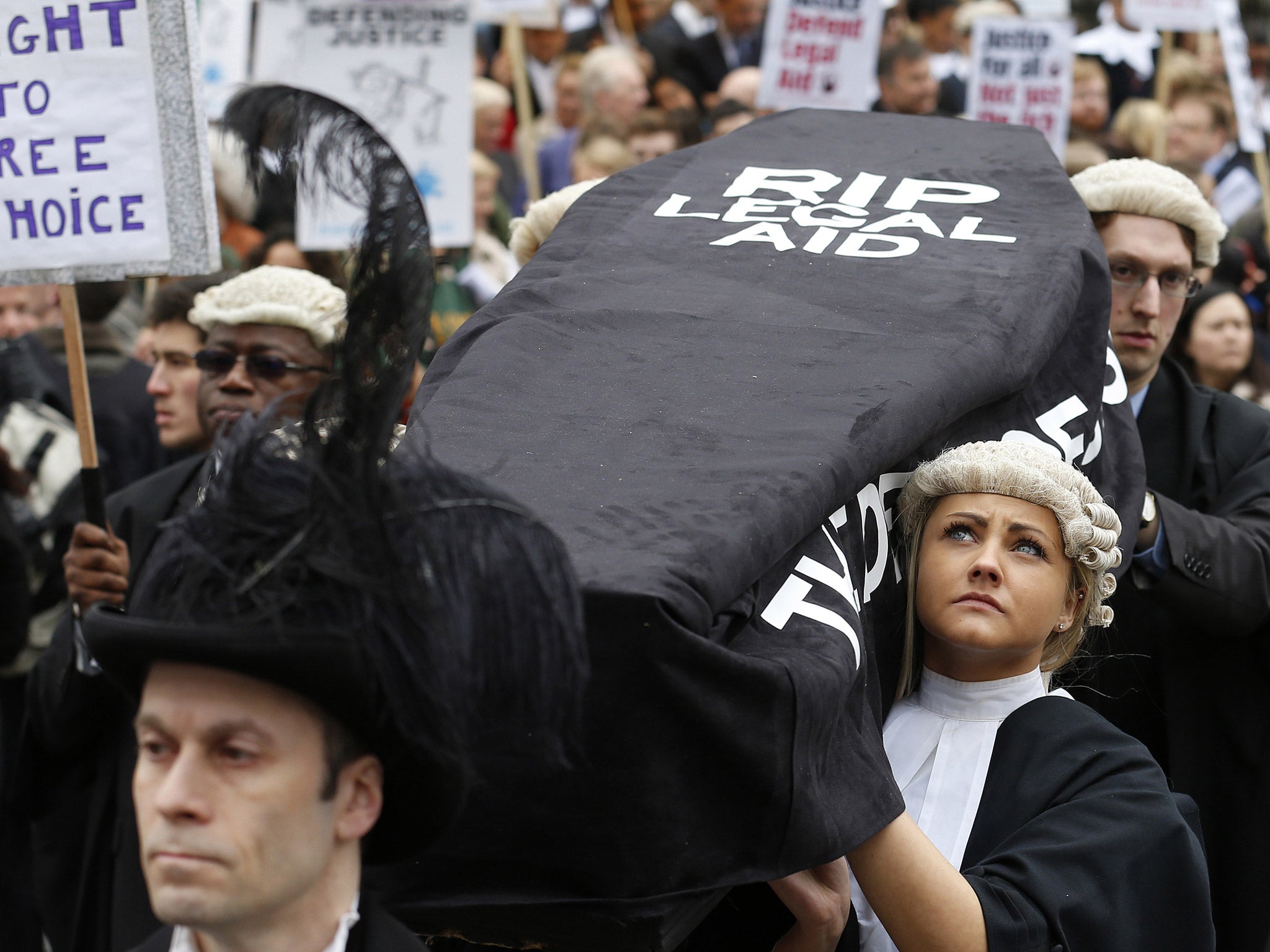
He added that the purpose of legal aid is to “level the playing field” as there is often a “power imbalance” in cases of family breakdown, such as Sarah’s. But their research shows many living below the poverty line have been left without help.
Mr Miller added that for legal aid to be saved, the government must commit to increasing rates for lawyers providing the service. “Research shows the majority of firms doing civil legal aid make significant losses from doing it,” he said.
As a result, he said Law Society data shows at least one in three people are living in a “legal aid desert” with no providers, leaving them unable to access the advice they should be entitled to.
Isabella Lowenthal-Isaacs, policy manager at Women’s Aid, said it was “clear” we are a “long way from ensuring that the courts are safe for women and children survivors of domestic abuse”.
“We know from our work with survivors that women are frequently disbelieved, their experiences of domestic abuse dismissed, and children’s voices are routinely silenced,” she continued.
She said the requirement to “prove” abuse left survivors without representation and at an increased risk of harm.
“The system, which has for so long benefited the perpetrator of domestic abuse, must change,” she added. “Women’s experiences must be listened to, and legal aid must be provided to ensure that decisions are just and fair.”
A Ministry of Justice spokesperson said: “This is a distressing case, and our thoughts are with the victim.
“Legal aid is available for victims of domestic abuse in family court cases, but applicants must meet eligibility criteria, including evidence such as a police caution or court order. We know this can be difficult for those dealing with trauma, but these requirements help ensure support is provided fairly and consistently.”
*Names have been changed to protect the source’s anonymity.
Southport Inquiry hears of killer’s comments about the Taliban
Concerns about Southport attacker’s ‘extreme views’ raised when he was 15
Teacher struck off after asking girl to wear uniform for sex
Prince Andrew ‘refused to sign off statements supporting abuse survivors’: Latest
‘I’m not eligible for the Covid vaccine and I’ve caught it three times in six months’
Andrew will head into exile at King Charles' private and remote Sandringham estate