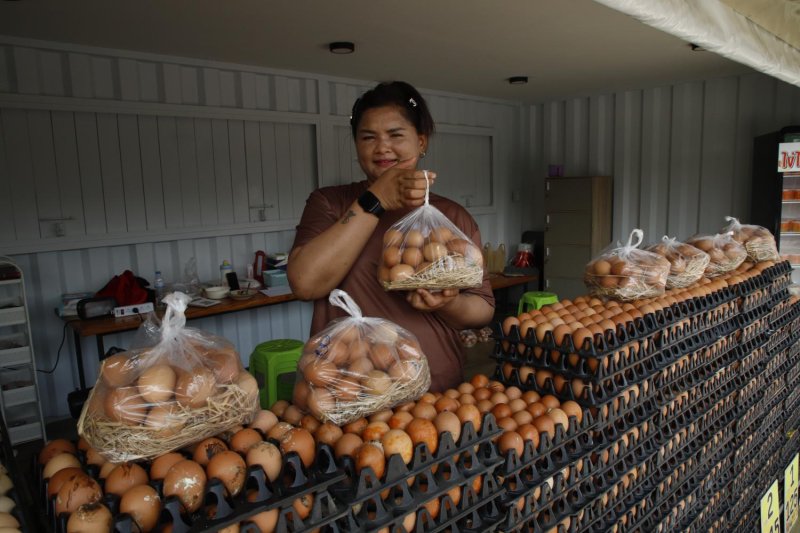
In economics, few indicators of food security are as simple -- and as powerful -- as the price of eggs. Affordable, accessible, and nutritious, eggs should be the most democratic source of protein in any society. Yet in Thailand, a single egg tells a far more complex story -- one of market power, distorted incentives, and a system that may no longer serve the public interest.
Over the past two decades, Thailand's egg industry has undergone a profound transformation. What was once a sector consisting of smallholder farmers has gradually evolved into a vertically integrated system, where large firms control the supply chain -- from breeding stock and feed production to distribution and retail. This structural shift has not only changed how eggs are produced, but also benefits sharing within the whole system.
At the heart of the issue lies a seemingly technical policy tool: the import quota for parent stock.
Originally introduced to stabilise supply and prevent price collapses, the quota system has become a powerful means of regulating access. In practice, access to breeding stock -- the foundation of the entire industry -- is concentrated among a small number of firms. The top five players now control more than 80% of the market, pushing concentration levels into total market capture.
Such concentration matters because it shapes everything downstream. When a few control the supply of chicks, they gain the ability to influence production decisions, input costs, and ultimately retail prices. For independent farmers, the consequences are clear: limited access to chicks, higher production costs and weaker bargaining power. As a result, many are left to take what the market dictates or risk being pushed out of the game.
Evidence from the industry suggests that this imbalance is not merely structural, but behavioural. Practices such as bundled sales -- where farmers must purchase feed, vaccines, and other inputs alongside chicks -- reduce market choice and increase dependency. Meanwhile, price movements among major players can undermine the very foundation of competitive markets.
The effects are not confined to producers. Consumers, too, are paying the price -- literally. Despite being a staple food, eggs in Thailand are often more expensive relative to income than in many other countries.
This is particularly troubling given that eggs are a key source of affordable protein for low-income households. When prices are elevated, the burden falls disproportionately on those least able to bear it.
Perhaps the most striking paradox is this: Thailand exports eggs at low prices while domestic consumers pay relatively high prices. This is partly driven by industry mechanisms designed to "manage surplus", including subsidised exports funded by industry pools.
While such measures may help stabilise the market in the short term, they can also create artificial scarcity at home, keeping domestic prices high and reinforcing market power.
From an economic perspective, the costs are substantial. The system generates significant "quota rents" -- excess profits derived from restricted access -- alongside measurable welfare losses to society.
But beyond the numbers lies a deeper concern: the risk of regulatory capture. When industry players exert strong influence over the rules that govern them, public policy can gradually shift away from serving the broader public and towards protecting entrenched interests.
This is not an argument against regulation. On the contrary, effective regulation is essential in agricultural markets. But the objective must evolve -- from controlling quantities to ensuring fair competition. Stability should not come at the expense of efficiency, innovation, or equity.
Reform, therefore, is not about dismantling the system, but about rebalancing it.
First, access to breeding stock must be opened up. A more transparent and competitive allocation mechanism -- one that allows cooperatives and new entrants to participate -- would reduce barriers at the very top of the supply chain.
Second, unfair trade practices must be addressed head-on. Clear rules against bundling and unfair contracts, backed by enforceable oversight, are essential to restore fairness for farmers.
Third, governance needs to be strengthened. Institutions such as the Egg Board must become more transparent, more accountable, and more representative -- incorporating voices from consumers and small producers, not just large firms.
Fourth, unnecessary regulatory burdens should be reduced. Simplifying procedures and cutting red tape can lower costs without compromising food safety.
Finally, competition policy must be enforced proactively. Waiting for clear violations is not enough in markets where power can be exercised subtly and cumulatively.
Thailand's egg industry stands at a crossroads. Continuing on the current path may preserve short-term stability, but it risks entrenching inefficiencies and deepening inequality. Reform, by contrast, offers a pathway to a more dynamic, competitive, and inclusive system -- one that benefits farmers, consumers, and the economy as a whole.
In the end, this is not just about eggs. It is about whether Thailand is willing to ensure that essential food systems remain fair, transparent, and truly competitive. Because when something as basic as an egg becomes distorted by market power, it is a signal that the system itself needs fixing.
Kamphol Pantakua is a researcher at the Thailand Development and Research Institute (TDRI). TDRI policy analyses appear in the Bangkok Post on alternate Wednesdays.