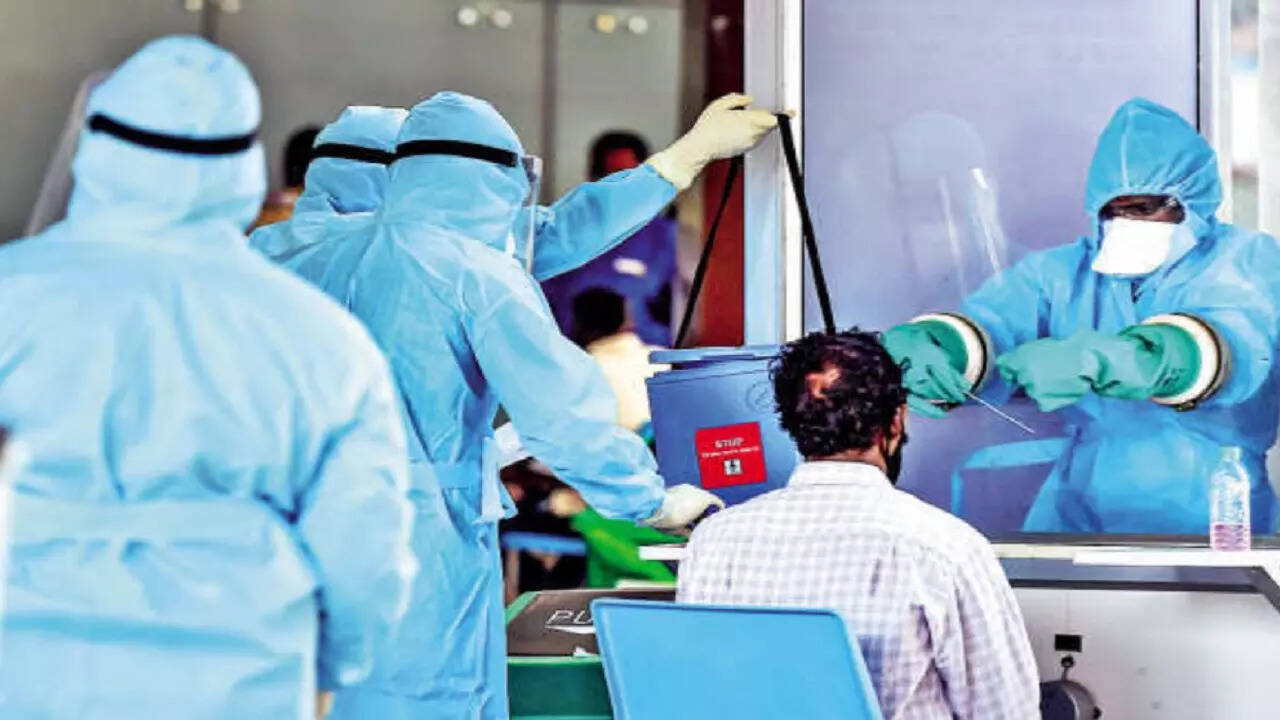
PUNE: It would not be correct to interpret the recent spike in Covid cases in states such as Delhi and Maharashtra as the start of another Covid wave, leading health experts told TOI on Thursday.
“The ongoing rise is nothing like how the previous waves started,” said Dr Rijo M John, professor and health economist at Kochi’s Rajagiri College of Social Sciences.
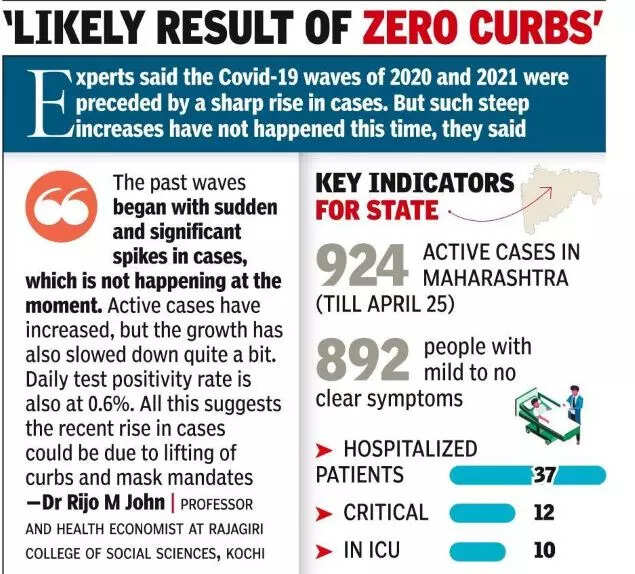
He said, “The past waves began with sudden and significant spikes in cases, which is not happening at the moment. Active cases have increased, but the growth has also slowed down quite a bit. Daily test positivity rate is at 0.6%, so it’s best not to hype this increase.”
Dr John also said that India’s seven-day TPR (test positivity rate) has stayed at around 0.5% to 0.6%, unlike the start of previous waves when both active cases and the TPR saw steep increases.
“This suggests the recent rise in cases may be due to lifting of curbs and mask mandates,” he said.
State surveillance officer Dr Pradeep Awate said the week-on-week increase in cases, seen in some parts including Pune and Mumbai, is likely an indication that Covid is now endemic. “Day-to-day fluctuations in cases are also a characteristic of endemicity of a disease. To call this the start of another wave in Maharashtra would be incorrect as cases have not been increasing in the magnitude that was seen before the start of previous waves,” he said.
Dr Awate added that Maharashtra’s test positivity rate is still less than 1% — at 0.73% — and hospitalizations too are low. “Most of the new cases emerging are also mild or asymptomatic,” he said.
Member of the state Covid-19 task force, Dr Shashank Joshi, said Maharashtra's current caseload is too small to be interpreted as the start of another major surge.
“The third wave has passed and only some scattered clusters of Covid cases are being reported in some geographies. This can be counteracted with Covid-appropriate behaviour, protection of vulnerable populations and increased testing,” he said.
Dr Sanjay Pujari, director of the Institute of Infectious Diseases, Pune, said his hospital has not seen an increase in admissions despite the recent rise in cases.
“This is because most patients may be having mild illness. Also, there is a lag between start of a spike and hospitalisations, which could explain low hospitalisation levels. We need to closely watch trends over the next two to four weeks,” he said.
Officials said Maharashtra’s action plan to tackle caseload spikes in some districts includes improved testing, monitoring of all patients with respiratory ailments and sequencing of samples from regions reporting infection clusters.
Officials also said districts with low vaccination coverage have been asked to ramp up drives.