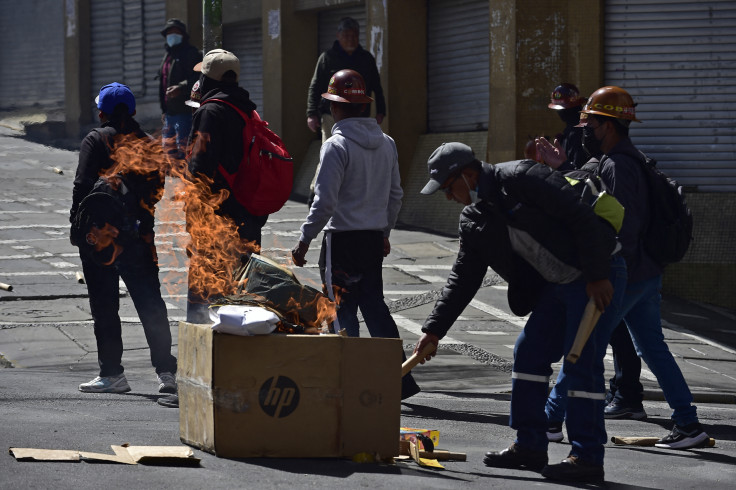
LA PAZ, Bolivia — The images coming out of La Paz tell a story of raw desperation: miners hurling dynamite sticks at riot police, tear gas drifting over demonstrators outside the presidential palace, highways blockaded for weeks, supermarket shelves emptied, hospitals running low on oxygen. Bolivia is living through what many analysts are calling the worst economic crisis in a generation — and its newly elected president, Rodrigo Paz, is fighting for his political survival just six months into office.
But beneath the genuine economic pain of ordinary Bolivians lies something more calculated. The Paz government, backed by an increasingly alarmed international community, is sounding the alarm: what looks like a spontaneous uprising is, at least in part, an orchestrated attempt by former president Evo Morales to topple a democratically elected government and claw his way back to power. And according to Bolivia's Minister of the Presidency, José Luis Lupo, the hands pulling the strings are not all Bolivian.
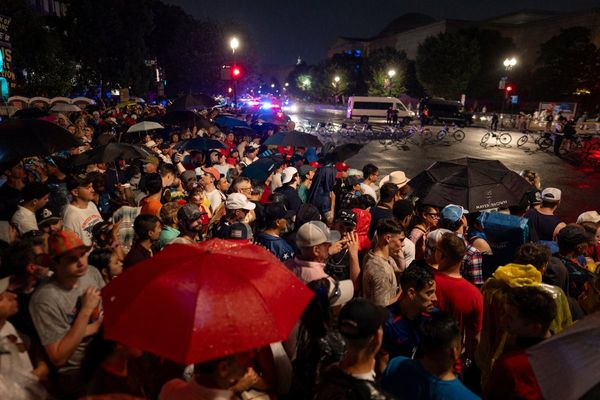
After a six-day march through the Andes, thousands of Morales's supporters, some brandishing dynamite sticks and slingshots, converged on La Paz on Monday, where they were met by riot police. Dynamite blasts rumbled downtown as security forces fired back with tear gas against demonstrators who called for the president's resignation just six months into his tenure.
A Crisis Built on Ruins Left Behind
To understand these violent Bolivian protests, you have to understand what Rodrigo Paz inherited. When he was sworn in on November 8, 2025, he took charge of a nation under severe economic strain: inflation above 20%, foreign currency reserves nearly exhausted, public services fraying, and fuel lines stretching for blocks.
That inheritance was not an accident. Between 2006 and 2024, "Bolivia created 67 state companies with investments totaling $7.55 billion, of which only 18% was recovered," according to a report by Intellinews. Presidential minister José Luis Lupo reported $1.46 billion in losses tied to "unviable" companies and an additional $1.13 billion linked to industrial plants promoted under former president Luis Arce's import substitution strategy, many of which remain unfinished, non-operational, or technically bankrupt as reported by Infobae. These investments were partly financed through loans drawn from international reserves, directly draining Bolivia's external financial position. Paz himself has described inheriting a "bankrupt state."
Revenue from natural gas exports — a key economic driver and source of foreign exchange — had declined since 2022, due in part to decreased investment under the state-led model. Shortages of gasoline and U.S. dollars contributed to rising inflation, with the IMF projecting economic growth of just 0.6% in 2025.
The trigger for the current wave of protests started arguably through a December 2025 presidential decree eliminating fuel subsidies. To rein in a massive budget deficit, Paz eliminated fuel subsidies that represented a pillar of the MAS economic model. Small things accumulated — the wage issue, the economic crisis, imported "junk gasoline" which affected drivers day-to-day lives, diesel shortages — until the frustration exploded into the streets.
Paz annulled a separate land mortgage law that had further inflamed rural communities, but even that concession was not enough to stop the protests from spreading. More than 40 blockade points were reported across six of Bolivia's departments, leaving the country nearly cut off internally. The National Chamber of Commerce estimated losses at more than $50 million per day nationwide, with accumulated losses from the blockades surpassing $500 million.
The Fracture That Made This Possible
Morales did not arrive at this moment alone. His ability to exploit the current crisis is inseparable from his bitter falling-out with Luis Arce, his former protégé and successor.
Bolivia's political divisions deepened after Morales split from the ruling MAS movement following a bitter feud with former President Arce. The fracture weakened Bolivia's political left and opened the door for Paz's victory in the 2025 election, ending nearly two decades of dominance by Morales-aligned forces.
The two men who had once been the twin pillars of Bolivian socialism became fierce rivals. During Arce's presidency, the conflict between them paralyzed governance and deepened the country's economic freefall. In 2024, former president Arce claimed to a Mexican media that rumors of Morales' relationship with a minor had been "an open secret" throughout his former mentor's rule.
The Arce years ended in a historic repudiation. In the 2025 national elections, the Bolivian electorate voted to end two decades of MAS governance. MAS representation was reduced from majorities in both chambers of Congress to just two members in Bolivia's chamber of deputies.
The Fall of the House of Arce
The scale of the corruption that fueled Bolivia's collapse has since been laid bare in a courtroom — and it goes beyond the former president himself.
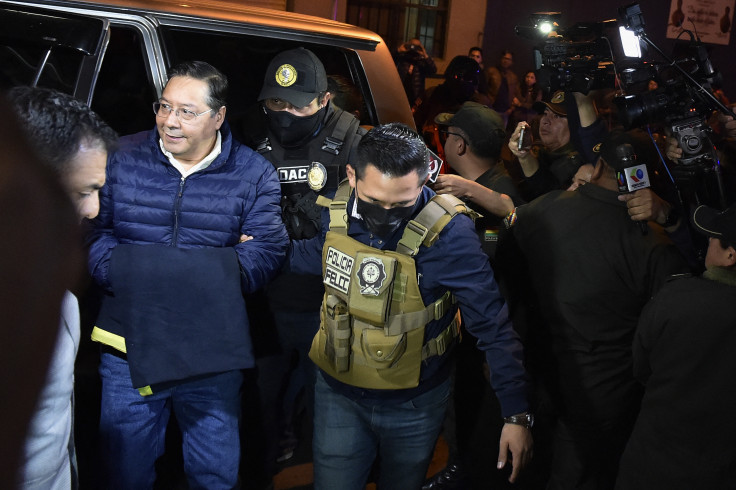
Just one month after leaving office, Luis Arce was arrested on the streets of La Paz in December 2025 by Bolivia's anti-corruption police force. A judge subsequently ordered him held for five months in pre-trial detention at San Pedro Prison — one of La Paz's largest — citing the seriousness of charges that "directly affect state assets and resources allocated to vulnerable sectors." Arce faces charges of breach of duty and financial misconduct, carrying a maximum sentence of six years in prison. He has denied all wrongdoing, calling himself "a scapegoat" and describing the case as politically motivated.
The accusations center on his decade-long tenure as economy minister under Evo Morales, between 2006 and 2017. According to an Al Jazzera report, "prosecutors allege that Arce oversaw the diversion of approximately $700 million from a state fund created to channel natural gas revenues into development projects for Indigenous peoples and peasant farmers" — the very communities that formed the backbone of Morales's political movement. The case had first surfaced in 2015 when the fund was shut down amid corruption allegations, but investigations stalled for nearly a decade during the years of uninterrupted MAS governance. It was only with Paz's election that prosecutors moved forward.
The scandal did not stop with the former president. In March 2026, police arrested Arce's eldest son, Luis Marcelo Arce Mosqueira, 33, after a pursuit through the streets of Santa Cruz, where he was caught attempting to flee in a vehicle. Officers seized more than $22,000 in cash at his residence, along with a Ford pickup truck. Marcelo Arce Mosqueira faces charges of money laundering, illicit enrichment, and economic damage to the state. Investigators with Bolivia's Financial Intelligence Unit identified 18 properties and 20 vehicles linked to him — assets authorities say bear no relation to any legitimate income. He had also been accused as far back as 2023 of acting as an unofficial intermediary between the state and private companies competing for Bolivia's lucrative lithium contracts, trading on his father's name without ever holding a public post. A Bolivian court subsequently ordered him held in preventive detention for 140 days at the Palmasola prison in Santa Cruz, considered the country's most conflict-ridden facility. His two siblings, Rafael and Camila, are also under investigation for alleged money laundering and illicit enrichment, with Rafael having had his own preventive detention requested by prosecutors. Their whereabouts are unknown.
The picture that emerges is of a former president now behind bars, a son in prison, and an entire family under criminal investigation — while the man who mentored them all, Evo Morales, directs roadblocks from a jungle hideout to avoid a trafficking trial.
The Man Behind the Marches Orchestrating Chaos?
Morales has been reportedly directing the latest march from his hideout in Bolivia's remote tropics, holed up in the highlands for the past year and a half, evading an arrest warrant on charges relating to his alleged sexual relationship with a 15-year-old girl.
The charges against him are serious and specific. Morales is accused of aggravated human trafficking related to an alleged relationship with a minor. According to Bolivian prosecutors, the alleged contact occurred through the "Youth Guard" or "Generation Evo," a group established during his presidency. A child was reportedly born from the relationship on February 8, 2016, with Juan Evo Morales Ayma listed as the father on the birth certificate. Tarija's Public Prosecutor's Office has collected over 170 pieces of evidence to support the charges.
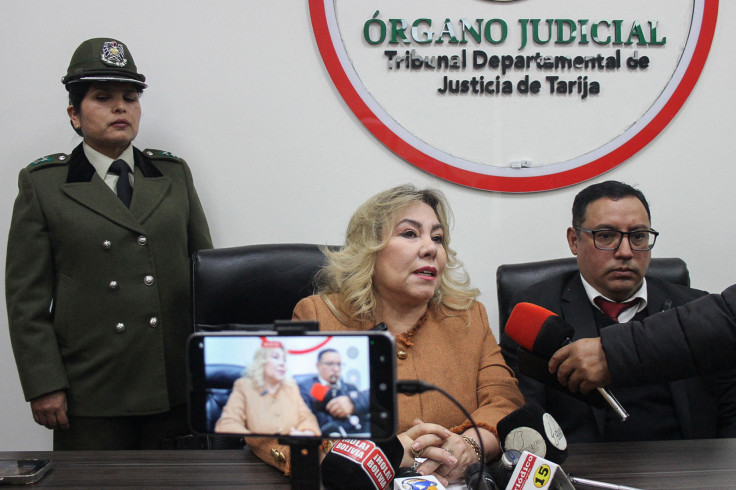
A criminal court in Tarija declared Morales in contempt after he failed to appear for trial. Authorities issued an arrest warrant authorizing security forces to detain him anywhere in the country and prevent him from leaving Bolivia. The court also ordered the freezing of his bank accounts and precautionary registration of his assets.
Rather than face justice, Morales has chosen a different tactic: escalating accusations of a CIA conspiracy to distract from the charges against him. In televised interviews and statements to supporters in the Chapare region, Morales has claimed that the CIA and Bolivian security forces are actively preparing a joint operation to "kidnap" him. He has alleged that three helicopters — which he claims were CIA-operated — attempted to detain him, saying "shots were fired in volleys" and that he "barely escaped alive." No evidence has been produced to substantiate any of these claims. Morales has also framed his legal predicament in sweeping geopolitical terms, accusing the Trump administration of orchestrating a broader campaign to eliminate left-wing movements across Latin America. "They want to eliminate every left-wing party in Latin America," he told supporters.
Morales has called the case politically motivated. But analysts believe Morales no longer has the power to rally mass support, suggesting instead that he is fueling the protests purely to evade justice.
Presidential authorities have claimed that the protests are financed by drug trafficking but have yet to formally present any evidence and accused political interests linked to Morales of attempting to "take by force" what they failed to obtain "at the ballot box." Public Works Minister Mauricio Zamora was blunt: "They do not have a serious proposal. They want to return to power through violence."
A History of Defying the Bolivian People
For those who know Morales's record, the current maneuver fits a familiar pattern of placing his personal ambitions above the democratic will of his country.
In February 2016, Bolivians were asked directly whether Morales should be allowed to seek a fourth term in office. A successful "yes" vote would have allowed President Morales and Vice President Álvaro García Linera to run again. The proposal was voted down by a 51.3% majority.
Morales accepted the result briefly — then moved to undo it. In September 2017, his supporters in Congress brought a lawsuit in the Plurinational Constitutional Tribunal seeking to revoke the constitution's term limits. Morales's supporters claimed that the term limit discriminated against the president and undermined his political rights under regional human rights standards. In November, the court ruled in favor of their abolition, citing the American Convention on Human Rights.
The court's decision stunned observers both in Bolivia and abroad. It transformed a democratic mechanism — term limits — into a legal obstacle that could be dismissed on the grounds of political rights. For the opposition, this was nothing short of constitutional manipulation, as the court had effectively overturned the will of the Bolivian people as expressed at the ballot box.
He went on to run in 2019, and when the results of that election were disputed amid fraud allegations, Morales resigned and fled into exile — only to return when his ally Arce won the subsequent election. Now, with Arce gone and a warrant out for his arrest, Morales could be attempting a third act: using street unrest to force out a president he could never defeat democratically.
"A Geopolitical Rescue Operation for a Crumbling Authoritarian Network"
Perhaps the most alarming dimension of the current crisis, according to the Bolivian government, is the degree to which it is being fueled from outside the country's borders.
In a wide-ranging interview, Minister of the Presidency José Luis Lupo laid out in explicit terms what the government believes is happening: a coordinated, multi-front effort by foreign actors to prevent Bolivia from turning the page on the Morales era.
At the center of the allegations is Venezuela. According to information cited by the same Minister Lupo, Morales has been making use of Venezuelan-registered vehicles — with specific license plates identified by authorities — and that associates in his circle have traveled to Caracas to secure financing. The stated purpose of that support, the minister argues, is to return Morales to power so that Bolivia can serve as a sanctuary for Venezuelans who have run out of safe options elsewhere in the region. What is being packaged as a popular uprising, in this reading, is also a geopolitical rescue operation for a crumbling authoritarian network.
The foreign dimension does not stop at Venezuela's borders. Minister Lupo identified two transnational political organizations — the Group of Puebla and the Forum of São Paulo — as active participants in Bolivia's destabilization.
The government has also taken direct aim at foreign leaders who have weighed in publicly. Colombian President Gustavo Petro's post on social media — in which he warned that any action against Evo Morales would "fill all of Latin America with blood" — was characterized by Minister Lupo as a brazen interference in Bolivia's internal affairs. Bolivia's Ministry of Foreign Affairs has formally addressed the remarks, and the government views them as confirmation that the campaign against the Paz administration has international backing and coordination.
Also woven into this foreign-influence network, according to the minister, are irregular groups tied to drug trafficking. In the Chapare region — Morales's stronghold and the area where he remains sheltered — conflicts between protesters and security forces have historically provided cover for narcotics transit and the forced expulsion of counter-narcotics units like UMOPAR. The government contends that criminal interests and political interests have found common cause in the current unrest.
Manufacturing a Martyr: The Plot to Plunge the Country into Ungovernable Chaos
Underlying all of it, Lupo describes what he calls a sophisticated "war of disinformation": a coordinated psychological operation on social media designed to spread false narratives — including fabricated claims about the privatization of water and other basic services, and rumors of sweeping constitutional changes — intended to frighten ordinary Bolivians into the streets. The goal, in his telling, is not dialogue or reform, but the manufacture of a death — a martyr whose killing could ignite a spiral of violence and tip the country into ungovernable chaos. "They are looking for a death," the minister warned, to use as a pretext for escalation.
The economic toll of this foreign-backed campaign, the government estimates, has already cost Bolivia more than half a point of its GDP — a punishing blow to an economy that was already on its knees.
The International Community Sounds the Alarm, Washington Calls It A "Coup"
Bolivia's neighbors have responded with unusual unanimity. Eight allied Latin American governments — from Argentina to Panama — released a joint statement rejecting "any action aimed at destabilizing the democratic order."
On Tuesday, the United States dropped any diplomatic ambiguity and named what is happening in Bolivia plainly. U.S. Deputy Secretary of State Christopher Landau, speaking at a conference hosted by the Americas Society/Council of the Americas, said he had personally spoken with President Paz and was "very concerned" about the escalating situation. His words were unsparing.
"Make no mistake about it," Landau declared according to a report by Reuters. "This is a coup that's being financed by this unholy alliance between politics and organized crime throughout the region." He expressed hope and expectation that other South American countries would join in formally repudiating it, framing Bolivia's crisis not as a domestic dispute but as a regional threat to democratic governance. "I am very concerned about Bolivia," he said, describing his call with Paz. "It cannot be that you have a democratic process where he was elected overwhelmingly by the Bolivian people less than a year ago and now you have violent demonstrators blockading the streets."
The statement marks a significant escalation in U.S. involvement, going beyond the State Department's earlier expressions of support for Paz to a direct, named characterization of the unrest as an antidemocratic power grab financed by criminal networks — language that aligns precisely with what Bolivia's own government and Minister Lupo have been saying for weeks.
Presidential spokesperson José Luis Gálvez said "there are dark forces seeking to destabilize our democracy," in a direct allusion to Morales.
Cynical Exploitation of Real Popular Grievances
Bolivia is not merely experiencing a protest movement. It is experiencing an attempt to bring down a government through economic strangulation, organized violence, foreign financing, and the cynical exploitation of real popular grievances — grievances that were themselves created by the very political force now seeking to capitalize on them.
The road blockades, a tactic long deployed by social movements tied to Morales, have stranded around 5,000 trucks on highways, choking populous cities such as La Paz and El Alto from basic and critical medical supplies.
Rodrigo Paz took office with a mandate to clean up a fiscal catastrophe that took nearly two decades to create. He eliminated subsidies that were hemorrhaging nearly a billion dollars a year. He restored diplomatic relations and invited international investment. His government is now facing pressure in being driven from office by several groups calling his ouster backed by allies reportedly in Venezuela, Colombia, and Brazil.
Evo Morales, hiding from a trafficking warrant in the coca fields of Chapare, seems to be betting that Bolivia's pain can be his ticket back. The question for Bolivia — and for the hemisphere — is whether democratic institutions can withstand one more attempt by a man who has already shown he will override referendums, pack courts, mobilize criminal networks, and now, apparently, invite foreign interference to keep himself in the game.