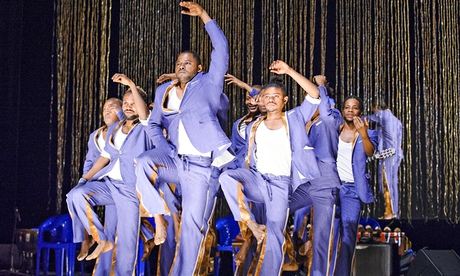
Coup Fatal, directed by Alain Platel of Ballets C de la B, defies easy categorisation. Created around the astonishing talent of the Congolese countertenor Serge Kakudji, the piece incorporates baroque arias, the popular dance and music of Kinshasa and the west African sartorial subculture known as La Sape.
Onstage are a dozen male musicians who also sing and dance. Led by the scintillating electric guitarist Rodriguez Vangama, they play an assortment of instruments including xylophones, balafons, rain sticks and likembes. The result is a catchy river of sound into which flow the grandly measured cadences of Monteverdi, Vivaldi and Handel. There’s nothing forced about this confluence, over which Kakudji’s voice rises and falls with calm, beautiful precision. When Kakudji’s not singing, the stage erupts into a fever of dance. Deep-bent knees, shuddering hip isolations, furiously rolling shoulders, fluttering fingers. There are flurries of bumping, grinding and crotch-grabbing. “Oh, baby, you kill me,” one guy gasps to another, flashing a conspiratorial grin at the audience.
Visually, the piece builds. The set, by Freddy Tsimba, is an arrangement of metallic strip curtains. What isn’t immediately obvious is that these are made up of spent cartridge cases, reminding us that decades of conflict have left the Congolese people in desperate straits, the victims of poverty, lawlessness and continuing violence. Against this sobering backdrop, the sapeurs strut and preen. La Sape takes its name from the Société des Ambianceurs et des Personnes Élégantes. Originally a form of political resistance – a mocking subversion of the gentlemanly dress of the French and Belgian colonisers – the movement has evolved into an elaborate dandyism which has spread to Paris and other European cities, although its spiritual heartland remains Brazzaville, the capital of the Republic of the Congo.
Here, the sapeurs shimmy, shake and pose in outrageous checks and pinstripes, hot orange suits, correspondent shoes, jazzy socks teamed with shorts or a kilt, lime-green braces, and sunglasses. One guy, brilliantly, wears a skirt of silk neckties. At their head is Vangama, unswervingly cool in a white admiral’s uniform and mink coat, executing lightning runs and flickering jazz riffs on his double-neck Gibson guitar. He and Kakudji segue into the evening’s haunting closing number, based on the aria Lascia ch’io pianga from Handel’s opera Rinaldo.
The words of the libretto (“Let me weep my cruel fate, and sigh for liberty…”) remind us, like Tsimba’s designs, that this is a political piece. Coup Fatal needs editing; Platel’s work is inclined to sprawl, and 90 minutes without an interval is too long. But at its best, like Kakudji’s voice, it soars.
- This article was amended on Monday 8 June. Brazzaville is the capital of the Republic of the Congo, not the Democratic Republic of the Congo. This has now been corrected.