
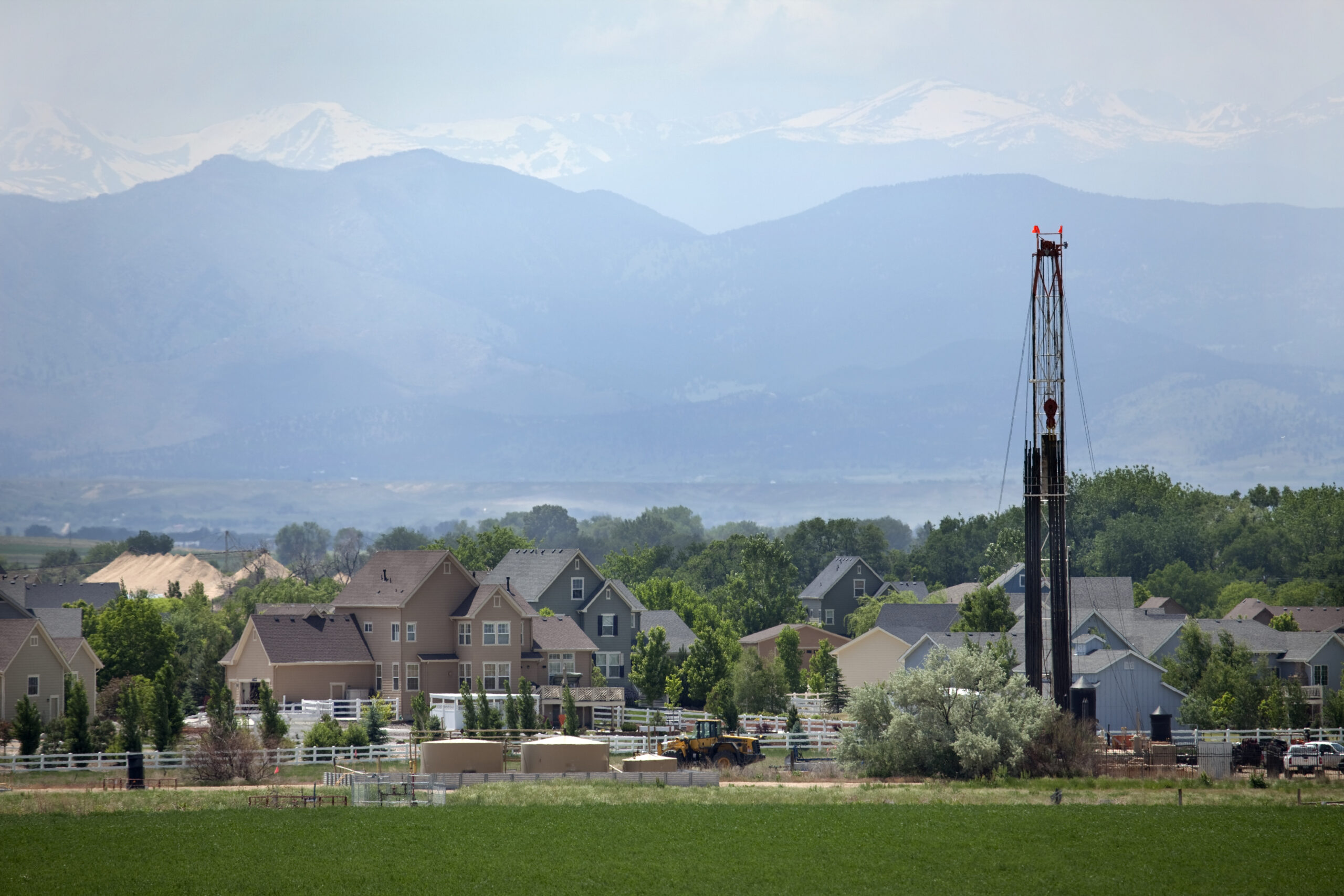
For the first time since Colorado began regulating drilling 75 years ago, state officials said they may order a company to move a well pad farther from the Denver suburbs — a decision that could force the firm to leave oil and gas worth tens of millions of dollars in the ground.
Energy & Carbon Management Commission members made the declaration during a permit hearing for a 32-well pad located about 3,000 feet from Aurora neighborhoods, where residents have fought to keep the industry at bay. Regulators dismissed several alternative locations for the site presented by Civitas Resources Inc. as inferior because they violated Arapahoe County rules that mandate such development be a mile away from the Aurora Reservoir.
The pad request, part of a 166-well, eight-pad development on a former military base, drew fierce opposition from residents. Homeowners raised thousands of dollars to hire an attorney who testified on their behalf — another historic first — throughout the hearing. Piping from wells drilled from what’s known as the Sunlight-Long pad would extend under their community, and the Aurora Reservoir, which stores drinking water.
At a Dec. 10 hearing, commissioners agreed that residents’ concerns about noise, truck traffic, air pollution, fire and health risks merited a more thorough analysis of locations “farther from dense residential development.” They voted 4-1 to order Civitas to conduct such a review, including sites from which it would be technically impossible for the company to extract all the available oil and gas — also known as minerals.
“I would like the analysis to include locations in which there may not be an ability to target all the minerals,” said Jeff Robbins, the commission’s chair. “I’d like an assessment of the nontargeted minerals. And I’d like that assessment to include an analysis of how much safer that might be.”
The order marked the latest nation-leading development to stem from a sea change in how Colorado, the country’s fourth-largest oil producer and its eighth-biggest gas producer, balances oil and gas development and public health. As multiwell pads moved ever closer to the expanding suburbs along the eastern flank of the Rocky Mountains, prompting some municipalities to ban drilling altogether, legislators enacted a law in 2019 that required regulators to prioritize public health over fossil fuel extraction.
Like private property rights on the surface, mineral rights have been considered sacrosanct by regulators nationwide for decades.
A major provision of the law that’s never been tested, until now, allows regulators to make decisions that would force an energy company to leave hydrocarbons in the ground “if necessary to protect public health, safety, welfare, the environment, or wildlife resources.”
Such a ruling would not only economically impact the industry, but also thousands of people who own the rights to such minerals. In the case of the Sunlight-Long pad alone, the list of such mineral owners extends for 47 double-columned pages — or about 3,542 people.
Oil and gas firms most often lease mineral rights from residents as well as state and federal governments. The companies pay the mineral rights owners royalties based on the amount of oil and gas produced. There are more than 600,000 mineral rights owners in Colorado alone. Often, these people do not also own the surface rights above, requiring companies to lease those rights from another party.
Like private property rights on the surface, mineral rights have been considered sacrosanct by regulators nationwide for decades. Now, Colorado, and California, are upending the long-held tenet that maximizing production trumps all else.
In the Golden State, several mineral rights owners in April sued the California Department of Conservation, Geologic Energy Management Division, claiming a rule that prohibits drilling or repairing wells within 3,200 feet of residences violates their property rights under state and federal constitutional law. The case is scheduled for trial in November. Mineral rights owners in Santa Barbara filed a similar lawsuit on Jan. 27, and the U.S. Department of Justice also filed suit on Jan. 14 claiming that the setback law would “knock out about one third of all federally authorized oil and gas leases in California.”
An estimated 500,000 Californians collect royalty payments from oil and gas companies including “ranchers, farmers, teachers, factory workers, retirees, foundations, religious organizations” and others, according to the lawsuit. The strongly worded complaint goes on to say that the economic impact of the setback rule “on the value of Petitioners’ property rights is catastrophic.”
In Colorado, the energy commission’s acknowledgement that it can do what’s known as “strand” oil and gas comes as scientists called on nations to “undertake steeper and faster reductions” in fossil fuel development. Planet-warming emissions that result from burning fossil fuels rose 2.4% in 2025 after two years of declines, according to a Jan. 13 report from the Rhodium Group, an independent economic research firm. The United States is the world’s largest fossil fuel producer.
“Income from development of these minerals can be the difference between grandma being able to afford her medications or not.”~ Sam Bradley, president, Colorado Alliance of Mineral and Royalty Owners
These warming effects are digging in hard this winter. Colorado’s snowpack is at a record low after the state marked its warmest December since 1895. Tulips sprouted. Hundred-mile-per-hour winds toppled semi-trailers on interstate highways. The 31st annual Ouray Ice Festival went iceless.
Like mineral owners in California, people who own rights to oil and gas underground in Colorado said the 2019 law that allows state regulators to leave fossil fuels untapped should be revised to prohibit such a weighty decision. Mineral owners said the provision not only disenfranchises them, but could also harm municipalities, which rely in part on severance taxes from companies based on the value of oil and gas production.
The Colorado Alliance of Mineral and Royalty Owners works to “protect every private property owner’s ability to have their minerals fully developed,” said Sam Bradley, the nonprofit’s president.
“Income from development of these minerals can be the difference between grandma being able to afford her medications or not,” he added. “This is an essential cash flow stream to many Colorado families.”
Civitas echoed this sentiment during its Sunlight-Long permit application hearing. If state regulators require the company to move the well pad to the east, it would not be “operationally feasible” for workers to extract 960 mineral acres owned by 400 mineral owners valued at $83 million (subject to oil price fluctuations), testified Dan Harrington, the firm’s asset development manager.
“There are not a lot of alternative locations,” he told commissioners in November. “Sunlight-Long is already a very challenging plan. I’ll remind you this is not the original plan. This is not the way from a drilling standpoint that we would want to do this.”
The company said it already combined several well pads to create this one and moved it to appease residents. As a consequence, Civitas is already pushing the limits of its fracking technology, which requires the firm to first drill down about a mile and then turn and drill horizontally for roughly three miles to reach fossil fuel deposits, Harrington testified.
Experts said there is legal precedent if Colorado’s energy commission ultimately requires Civitas to leave some fossil fuels underground.
“The rapid growth of unconventional oil and gas development has, in a lot of ways, outpaced scientific study.”~ Shaina Stacy, epidemiologist
Courts have upheld that a developer “has a right to develop a property, but doesn’t have a right to create a nuisance,” said Tara Righetti, a professor of law at the University of Wyoming. “As long as there is some way to develop the minerals, as long as regulations are reasonable, courts are saying that it’s within the state’s power.”
She added that it’s important to remember that oil and gas operators are unable to recover all the minerals they are targeting anyway. Fracking, a process in which sand, chemicals and water are forced down a pipe at high pressure to crack shale and release oil and gas, typically produces less than half of what’s available, she said.
In addition, the 2019 Colorado law that prioritizes public health over fossil fuel extraction requires companies to move drilling farther away from suburbs, testified Julie Murphy, the energy commission’s director, during a Jan. 16 legislative hearing. The number of locations approved within 2,000 feet of residential buildings fell to 87 between 2022 and 2025, down from 719 between 2015 and 2018, Murphy said.
Even so, this 2,000-foot setback, mandated as part of the agency’s mission change, is not enough to protect residents from air pollution emitted by oil and gas operations that will continue for decades, epidemiologist Shaina Stacy told commissioners during the hearing on Civitas’ Sunlight-Long permit application. Neither is the 3,000 feet that Civitas proposed allowing between its pad and homes, she added.
“The rapid growth of unconventional oil and gas development has, in a lot of ways, outpaced scientific study,” Stacy testified. “We are still seeing epidemiological studies that are showing health effects beyond 3,000 feet.”
Homeowners echoed her concerns and pushed back against Harrington’s assertion that moving the 35-acre well pad farther from their community was not feasible in part because it would harm mineral rights owners. Representatives of a community group known as Save the Aurora Reservoir said some of its more than 2,000 members don’t want their mineral rights developed.
“Despite assumptions to the contrary, numerous mineral owners within the Sunlight Long drilling and spacing units have not leased or sold their mineral rights,” said Nathan Lyon, who lives in a suburb adjacent to the Aurora Reservoir. “A location further from homes would significantly help minimize risks.”