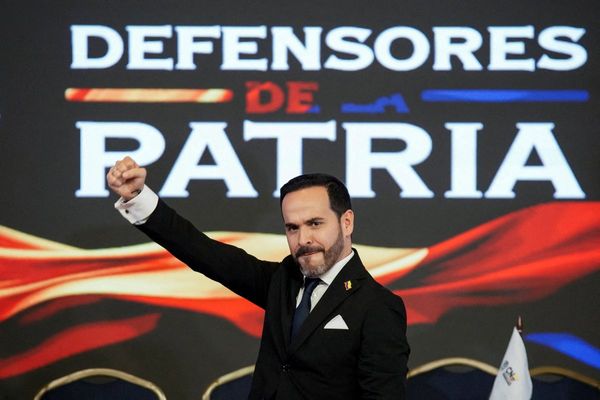
Colombia's president-elect, Abelardo de la Espriella, announced that he has ordered the immediate suspension of his transition team's work with the outgoing administration of President Gustavo Petro, escalating an already unprecedented constitutional and political crisis just one month before the scheduled transfer of power.
In a statement posted on X, De la Espriella said he had instructed Vice President-elect José Manuel Restrepo, who leads the transition process, to immediately stop the handover with what he called the "corrupt government" that is completing its term.
"I have just instructed the vice president-elect of the Republic to immediately suspend the transition process with the corrupt government that is ending its term, a government that, through its decisions and conduct, intends to destroy Colombia," De la Espriella wrote this Tuesday.
He added that his "duty is to protect the interests of the nation and guarantee a serious, transparent transition in the service of Colombians, never to legitimize disaster or the disregard of the constitutional order."
Acabo de darle instrucciones al señor vicepresidente electo de la República para que suspenda de manera inmediata el proceso de empalme con el gobierno corrupto que termina su periodo, un gobierno que, con sus decisiones y su conducta, pretende destruir a Colombia.
— Abelardo De La Espriella (@ABDELAESPRIELLA) July 7, 2026
Mi deber es…
The president-elect said he would address the nation later to explain the reasons behind the decision and announce additional measures.
The move represents a dramatic reversal. Only days ago, both administrations had formally launched the transition process, with Restrepo heading a team of roughly 1,300 people working with Petro's government to prepare for the Aug. 7 inauguration. Even then, the transition was already considered unusual because Petro and De la Espriella had declined to meet face-to-face.
Petro has repeatedly refused to recognize the legitimacy of the June 21 presidential election, alleging widespread fraud and continuing to refer to defeated leftist candidate Iván Cepeda as Colombia's legitimate president. Petro and his allies have also supported legal challenges seeking to nullify the election and have called for public demonstrations against the results.
Algunos loquitos hablan de desobediencia civil, que no es otra cosa que primeras líneas, bloqueos y terrorismo urbano.
— Abelardo De La Espriella (@ABDELAESPRIELLA) July 6, 2026
¡Yo propongo obediencia a la Constitución! Que la Carta Magna sea nuestra guía para sacar adelante al país.
La ley y el imperio de la ley.
Firme por la… pic.twitter.com/9lStPeWqIT
For his part, De la Espriella has accused Petro's administration of attempting to undermine the constitutional transfer of power. Over the weekend, the president-elect claimed his anti-corruption transition committee had uncovered "hundreds of irregularities" within the outgoing government and said teams of lawyers were preparing criminal, fiscal and disciplinary complaints against officials.
The confrontation has fueled concerns about Colombia's institutional stability as the country approaches the constitutionally mandated inauguration date.
Despite the political turmoil, Colombia's electoral authorities formally proclaimed De la Espriella president-elect after he narrowly defeated Cepeda in the June runoff election. He is scheduled to assume office on Aug. 7 unless a court intervenes.
The constitutional dispute has expanded beyond allegations of electoral fraud. Cepeda has argued that De la Espriella should renounce his U.S. citizenship before taking office and has threatened a campaign of civil disobedience if his demands are not met, although legal experts have questioned the viability of those claims.
Meanwhile, De la Espriella has continued forming his incoming administration. On Monday, he named retired Major General Jorge Eduardo Mora as his defense minister, signaling a tougher security policy and a break from Petro's "Total Peace" negotiations with armed groups.
It remains unclear how suspending the transition process will affect preparations for the change of government. Colombia's transition teams typically coordinate the transfer of sensitive information, budget planning, national security briefings and ministry operations ahead of the presidential inauguration.