Since April, cooperation between Mexican authorities and U.S. law enforcement and intelligence agencies has become an increasingly sensitive topic for Mexican officials.
President Claudia Sheinbaum on July 10 blamed the administration of former President Felipe Calderón for "opening the door" to U.S. agencies operating on Mexican soil, arguing that her government has adopted a fundamentally different approach that limits foreign agents to intelligence-sharing roles unless explicitly authorized by Mexico's federal security cabinet.
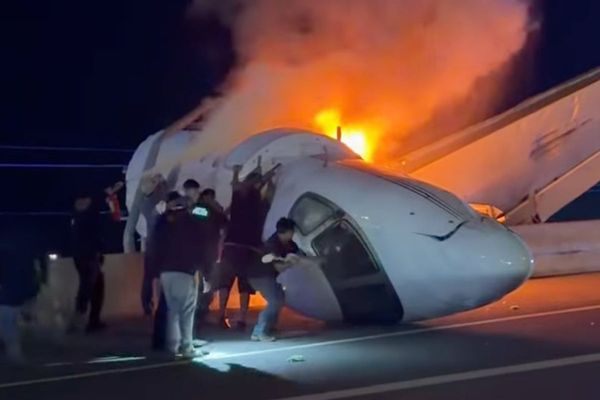
In April, a counternarcotics operation targeting a clandestine drug lab in the border state of Chihuahua led to the deaths of at least four people allegedly linked to U.S. agencies, including the CIA and the DEA. The incident fueled political tensions in Mexico, with Sheinbaum's administration repeatedly saying the bilateral security agreement with the United States limits foreign agents to intelligence-sharing roles rather than field operations on Mexican soil.
Since then, Sheinbaum has required state officials to report any cooperation with U.S. operations to the federal government.
"We have a different policy than the one Calderón had. Calderón opened the door to U.S. agencies to carry out intelligence, planning and operational activities in our country," Sheinbaum said, as reported by Infobae México. "In particular, this happened through the Navy during that administration and through the Public Security Ministry, which was headed by Genaro García Luna."
“Calderón abrió las puertas a las agencias estadounidenses”, señaló la presidenta @Claudiashein al recordar operativos como “Rápido y Furioso”, el cual violentó la soberanía y puso en riesgo al pueblo al permitir el ingreso ilegal de armas a México.
— Canal 22 México (@Canal22) July 10, 2026
La mandataria aseguró que la… pic.twitter.com/KbYovIs8xu
In the April case involving the alleged CIA and DEA agents, exactly how events unfolded remains unclear, raising questions within Sheinbaum's administration about how much state governments disclose to federal authorities regarding cooperation with U.S. agencies.
According to state prosecutor Wendy Paola Chávez Villanueva, who was appointed by Chihuahua Gov. María Eugenia Campos Galván to investigate the case, the agents' involvement was never reported to senior command or the State Investigation Agency. She said the only person who knew about their involvement was agency director Pedro Oseguera Cervantes, who also died in the crash alongside the U.S. agents.
Addressing the conflicting accounts surrounding the presence of the U.S. agents, journalist Ioan Grillo reported earlier this year that the discrepancies appeared to reflect an effort to downplay or conceal foreign involvement, which would be illegal under Mexican law if foreign agents participated on field operations.
"I think they want to hide it because, first, it's illegal, and second, it would be very convenient to say that the only person who knew is dead and can no longer be held accountable," Grillo said.
Speaking to reporters, Sheinbaum linked that case to the 2024 arrest of Sinaloa Cartel co-founder Ismael "El Mayo" Zambada, saying the circumstances surrounding the arrests also pointed to alleged foreign involvement that was never disclosed to the Mexican government when Zambada and Joaquín Guzmán López, one of the sons of Joaquín "El Chapo" Guzmán, were arrested.
She argued that the operation triggered an internal split within the Sinaloa Cartel that has fueled violence in the state ever since. According to Sheinbaum, the outcome would have been different had Mexican authorities been informed of the suspects' whereabouts because they would have carried out the arrests themselves.
Sheinbaum also said there was at least one contradiction in the accounts of how the two men were transported to the United States. On one hand, she cited a version claiming they arrived at the U.S. by chance. On the other, she noted that the FBI described the aircraft as part of its own operation, which she argued suggested direct U.S. involvement.