Two months before aviator Alberto Santos-Dumont made his 1901 flight around the Eiffel Tower in a homemade dirigible, his balloon lost hydrogen and crash landed, leaving the Brazilian-born aviator dangling from the side of the Trocadéro Hotel. It’s a scene artist Chris Burden might have emulated in one of his “danger pieces” of the 1970s, like the time he was shot by an assistant wielding a .22 caliber rifle in a Santa Ana gallery, or when he had himself crucified on a Volkswagen for a piece called Trans-fixed.
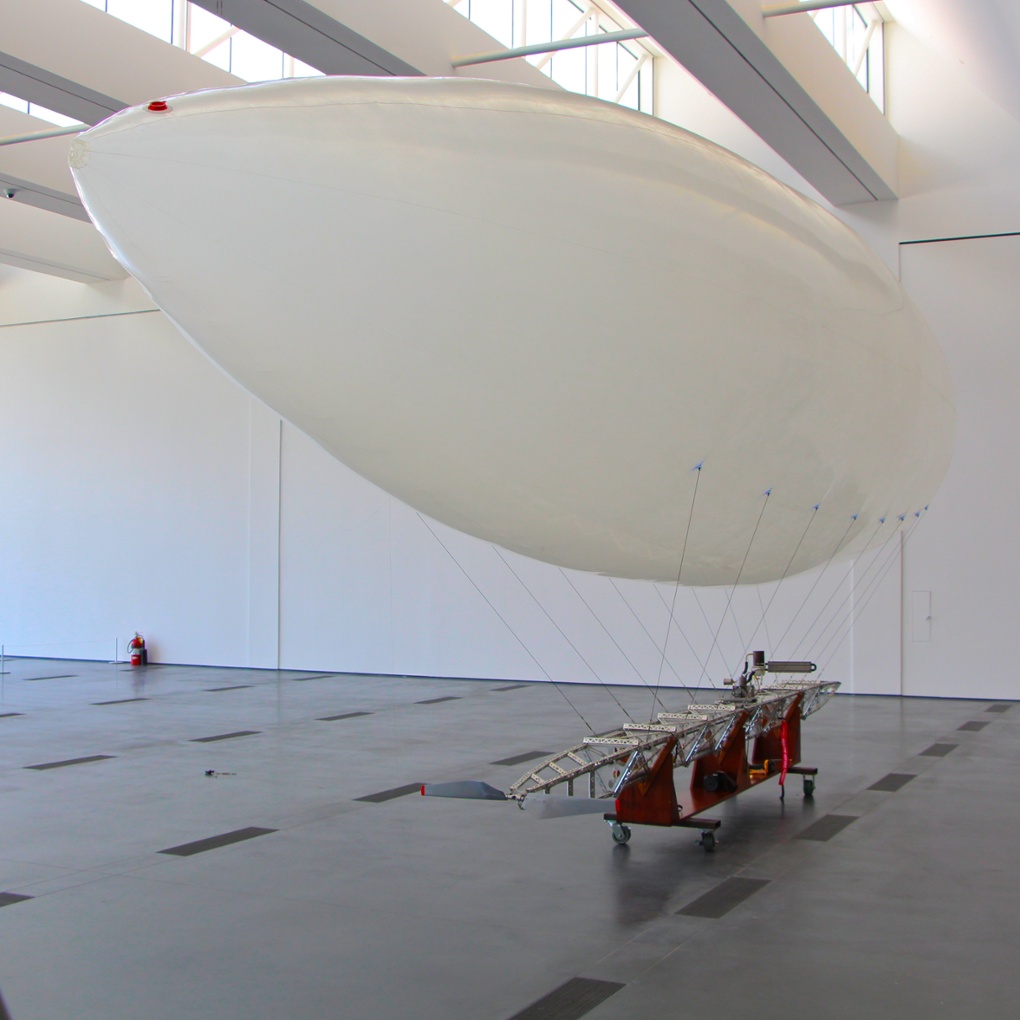
Burden died of melanoma at the age of 69 on 10 May in his Topanga Canyon home. His final piece, Ode to Santos Dumont, will take flight in 15-minute intervals inside the Renzo Piano-designed Resnick Pavilion at Los Angeles County Museum of Art until 21 June. A scale recreation of the dirigible used by Santos-Dumont, the new work is fitted with a custom-built quarter-scale 1903-style engine designed by collaborator, production designer John Biggs. The engine turns a fiberglass propeller and the spirit of Santos-Dumont ascends – a 40ft polyurethane dirigible with an aluminum gondola made from custom Erector Set parts.
“Santos-Dumont, the aviator, is kind of the artist, trying, failing, thinking, figuring it out,” is how museum director, Michael Govan, interprets the new work. “That was the particular affinity Chris had for this character. Santos-Dumont is a character who fails and then tries again.”
Burden came up with the idea in 2002, at which time he planned to build a replica of the Eiffel Tower for the dirigible to circle. When hired, Biggs, a movie veteran, welcomed the change of pace from places like Jim Henson’s Creature Shop, the visual effects company where he usually works. When he completed the engine for Ode, he submitted his invoice to learn they had only finished the first phase. “This is a journey,” Burden told him. “We’re on a path, that concept of walking and seeing a beautiful flower, and really absorbing that in the moment – it’s just that sense of exploration and wonder.”
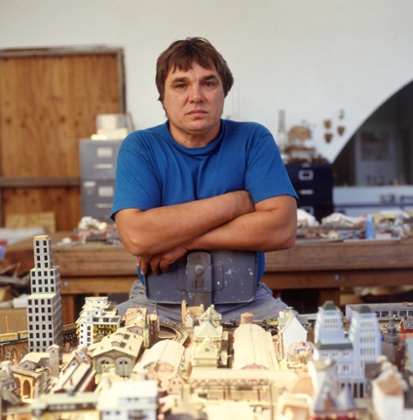
Burden began his career with his 1971 graduate thesis, Locker, in which he remained tucked inside a school locker to comment on the restrictions of institutionalized education. The same year, he performed Shoot, a piece that starkly illustrated the violence of the Vietnam war. Dead Man followed a year later, when he lay out in the street in front of Mazuno gallery on La Cienega Boulevard with only flares to protect him from unsuspecting motorists.
“He liked testing his own mortality,” says fellow LA artist Ed Moses. “I heard when he was a student in Pomona, he used to ride around on an old motorcycle, trying to get cops to chase him. Then he’d turn out the lights and go as fast as he could down alleys and all around.”
As the 70s came to an end, Burdened turned toward sculpture, in his art replacing himself with kinetic objects. Erector sets became a staple of his work in pieces like What My Dad Gave Me, a 60ft toy skyscraper installed in Rockefeller Center in 2008, offering a sense of scale next to midtown Manhattan’s real thing. Erector sets are also featured prominently in LACMA’s Metropolis II, a model city with toy cars careening through its streets, as well as the undercarriage of Ode to Santos Dumont.
“It’s right in the middle of his last two decades of work,” Govan says of the new piece. “It’s kinetic, it’s in motion. What’s very different about it is the immense lightness.”
If there’s an opposite to Ode to Santos Dumont, it would have to be 2006’s Flying Steamroller, in which a steamroller is tethered and counterweighted, then driven in a circle at speeds fast enough to lift it off the ground.
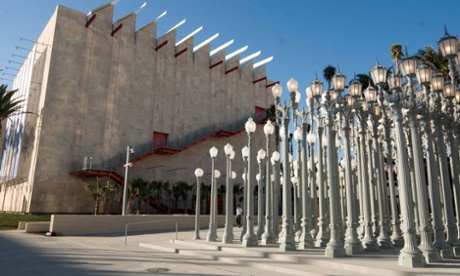
“This idea that things perform and art is not static, even Urban Light turns on and turns off,” Govan says, referring to Burden’s most famous piece in his home city, a series of 202 antique street lamps that fill the museum’s southern courtyard. It forms a potent counterbalance to Michael Heizer’s Levitated Mass, a rustic boulder occupying the museum’s north campus. Together, they comment on the city’s urban rusticity.
It was early winter by the time Ode to Santos Dumont made its maiden voyage in a hangar in Camarillo. “That’s great news,” Burden told Biggs over the phone from Los Angeles. “Sadly, the whole cancer thing, if he had been in a healthy state, I think he would have been there for the first flight,” recalls Biggs. “It was December. That’s when we all heard the news.”
“Chris Burden was very central to the art of our time. I was around the fringes. Same thing with Ed,” sculptor George Herms says about himself and Ed Moses, who adds, “He was a phenomenal person outside of being an artist. I always had a great time with Chris because he didn’t play like anybody else. He had his own way.”
Burden was relatively young when he died. But those who knew him, couldn’t imagine him dying. “I really thought Chris is a tough dude,” says Biggs, wiping away a tear. “Crawled through glass, locked himself in a locker. I was like, He’s going to beat that. He’s going to beat it, and come back with a vengeance. And then I got the phone call, and that was that.”
“He had such a powerful life force flowing through him,” adds Herms. “One doesn’t think of it ever ending.”