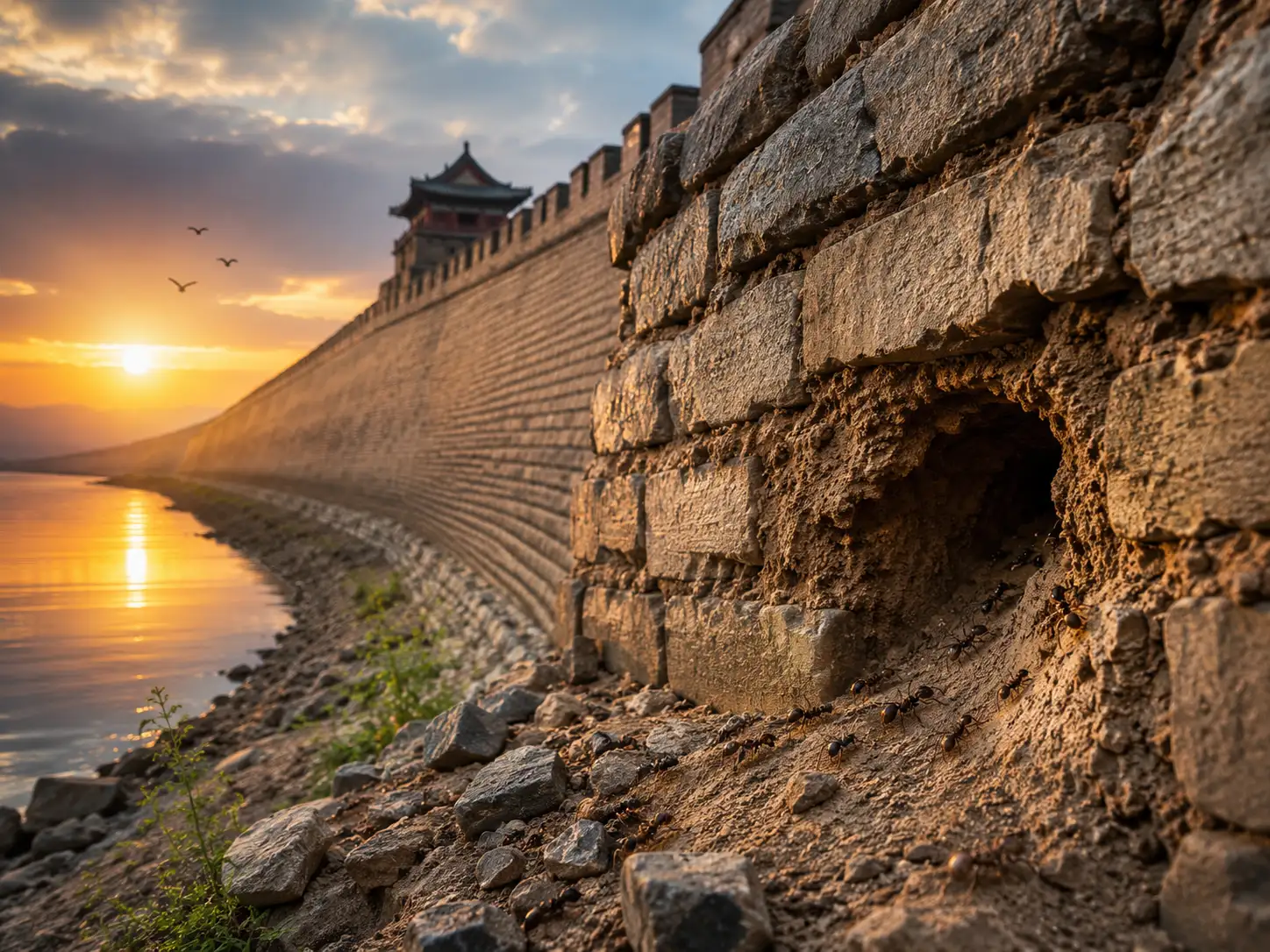
There is a Chinese proverb that has quietly outlived every empire it ever warned about. "An embankment a thousand miles long can be destroyed by an ant's nest." It is not a dramatic warning. It does not arrive with thunder. That, of course, is the entire point. The ant's nest does not announce itself. It does not send a signal before the wall comes down. It simply grows, quietly and invisibly, inside the very structure that everyone believed was permanent.
Most people who read this proverb nod along and move on. They picture floods, dynasties, great wars. They do not picture their own inbox, their own morning habits, their own small compromises. But they should. Because this ancient Chinese wisdom is not a history lesson. It is a mirror.
The proverb belongs to a tradition of Chinese thought that understood something Western philosophy took centuries longer to articulate — that strength does not fail at its edges. It fails at its core, through the slow accumulation of what seems harmless. A thousand-mile embankment is an extraordinary feat of human will. It holds back rivers, protects cities, sustains generations. And yet one neglected nest, one hollow inch, one overlooked crack is enough. Not eventually. Absolutely.
This is the hidden secret behind every major failure in human history. Not the storm. The ant.
Chinese Proverb of the Day: How Tiny Unnoticed Mistakes Quietly Hollow Out Strong Foundations
The Roman Empire did not fall because of the Visigoths. Historians who dig past the surface find something far more uncomfortable — decades of currency debasement, civic disengagement, leaders who confused ceremony for governance.
Each individual decision seemed survivable. Reducing the silver content of a coin by a few percent. Skipping a border inspection. Postponing a repair to the aqueduct. Small things. Reasonable delays. Sensible compromises. And then one morning, a thousand-mile embankment is hollow all the way through.
The Chinese understood this long before Rome fell. The great Han dynasty did not collapse under invasion alone — it collapsed because governors had quietly grown wealthy on tax fraud, because military inspection had become performative, because the people who were supposed to notice the ant's nests had learned it was safer not to look. Neglect, when it becomes institutional, becomes fate.
"The ant does not know it is dismantling an empire. It is simply doing what ants do — one grain at a time, one tunnel at a time, in the dark."
This is what makes tiny mistakes so lethal. They are not experienced as mistakes at all. They feel like efficiency. Like pragmatism. Like choosing your battles. A leader who stops holding people accountable on small things tells themselves they are saving energy for the important fights. They do not realize that the small things were the important fights. The ant's nest grows precisely in the space that no one bothered to protect.
Why the Strongest Empires and Careers Fall from Within — Not from Outside Forces
Ask anyone who has watched a business collapse from the inside. They will not point to the market crash or the competitor who outmaneuvered them. They will remember the meeting where honesty was subtly discouraged. The quarter where shipping fast mattered more than shipping well. The morning the founder stopped walking the floor. These are not dramatic moments. There is no scene in the film, no turning point you can circulate in a post-mortem presentation. There is only the slow, invisible work of the nest.
The same pattern appears in personal life with remarkable regularity. A marriage does not end because of one fight. It ends because of a thousand small withdrawals — a dismissive comment left unchallenged, a vulnerable moment met with distraction, a gradual drift that no single day could account for.
The embankment was not destroyed by a flood. It was destroyed by all the mornings someone walked past the wall and told themselves the crack was not worth mentioning yet.
This is the lesson Western culture finds hardest to absorb. We are trained to scan the horizon for threats. We build early-warning systems for visible danger. We celebrate dramatic interventions and crisis management.
But the Chinese proverb about the ant's nest inverts the entire framework. The threat is not on the horizon. The threat is already inside the wall, working in silence, and it will keep working until someone chooses to look closely at something ordinary.
What Ancient Chinese Wisdom Reveals That Modern Leadership Books Miss
There is a booming industry of leadership literature built around vision, disruption, and bold moves. It is not wrong, exactly. But it is incomplete. Because none of it teaches what Chinese wisdom encoded thousands of years ago — that the quality of a civilization, a company, or a life is determined not by its grandest moments but by what it does when nothing important seems to be happening.
The ant's nest grows during peacetime. During prosperity. During the long, ordinary stretches when vigilance feels unnecessary.
The Tang dynasty had a concept called jian wei — governance of the subtle. The idea was that a wise ruler attends to small disturbances before they become large ones, precisely because large ones are often irreversible. A crack in the embankment is fixable. A collapsed embankment is a catastrophe requiring generations to address. The cost of early attention is almost nothing. The cost of late attention is everything.
"Every great failure has a long rehearsal. The collapse itself is only the final performance of a drama that began quietly, in the ordinary hours, when no one thought the stakes were high."
This is what modern leadership culture consistently undervalues. The brilliant strategy, the bold pivot, the visionary product — none of it holds if the small disciplines have been allowed to erode. The thousand-mile embankment is only as strong as the mile nobody visited last month. The ant does not respect your quarterly earnings report.
How to Walk the Embankment — Before the Ant's Nest Becomes Irreversible
There is a practice that ancient Chinese engineers reportedly followed — walking the full length of a flood embankment after every significant rainfall, not to check for catastrophic damage, but to look for small signs. Soft ground. A subtle depression in the surface. A patch of grass that had died for no obvious reason. These were not dramatic warnings. They were whispers. And the engineer's entire value lay in knowing how to listen to them.
This is the practice the proverb is really teaching. Not fear of ants. Not paranoia about small things. But a disciplined, unhurried habit of attention — the willingness to walk the full length of what you are responsible for, looking not for the catastrophe but for its quiet predecessor.
In a team, that might mean listening carefully to the person who seems slightly less engaged than last month. In a relationship, it might mean naming the small distance before it becomes a canyon. In one's own inner life, it might mean noticing the compromises that have quietly become habits.
The proverb does not promise that walking the embankment will prevent all collapse. Life is not that tidy. But it does promise something more valuable — that collapse, when it comes, will not come as a surprise. And that most of the collapses that destroy otherwise extraordinary things could have been met, a hundred quiet mornings earlier, with nothing more than honest attention and a willingness to act on what you find.
The ant's nest is real. The thousand-mile embankment is real. And somewhere between them is the only question that matters — how carefully are you walking yours?