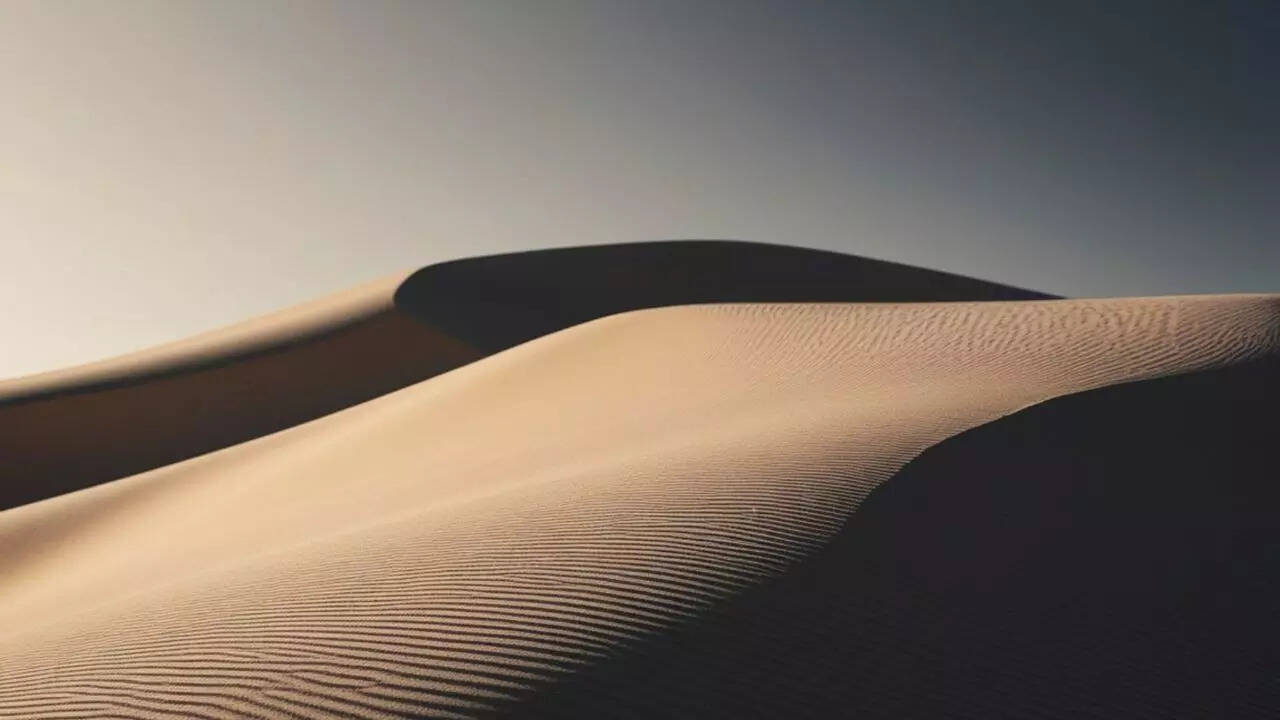
Deserts are usually described as silent places, which is why the sound catches people off guard. In parts of China, visitors have reported dunes that hum, boom, or whistle when wind passes over them or when someone slides down their slopes. Over the past decade, these “singing dunes” have drawn renewed attention, partly because of tourism and partly because researchers have made progress explaining how sand, air, and landscape work together to produce sound.
What matters here is how rare singing dunes are. Most deserts never do this. Even neighbouring dunes can remain silent while one ridge seems to respond like an instrument. That selectiveness is what keeps scientists interested and travellers curious, especially along China’s historic desert routes.
Why do dunes sing in China desert
As per a study titled “Progress on research and mitigation of wind-blown sand risk in Dunhuang Singing Sand Mountain and Crescent Spring Scenic area, China”, singing dunes are made up of grains sliding past one another. When that happens, they vibrate, and the dune helps amplify the low-frequency waves. These grains are unusually uniform in size and smoothness. This allows them to slide together in coordinated layers instead of colliding randomly. When movement happens evenly across a slope, vibration becomes possible. With the help of steady airflow that pushes grains into synchronised motion, these sand grains seem to sing.
Why are these singing dunes important
Singing dunes are more than a curiosity. They offer insight into how granular materials behave under stress, something that matters far beyond deserts. Understanding how sand grains synchronise informs research across fields ranging from geology to industrial material handling.
Where can you find these singing deserts
Singing dunes are scattered across arid regions rather than concentrated in one place. But the place that attracts most of the tourists in China is Duahuang. The dunes vary widely in height and shape and are around 500m. The climate there is dry, vegetation is sparse, and winds arrive with enough consistency to move sand without saturating it.
What to do in these singing deserts
Such singing deserts are very popular among tourists, and activities like sandboarding or guided walks are often done. Observation platforms are also available, which allow people to listen without disturbing sensitive areas. Night visits are especially popular, since cooler air and reduced background noise allow sound to travel farther.
People have become cautious regarding excessive foot traffic and vehicles, as these can disrupt the grain structure. Once that balance is lost, the dune may fall silent.
Are there any other singing deserts
As cited in EarthDate, apart from these deserts that sing in China, there are around three dozen places on Earth where dunes sing. They can be found in Nevada, Chile, Morocco and even India. You can visit these places and experience this wonder yourself. Factors like grain size, humidity, and wind play a key role in creating this rare natural phenomenon.