
/The%20Cerebras%20logo%20on%20a%20smartphone%20and%20computer%20screen%20by%20Timon%20via%20Adobe%20Stock.jpeg)
Instead of cutting a silicon wafer into hundreds of small chips, and then attempting to tie them together with slow wires, Cerebras (CBRS) leaves the wafer whole. The result is a single gigantic chip.
The main question for Cerebras Systems ahead of its IPO on May 14 was whether Wall Street would accept such an unusual technology. A technology, which, as the company claims, is capable of eliminating the delays of physical transmission of data between chips, simply because its product launches neural networks on a single silicon brain the size of a dinner plate.
The market gave us its answer. Cerebras priced its IPO $185 and opened trading at a whopping $350, even hitting highs above $380 on the day.
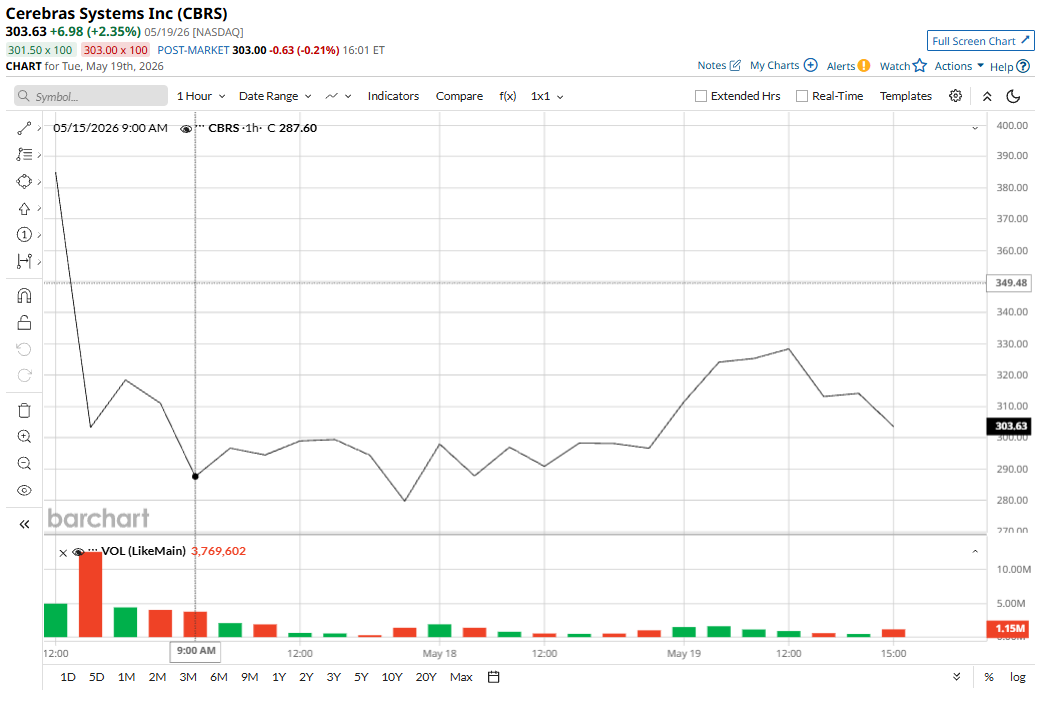
The very mechanics of this debut clearly show, in my view, that institutional investors, most likely, were not guided by the company’s current financials. Let us look at the numbers for a minute. For the full year 2025, Cerebras’ revenue was around $510 million, and net profit was around $87.9 million. This is an excellent result for a young developing company.
But are these metrics enough to justify a capitalization of nearly $100 billion?
Hardly.
These institutional investors were instead clearly valuing the company’s future plans and its unique technology. After a staggering 20-time oversubscription brought the final price of the IPO to a highly aggressive $185 for a share, the floodgates literally opened. Trading started on a breathtaking level of $350. A further powerful intraday impulse propelled the stock to a peak of $385. This brought the valuation of the company, by some calculations, closer to the threshold of $100 billion in the course of a highly impressive demonstration of momentum trading.
On Friday followed a wave of profit-taking. It dropped the shares to the level of $280. Nevertheless, I suppose, this initial technical correction does not strongly change the key reality of the debut. The market possibly confirmed one base premise: when a fundamental paradigm shift emerges, investors often quite willingly throw away traditional metrics, attempting to value the very scale of the approaching breakthrough.
Vision vs. Numbers
When the industry collides with what very much looks like a true structural evolution, classic financial formulas like price-sales or price-earnings often become outdated. After all, they were initially created for the measurement of gradual growth within the framework of an established system. Absolutely not for the valuation companies that refuse to participate in the status quo.
It seems to me important to note that Cerebras does not offer some gradual raising of efficiency by 10%. Its main value proposition is, in essence, the physical elimination of the bottleneck of interconnect — the transmission of data between separate chips — from which traditional GPU clusters suffer so strongly.
Consequently, the current gigantic valuation is provided largely by a certain extraordinary vote of confidence generously given out by Wall Street. I think it is possible to boldly call this an investment into unexplored territories.
But what exactly is the essence of this trust? Why is the market generally ready to pay so much money for Cerebras?
It seems to me that the answer hides in the very core of its innovation. Those who are aggressively buying CBRS stock are only valuing potential. This is a pure bet that the technology of a huge chip really has a real chance to become a full-fledged competitor to graphic processors from Nvidia (NVDA) and Advanced Micro Devices (AMD). If this non-standard architecture proves its efficiency in the long run, a gigantic market will simply open before Cerebras. A market which is calculated by tens and even hundreds of billions of dollars.
Here it is extremely important to make an important caveat. This vote of confidence hardly demands immediate, explosive indicators of revenue in the next one or two quarters. Experienced institutional investors perfectly understand that semiconductor supply chains move slowly. The processes of booking advanced capacities and deploying multi-ton server racks in data centers take long months. The nearest financial reports will most likely not yet reflect multibillion-dollar obligations from large partners such as OpenAI.
And it is fully probable that this vote of confidence can grow and push the shares further. In the next few months, I would expect that shares will trade on news related to Cerebras’ CSoft proprietary stack and how seamlessly clients can integrate it. Announcements about secondary and tertiary commercial contracts outside of key anchor clients can also strongly influence the stock price. We should not forget about technical cases, which are obliged to prove that these massive wafers are capable of working uninterruptedly and without serious architectural failures.
If the software works smoothly and new corporate buyers appear, the market will possibly constantly prolong this vote of confidence. This can push the valuation forward long before real cash flows conclusively reflect themselves in the balance.
How Does Cerebras Stack Up Against Nvidia?
To at least try and understand whether the current valuation of Cerebras IPO represents a regular bloated bubble or a rare opportunity, we probably need to rely on non-standard logic. We need that same logic to value the whole AI infrastructure ecosystem.
As I see it, as of mid-2026, the market already formed a colossal base valuation for AI equipment. Nvidia possesses a market capitalization fluctuating around $5.3 trillion. AMD, which is successfully positioning itself as the main alternative force, trades near $700 billion. If we add these figures together, the market value of these two main suppliers of silicon for AI constitutes an astronomical $6 trillion. Such is, by essence, the financial weight of the current computing capacities of our planet.
Now let’s try to apply that same math to Cerebras.
Following its debut, its market cap is fluctuating between $80 billion and $85 billion. In comparison with the huge pool of $6 trillion, this means only one thing: Wall Street currently values the breakthrough potential of Wafer-Scale Engine at 1.4%-1.5% of the general target market.
The architecture of Cerebras will prove its operational stability over the next several years. Let us imagine that it successfully will take at least 5% of the market from traditional GPU systems. In such a case, its fair valuation can mathematically go to $300 billion. If we look through this lens, then the company, which right now is valued at less than 1.5% of its competitive market, by no means seems expensive. Rather, it remains an extremely asymmetric bet on long-term expansion.
How much does unrealized potential cost?
At the base of the current market discussion around Cerebras, I think, lies a quite deep conceptual dead end. The modern financial world, armed with complex algorithms and models of discounted cash flows, collided with an object, which it is extremely hard — and maybe completely impossible — to measure by a standard ruler. There is simply no formula in classic economics textbooks capable of calculating the fair value of a yet unrealized innovation.
Usually, when an investor buys a share in a mature company, he buys its past and present: cash flows, margins, and a predictable trajectory. But when capital enters an asset of the scale of Cerebras, it buys, by and large, the future. Investors are purchasing a concept. A concept which could rewrite the whole industry.
The future trajectory of CBRS shares will depend on whether a critical mass of managers of large funds believes that monolithic silicon is really the path of development of AI. The price of this idea fluctuates right now together with the order book. And its true value is hardly possible to calculate with mathematical exactness.
The Game Is Worth the Risk
However, I suppose, we should not forget about the flip side. A single 20-centimeter silicon wafer is an incredibly brave step from the point of view of physics and production. And exactly this exceptionality hides the main risk. Since nobody in the world produces commercial chips of such format except Cerebras, nobody can give investors a 100% guarantee that they work in all conditions. High tech, as a rule, does not forgive mistakes. If in the process of long-term exploitation or massive deployment in data centers some hidden architectural defects or software failures suddenly uncover themselves, client trust will be destroyed.
And all the same, I am inclined to suppose that this game, most likely, is worth the risk. Investors considering Cerebras now do not need to worry about exact fundamental analysis. They just need to decide if they believe in the innovation it is selling.
If the answer is “yes,” then the current 1.4%-1.5% market share Cerebras could grab shows that CBRS is not yet fairly valued.
This is a potentially unique, highly asymmetric window of possibility for an entry into an asset, which could become the new standard of the industry. The risks here are unconditionally huge. And the vote of confidence, so generously given out by the market, will take a long and heavy time to work off. But for those who are ready to play the long game and bet on a fundamental paradigm shift, Cerebras offers perhaps the most intriguing option right now.