In the summer of 2012, Celtic’s board of directors found themselves in an invidious position, and through no fault whatsoever of their own. The debate surrounding which tier of Scottish football Rangers should restart football affairs after liquidation was frenzied in nature. Celtic’s supporters, and to be fair most others in the country, were noisily adamant Rangers should be placed in Division Three. An attempt by the Scottish Premier League to parachute the Ibrox club in at a higher level was understandably rejected. Still, bad feeling over that affair and the actions of the game’s administrators has never really disappeared.
Celtic kept their powder dry before eventually admitting they had voted against a top-flight Rangers proposal in order to protect “the integrity of the game”. Peter Lawwell, Celtic’s chief executive, had spoken earlier in the year of a standalone financial strategy. “We look after ourselves,” Lawwell added. “We don’t need any other club.”
In the context of the Old Firm, there is clear evidence which contradicts that sentiment. Lawwell may even have realised that at the time, while for obvious reasons being unable to say so in public. By last August, the chief executive was estimating that Rangers’ absence from the top flight was costing Celtic £10m a season. Scottish football has a tedious league set-up which is entirely predicated on the earlier insistence from television companies of four Old Firm fixtures a season, a laughable scenario in many ways yet an unfortunate, telling reality.
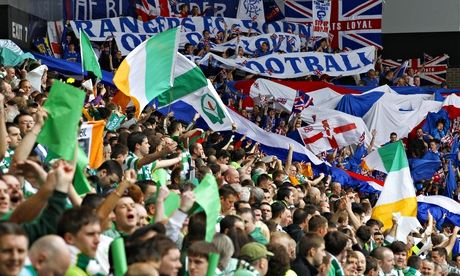
When Rangers and Celtic are reunited at Hampden Park on Sunday, it will be a one-off occasion and probably not particularly pleasant. In a simple footballing sense, it is debatable whether there has ever been a bigger chasm between them; the disparity in ability does not exist because Celtic have a wonderful team, rather because Rangers are so poor. A comfortable victory for either side, let alone after almost three years of waiting, is never the preferable scenario for those public servants who have to handle Old Firm fallout.
How the Celtic support has revelled in Rangers’ demise, as they are perfectly entitled to do. During the days of Rangers’ lavish, occasionally reckless, spending, it was Celtic who were made to suffer the most. When days of reckoning arrived at Ibrox, wild celebration on the other side of Glasgow was as inevitable as it was natural.
But at what cost? The Old Firm were so named for good reason: they have a commercial and competitive use to each other which has spanned footballing ages. When one half topples as spectacularly as has been the case at Rangers over the past three years, not every knock-on effect for the other can be positive. The bitterness which now exists among the Rangers support is towards those controlling their own club but a heavy defeat to Celtic will never go down well.
Celtic continue to sell more than 40,000 season tickets but a significant proportion of that number see no reason to turn out for run-of-the-mill league games. The simple explanation for that resonates in the lack of any credible challenge to Celtic’s league dominance. Another, although Lawwell and his colleagues would vehemently dispute it, is the sense that Rangers’ removal from prominence has allowed complacency or lack of ambition to creep in at Celtic.
When the Old Firm went head to head for championships, fans were excited and engaged, if partly through the fear of losing out to the opponent who hurt them most. Celtic’s supporters remain as obsessed with Rangers as ever – and vice versa – but the fact they ply their trade in different leagues offers no logical focal point for this feeling. Which makes a lot of the discussion pretty tiresome.
Neil Lennon had been steeped in Celtic since childhood. He left as the club’s manager last summer of his own volition. I put it to the Northern Irishman at the time that he could have hung around in an attempt to become the first Celtic manager to win 10 titles in succession. “And what would you get for that?” he replied. “A small pat on the back. A ‘well done.’” That answer owed everything to the context of such an achievement.
When Lennon departed, a lack of appetite for the remaining challenge was a crucial factor. “You missed the challenge week in, week out,” he said last week. “When you’re so far ahead, you don’t get the credit that you would normally get. That’s understandable, it’s just the reality of it.
“You used to look for the Rangers result every week with your heart in your mouth, and the Rangers fans would be the same. If they kicked off at half past 12 and they won, you knew you had to win at three o’clock and vice versa. There’s no question it [Rangers’ problems] has had a big impact on the state of Scottish football now.”
There is, though, an alternative narrative. That is, Celtic have been allowed breathing space outside a typically claustrophobic Old Firm environment. Players and coaches have a more comfortable backdrop in which to develop; Celtic have been highly successful in selling Victor Wanyama, Fraser Forster and Gary Hooper for sizeable fees. The absence of Rangers played no negative role whatsoever in that.
The rivalry historically defines these clubs. Darren O’Dea, who joined Celtic as a teenager and scored a crucial goal against Rangers in the 2009 League Cup final at a time when the sides were neck and neck in pursuit of honours, recalls that much. “I remember as a 16-year-old youth team player, being undefeated in a league campaign but being told before an Old Firm game that nothing else mattered,” he said. “That game was what you were judged on and that went right through the playing system. You could have eight wins in a row but if the ninth was an Old Firm game, that would be the one people remembered.
“It was also the case that for a long time the league was a close, two-horse race anyway. So the result that could impact the most on whether you won the league or not was against Rangers. That just intensified the rivalry; if you lost, you had also given your biggest rival a big advantage.”
But what happens when that challenge vanishes? “Celtic have got on with things,” O’Dea added. “They have still had a lot of fantastic games, they have still won a lot, been in the Champions League and got to the last 16 there. So you can’t really say the players have lacked motivation. They have more than coped.
“But whether people admit it or not, the one game people recognise outside of Scotland is an Old Firm game. I have seen that; whether in Toronto, Ukraine or England, all people want to talk about is Celtic and Rangers. All people want to ask about is what it was like to play in that fixture.
“ Rangers and Celtic together have that global reach. People are excited by the rivalry; this weekend, the whole world will watch.”
That much is unquestionable. Open to far more debate is whether it is productive, mutually beneficial or otherwise for the Old Firm’s separation to continue.