
In a July 3 letter to his wife, Abigail, John Adams wrote that the day the Continental Congress voted to approve America’s Declaration of Independence (July 2) would be “the most memorable Epocha, in the History of America.”
“It ought to be solemnized with Pomp and Parade, with Shews, Games, Sports, Guns, Bells, Bonfires and Illuminations from one End of this Continent to the other from this Time forward forever more.”
For 250 years, America has done exactly that, celebrating not only our Independence, but also rededicating ourselves to the American experiment in self-governance.
Understanding how our system of government works is essential to that experiment’s ultimate success. That’s why, every month this year, Ballotpedia is exploring the mechanics of our political system, and the practical applications of governance in our series, The Blueprints of Democracy.
Each month, we will discuss what makes American democracy work. Here are the topics we’ve written about so far:
- February 2026: Ground Floor
- March 2026: The Primary System
- April 2026: Ballot Access
- May 2026: Redistricting
- June 2026: State and Federal Courts
Almost 50 years after Adams wrote his letter at the dawn of America, Thomas Jefferson, the author of the Declaration of Independence, wrote a letter to Washington, D.C. Mayor Roger Weightman declining an invitation to gather at a celebratory dinner with the remaining signers of that document (he died on July 4, 1826, the same day as Adams). But Jefferson also wrote that the Declaration remained a powerful testament to the rights of man, and “the blessings and security of self-government.”
We hope you and yours have a joyous Independence Day, and as part of your celebrations, you join us in exploring what truly makes our system of government so special. Visit and bookmark our Blueprints of Democracy page to follow along all year.
U.S. Supreme Court agrees to review Arizona's documentary proof of citizenship and noncitizen voter removal laws
On June 29, the U.S. Supreme Court announced that it would hear Republican National Committee v. Mi Familia Vota, a case disputing whether two Arizona laws requiring documentary proof of citizenship (DPOC) to register to vote in federal elections and requiring election officials to remove noncitizens from voter rolls violate the National Voter Registration Act (NVRA). Federal courts have blocked most of the challenged provisions from being enforced.
The NVRA requires 44 states, including Arizona, to accept a standardized registration form for federal elections and prohibits the systematic cancellation of voter registration within 90 days of an election, among other requirements. The other six states are exempt from the NVRA.
The questions presented to the court are as follows: "(1) Does the National Voter Registration Act or a federal consent decree prohibit Arizona from requiring voter-registration applicants to produce 'satisfactory evidence' of U.S. citizenship when registering with a state registration form?" and "(2) Does the National Voter Registration Act prohibit Arizona from implementing a program within 90 days of a federal election to cancel the registrations of voters who are not U.S. citizens?"
In 2022, Arizona Gov. Doug Ducey (R) signed HB 2492, a law requiring election officials to reject any voter registration application using the state-provided registration form if it was submitted without DPOC, such as a state driver’s license or ID card, a passport, a naturalization certificate, or a photocopy of a birth certificate. Under the law, anyone who did not provide DPOC when registering with a federal voter registration form and whose citizenship could not be verified using other data sources would only be registered to vote in federal elections.
Ducey also signed HB 2243 in 2022, a law requiring county recorders to conduct a monthly check of the Systematic Alien Verification for Entitlements program for individuals suspected to be noncitizens and to cancel the voter registration of any individual about whom they received information that the person was not a U.S. citizen. The law required the county recorder to notify the person by mail that their registration would be canceled if they did not provide DPOC within 35 days. It did not block these cancellations from occurring within the 90 days before the election.
After Ducey signed the bills, several nonprofit groups, the Democratic National Committee, and the U.S. Department of Justice under President Joe Biden (D) separately filed eight lawsuits in the U.S. District Court for the District of Arizona, alleging that the laws violated the NVRA.
Judge Susan Bolton consolidated the eight lawsuits and struck down the challenged provisions of the laws in 2023, holding that both laws violated the NVRA and that the DPOC requirement violated a 2018 consent decree from an earlier lawsuit. Republican lawmakers and the Republican National Committee appealed to the U.S. Court of Appeals for the Ninth Circuit.
In August 2024, while the case was pending in the Ninth Circuit, the Republican National Committee asked the Supreme Court to stay Bolton's rulings. The Supreme Court granted a partial stay, reinstating the provision of the law that required election officials to reject state voter registration forms submitted without DPOC.
In February 2025, a Ninth Circuit panel upheld Bolton's rulings that the laws violated the NVRA and the 2018 consent decree. "The DPOC requirement renders the state form not 'equivalent' to the federal form for applicants without DPOC," Judge Ronald Gould wrote. "That difference prevents the forms from being 'virtually identical' for applicants without DPOC, and the requirement of DPOC for state-form applicants violates Section 7 of the NVRA."
Gould also wrote, "We hold that H.B. 2243’s periodic cancellation of registrations violates the 90-day Provision of the NVRA to the extent that H.B. 2243 authorizes systematic cancellation of registrations within 90 days before a federal election."
The Ninth Circuit denied the state's request to rehear the case en banc.
In February 2026, the Republican National Committee, which intervened to defend the laws, appealed to the U.S. Supreme Court.
Attorneys for the RNC wrote, "The Ninth Circuit’s decision threatens States’ ability to protect the integrity of their elections. Arizona passed laws 'protecting the right of all citizens to vote, and … ensuring non-citizens do not vote.' … The Ninth Circuit’s decision striking those measures down 'undermines republican government, shreds federalism and the separation of powers, and imperils free and fair elections.'"
Lawyers for Mi Familia Vota and Voto Latino, two of the groups that challenged the laws, wrote that the Supreme Court should not take the case, as the "Ninth Circuit’s resolution of both questions presented was correct, did not conflict with any other circuit’s decisions, and does not implicate any other State’s law. There is no basis for the Court’s review."
The case marks the second time an Arizona DPOC law has been reviewed by the Supreme Court. In 2013, the court ruled that a previous law requiring DPOC to register to vote with the federal voter registration form violated federal law.
Twelve states — Alabama, Arizona, Florida, Georgia, Kansas, Louisiana, Mississippi, New Hampshire, Ohio, South Dakota, Utah, and Wyoming — have laws requiring DPOC to register to vote in at least some cases.
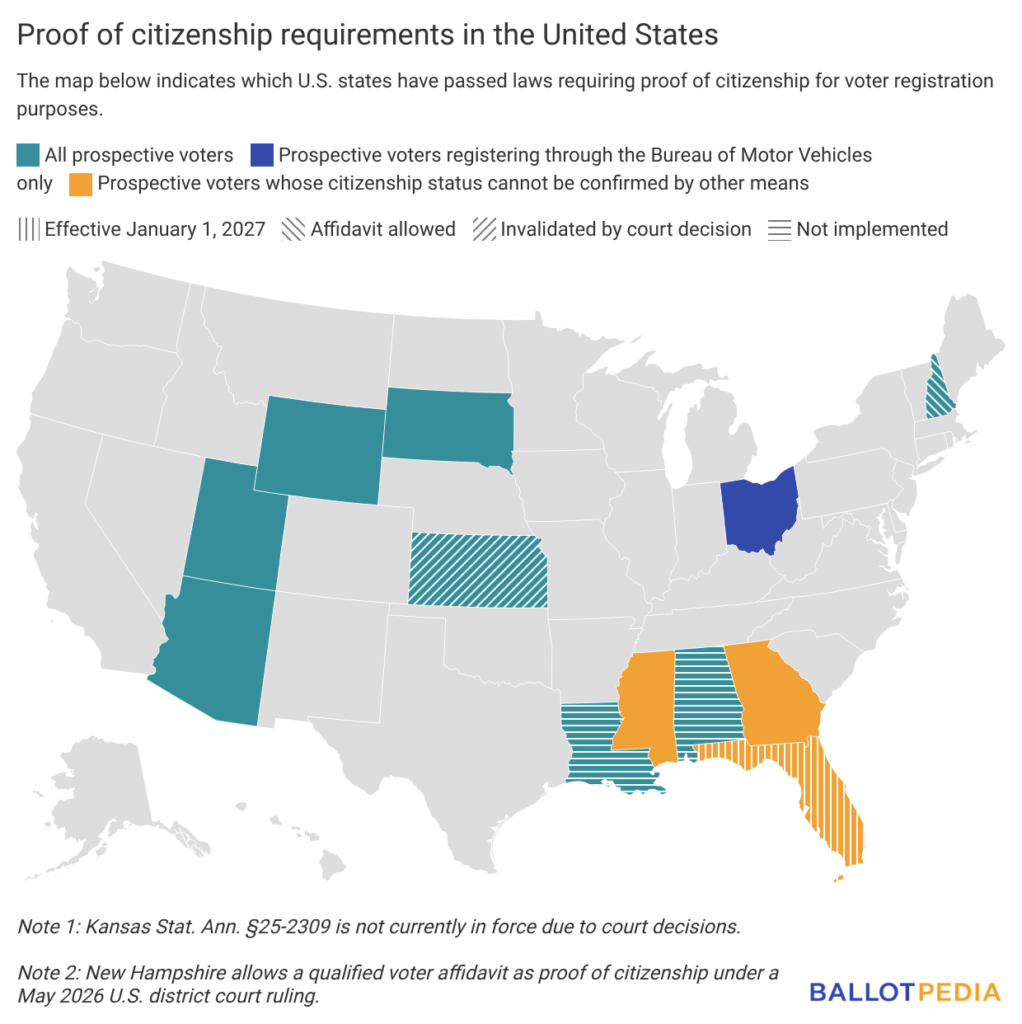
Alabama and Louisiana have not implemented their DPOC laws. A federal court blocked Kansas' DPOC law in 2018.
Arizona, South Dakota, and Utah allow individuals who do not provide DPOC to vote in federal elections only. New Hampshire and Wyoming are exempt from the NVRA and require all voters to provide DPOC to register to vote.
Three other states — Florida, Georgia, and Mississippi — require DPOC at the time of registration if a person's citizenship status cannot be confirmed by other means. Ohio requires DPOC when registering to vote at a Bureau of Motor Vehicles office.
So far this year, four states — Florida, Mississippi, South Dakota, and Utah — have enacted legislation creating or expanding a DPOC law.
Six states will decide on ballot measures on citizenship voting requirements this year, though none explicitly address DPOC. There are citizen initiative campaigns in an additional two states – Michigan and Washington – targeting the Nov. 3 ballot that would require DPOC.
Click here to read more about challenges to Arizona’s DPOC laws.
Seven states have candidate filing deadlines in the next two weeks
As many of us rest and relax for the July 4 Independence Day holiday, the coming weeks promise further opportunities for civic engagement.
For candidates seeking office, there are seven states with filing deadlines in the next two weeks. The map and bulleted list below show which states have candidate filing deadlines scheduled between July 4 and July 17.
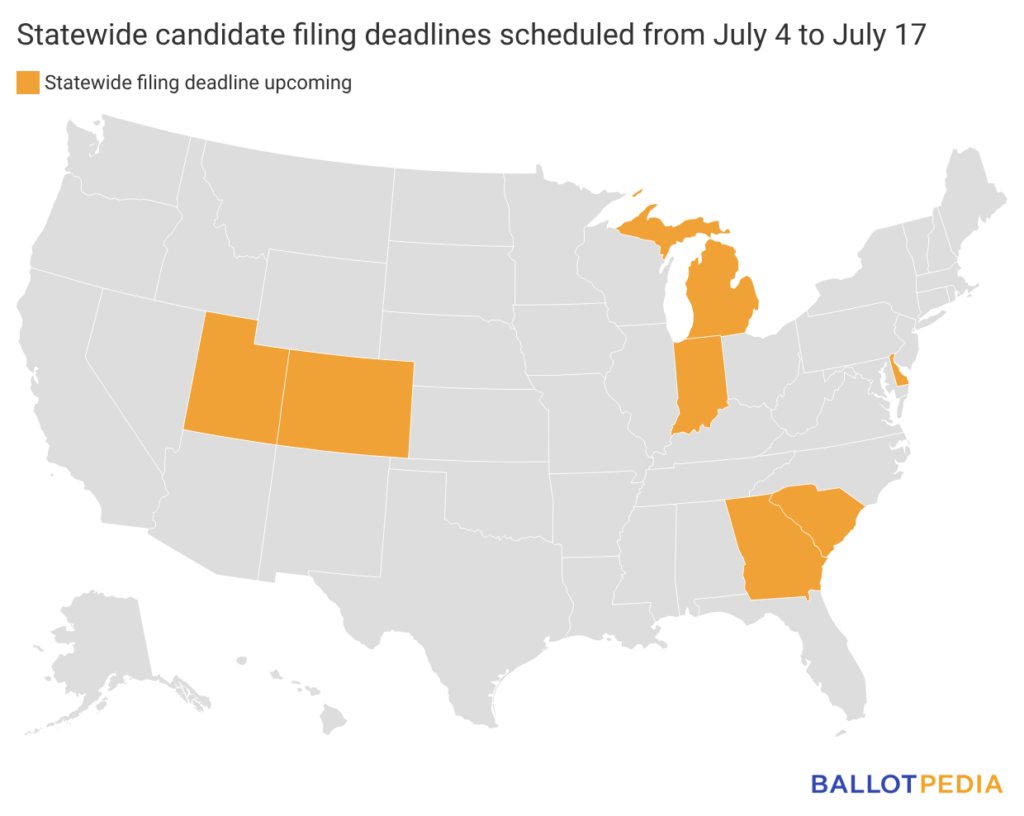
- Colorado : July 9 (statewide general unaffiliated candidate filing deadline)
- Colorado : July 16 (statewide general write-in candidate filing deadline)
- Delaware : July 14 (statewide primary candidate filing deadline)
- Georgia : July 14 (statewide unaffiliated and minor party candidate filing deadline)
- Indiana : July 6 (statewide write-in candidate filing deadline)
- Indiana : July 15 (statewide judicial retention candidate, unaffiliated, and minor party candidate filing deadline)
- Michigan : July 6 (statewide Supreme Court justice incumbent candidate filing deadline)
- Michigan : July 16 (statewide unaffiliated candidate filing deadline and non-incumbent or non-party affiliated Supreme Court Justice candidate filing deadline)
- South Carolina : July 15 (statewide unaffiliated filing deadline)
- Utah : July 15 (statewide judicial retention candidate filing deadline)
Looking Back
Three states had candidate filing deadlines in the past two weeks:
- Nevada : June 22 (statewide unaffiliated candidate filing deadline)
- New Mexico : June 25 (statewide general unaffiliated, minor party, write-in candidate, and judicial retention candidate filing deadline)
- Rhode Island : June 24 (statewide primary candidate and general unaffiliated candidate filing deadline)
Candidates must meet various state-specific filing requirements and deadlines to appear on primary and general election ballots. These regulations, known as ballot access laws, determine whether and how candidates can make it onto the ballot. These laws are set at the state level and apply to candidates running for state and federal offices.
Voting in upcoming elections
There are no statewide elections taking place in the next two weeks.
Voter participation deadlines
Three states and Guam have early voting periods that start in the next two weeks:
- Guam : Early voting begins July 7 for the Aug. 1 primary.
- Kansas : Early voting begins July 15 for the Aug. 4 primary.
- Tennessee : Early voting begins July 17 for the Aug. 6 primary.
- Washington : Early voting begins July 17 for the Aug. 4 primary.
Four states and Guam have voter registration deadlines in the next two weeks:
- Guam : July 17 is the last day to register to vote in person or online in the August 1 primary.
- Kansas : July 14 is the last day to register to vote in the Aug. 4 primary.
- Missouri : July 8 is the last day to register to vote in the Aug. 4 primary.
- South Dakota : July 13 is the last day to register to vote in person or by mail in the July 28 primary.
- Tennessee : July 7 is the last day to register to vote in the Aug. 6 primary.
One state has an absentee/mail-in ballot request deadline in the next two weeks:
- Arizona : July 10 is the last day to request an absentee/mail-in ballot for the July 21 primary.
Click here to see our list of upcoming election dates and filing deadlines.