Cruise line operator Carnival Corp. (NYSE: CCL) is down nearly 6% after it reported Q1 2026 earnings on March 27.
Investors seem to be concerned about the company’s earnings guidance for the coming year, despite Carnival’s double beat and bullish outlook for 2026 bookings.
Shares of cruise line stocks had been soaring in 2026 as the industry is experiencing smooth sailing with bookings at or near record levels.
Carnival's financial results bore this out, but the market punished the stock for reasons out of its control.
Still, the company's improving balance sheet, discounted valuation, and long-term strategy support a bullish outlook, even as technical indicators signal short-term caution.
Q1 Earnings and Guidance Were Strong
Carnival noted in its Q1 report that approximately 85% of its 2026 bookings are already on the books, and cumulative future-year bookings hit a first-quarter record. That went along with a beat on the top and bottom lines.
Adjusted earnings per share (EPS) of 20 cents beat estimates by 2 cents and were up about 53% from the prior year. Revenue of $6.17 billion edged out analyst expectations of $6.13 billion and was about 6% higher year-over-year.
The wild card in the report was fuel costs, which have risen considerably following the recent spike in oil prices. Carnival doesn’t hedge fuel prices, so a 10% increase would result in a $160 million hit to the company's bottom line. Put another way, that works out to approximately 11 cents per share in diminished earnings.
Since the report, several analysts have lowered their price targets on CCL stock. However, their response seems prudent, not panicked, while also maintaining a consensus Moderate Buy rating.
PROPEL: Carnival's Roadmap for the Next Chapter
Beyond the quarterly numbers, the bigger story in Carnival's report may be the formal launch of PROPEL (Powering Growth and Returns Responsibly), the company's strategic framework through 2029. Management has set ambitious targets for the plan, including:
- Return on invested capital (ROIC) above 16%
- EPS growth of more than 50% versus 2025
- The return of more than 40% of operating cash flow to shareholders, totaling an estimated $14 billion
That shareholder return commitment is backed by a freshly authorized $2.5 billion buyback program and a reinstated dividend.
Underpinning all of this is disciplined capacity growth. Only three new ships are planned throughout the PROPEL period. That comes alongside continued investment in private destination assets and fleet modernization. Notably, PROPEL also carries a leverage target of net debt to earnings before interest, taxes, depreciation, and amortization of 2.75x, signaling that returning capital and paying down debt are not mutually exclusive goals for management.
Fuel Costs Could Lead to a Snapback
Carnival can’t do much about rising oil prices, and that will be a stressor on the company's earnings for as long as prices remain elevated as a consequence of the Iran war. However, it would be far more concerning if the company were projecting margin pressure based on lower demand, which is not the case.
Nevertheless, analysts have to make forecasts based on the available facts. That means the bet is for oil prices to remain elevated, which justifies lowering their price targets on CCL stock.
Two things are worth noting. First, the lower price targets still allow for some upside. Most of the “lower” price targets still leave about 20% upside from CCL's current stock price. Second, fuel costs can reverse, and if they do, Carnival will reap those benefits. That may prompt analysts to rethink their targets for CCL and is likely to occur before the company delivers its next earnings report, which is scheduled for June.
However, the cost of fuel isn’t a good reason to buy or hold Carnival during this period. A better reason is the company’s improving debt picture. Like most cruise line operators, Carnival took on significant debt in 2020. But according to its most recent report, interest expenses were down to $291 million from $377 million. That’s further indication of a stronger balance sheet.
Another reason is the company’s valuation. At 11x current earnings and around 13x forward earnings, investors can get CCL stock at a discount to the broader market, consumer discretionary stocks in general, and the hotels, resorts, and cruise line industry.
Technical Outlook: Watch for a Potential Death Cross
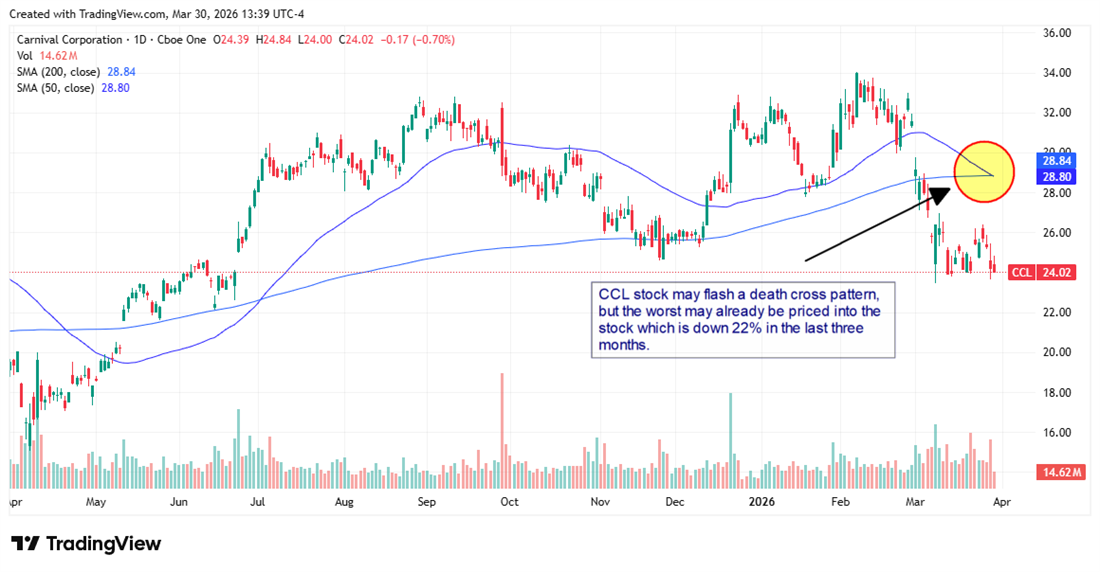
Still, the technical chart tells a cautionary tale heading into April. CCL is currently trading around $24, well below both its 50-day and 200-day simple moving averages (SMA). More importantly, in the short term, the 50-day is rapidly converging on the 200-day SMA from above, suggesting a death cross pattern is imminent.
Historically, that's a signal that draws selling pressure from technically-oriented investors. That said, a death cross is a lagging indicator, and by the time it forms, much of the damage may already be priced in. CCL has already shed roughly 25% from its recent highs near $34.
A true breakdown would likely require a new fundamental catalyst, such as sustained elevated fuel costs, weakening bookings, or a meaningful uptick in cancellations. Absent those, the stock may find support near current levels, especially given its undemanding valuation. If oil prices moderate, a snapback rally could develop well ahead of the June earnings report.
Where Should You Invest $1,000 Right Now?
Before you make your next trade, you'll want to hear this.
MarketBeat keeps track of Wall Street's top-rated and best performing research analysts and the stocks they recommend to their clients on a daily basis.
Our team has identified the five stocks that top analysts are quietly whispering to their clients to buy now before the broader market catches on... and none of the big name stocks were on the list.
They believe these five stocks are the five best companies for investors to buy now...
The article "Carnival Stock Forecast: Headwinds Now, Upside Ahead?" first appeared on MarketBeat.