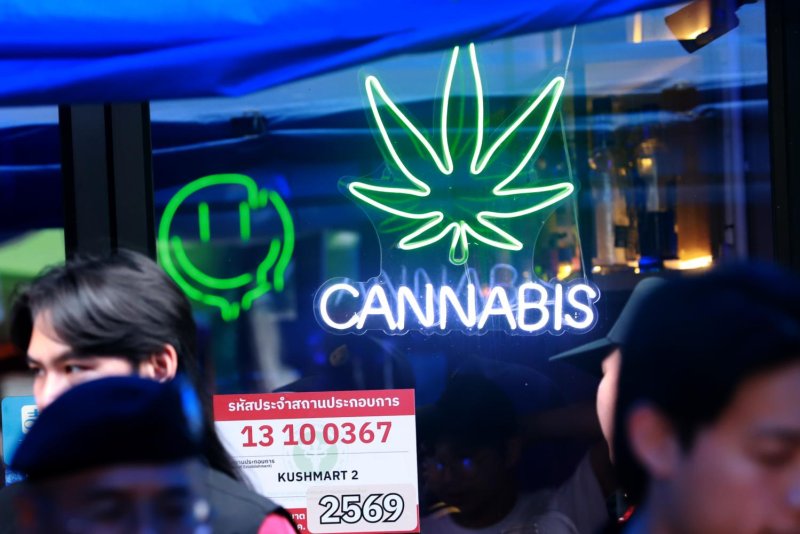
Thailand's latest effort to tighten cannabis controls has introduced stricter rules -- but on Bangkok's streets, particularly in tourist areas where cannabis shops thrive, little appears to have changed.
Despite regulations aimed at restricting cannabis use to medical purposes, including prescription requirements under the new framework, cannabis remains widely accessible for recreational use, workers and advocates say.
The gap underscores the challenge authorities face as they try to steer a rapidly expanding market towards medical use.
Public Health Minister Pattana Promphat said a Cannabis and Hemp Bill is under public consultation until the end of this month, with plans to accelerate its passage through parliament to tighten controls over cultivation and distribution.
Uneven enforcement
Current regulations require consumers to obtain a prescription before purchasing cannabis products.
Under the framework, users must register with a Thai traditional medicine clinic, receive a diagnosis and obtain a prescription, while retailers must record transactions and retain documentation for inspection.
Critics, however, say implementation diverges sharply from the rules.
Cannabis advocate Chokwan Chopaka said the official process is largely disconnected from practice.
"No one really follows the official way of making a legal purchase," she said.
Shops routinely sell without prescriptions and later create documentation if needed. She also claimed some doctors issue prescriptions in bulk or through informal arrangements with retailers, while telemedicine systems operate with limited oversight.
"Whatever rule you put out, if it's not going to be enforced, nothing's going to happen," she said.
The criticism reflects broader concerns that regulations are becoming more detailed while enforcement remains inconsistent.
Nowhere is that contradiction more visible than on Khaosan Road.
Along the roughly 400-metre tourist strip, more than 10 cannabis dispensaries operate within walking distance.
On a recent weekday afternoon, all were open for business, with customers browsing or consuming cannabis on-site.
The Bangkok Post spoke to workers from three dispensaries along the street, all of whom requested anonymity due to regulatory uncertainty.
Their accounts suggest an industry adapting unevenly to shifting rules.
Mixed signals
One dispensary said compliance had increased costs. The shop now requires prescriptions and has hired a doctor to visit several times a week to verify documentation.
"Employing the doctor is an added cost, which means everything has been made more expensive," an employee said.
"But it's what we have to do to stay within the regulations."
The worker said the prescription requirement had discouraged some customers, citing privacy concerns.
"To get a prescription, they have to give all their details, and they don't want to do that because they're worried they'll get in trouble," he said.
Despite these efforts, enforcement appears limited.
"Even if customers get stopped by police without a prescription, I've seen they're given softer treatment if they're tourists," he said.
"The police will give them a warning."
Just metres away, another dispensary had taken a different view.
A staff member said operations had not been significantly affected because the shop's licence remains valid for three more years.
Earlier in April, the Public Health Ministry said cannabis businesses would have a three-year transition period to convert into medical-style clinics, in line with licence expiry cycles.
Prescriptions needed
Under the regulations, all shops are required to sell only to customers with prescriptions, regardless of licence status.
Asked whether customers needed prescriptions, the worker gave no clear answer.
"It's very much based on the shop and the customer," he said.
He added that strictly limiting sales to medical users would hurt business.
"If all stores only catered to medicinal users, they wouldn't get any business," he said.
Elsewhere, another dispensary worker backed tighter regulation but said cannabis should remain legal. Her shop requires prescriptions and employs a doctor to ensure appropriate dosages.
"People are getting prescriptions because they're scared of being stopped by police without one," she said, while acknowledging that many operators remain uncertain about the system.
The changing rules have left businesses balancing compliance with profitability.
She added that alcohol caused more visible disorder on Khaosan Road than cannabis.
Officials defend controls
Authorities say the stricter measures are needed to bring order to a fast-growing sector.
The Department of Thai Traditional and Alternative Medicine said cannabis businesses would gradually transition towards operating more like medical clinics.
Regulations that took effect on April 30 strengthened controls over research, imports, processing and distribution.
New licence applicants must be linked to healthcare-related activities, such as clinics, herbal product manufacturers, pharmaceutical companies or licensed traditional healers.
Licensed outlets must also employ trained staff.
Existing businesses may continue operating until licences expire, but must comply with new requirements when renewing.
The ministry has also introduced stricter inspections and digital reporting systems, allowing the public to report suspected violations.
Officials say the reforms respond to concerns over widespread recreational use following decriminalisation, including complaints about cannabis smoke, youth access and rising hospital cases linked to excessive consumption.
Around 12,000 cannabis distribution licences valid between 2026 and 2028 have been issued nationwide, with about half set to expire this year.
Education a missing piece
Critics such as Ms Chokwan argue that enforcement alone is insufficient.
"If you regulate without educating the public, how are they going to know the rules?" she said.
Without better public understanding, she warned the industry risks drifting further into an informal system where regulations exist on paper, but daily practice relies on workarounds.
Thailand's cannabis challenge may lie less in drafting stricter rules than in ensuring they are enforced in practice.
As policymakers debate tighter controls, Khaosan Road continues much as before -- shops open, customers browsing, and a market adapting faster than regulators can keep up.