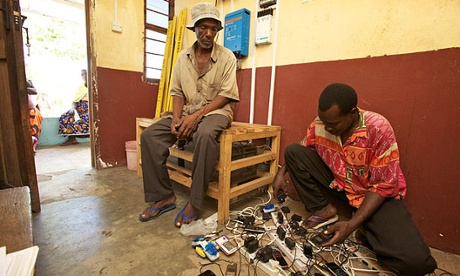
A variety of pilot schemes are using smartphone technology and big data to help people in low-income communities to launch micro-businesses, access healthcare and reduce their energy consumption. But for data and technology to really benefit people in the developing world, care needs to be taken over how information is collected and used.
As Simon Thompson, BT’s head of practice for big data and customer experience says: “Good intentions are not enough in trying to employ new technologies for social good. A lot of care and thought is required to make sure these applications don’t have unexpected consequences.”
Thompson says the implications of how the data will be used needs to be understood by all stakeholders, and informed consent from users is key. Privacy is a huge issue whether you are in a European city or a rural community in Africa. For some communities, data about gender for example, seems innocuous to application developers in Europe but could be explosive in the context of the developing world, says Thompson.
Many believe that applying the insights of big data to developing countries could help solve some of their biggest challenges. Ownership of mobile phones is spreading across the developing world, offering a flow of data about people’s everyday activities.
For instance, NGO Ushahidi uses crowdsourced data from mobile phones to create real-time insights about natural disasters and election monitoring. One initiative it runs is Watertracker, where local people upload data about water wells in their area. They can phone in to report if a water well is out of order so it can be fixed quickly.
Meanwhile, monitoring mobile data can help trace the outbreak of epidemics. The organisation Global Viral Forecasting is looking at how it can collect data from mobile phones and social media to trace outbreaks of contagious diseases.
The United Nations’ organisation Global Pulse has monitored food-related conversations on Twitter in Indonesia to track the impact of rising food prices. The organisation believes social media analysis can help identify problems such as food shortages or price hikes at an early stage and indicate to governments and aid agencies where they need to put resources.
Another example is the BT for Life Sciences cloud platform, which is helping facilitate large-scale collaboration for health and pharmaceutical companies such as helping researchers gain medical insights from data buried in large datasets. It also offers new solutions to get to market more quickly and ensures regulatory compliance.
Many of these initiatives are in their early stages, but along with excitement at the opportunities opening up, there are concerns about the way data will be used. Some worry that big data could actually boost inequality around the world rather than ameliorate it.
At BT’s Better Future Forum earlier this year Jasmine Whitbread, chief executive of Save the Children International told the discussion: “I believe there is huge potential for data to be used for social good. At Save the Children each year we collect data on over 100 million children in 120 countries. If we did a better job of collecting and mining that data, this could make the case for investment in children.”
However, others wonder whether big data and connectivity might actually lead to a more divided world. As Sean Gourley, founder of data visualisation site Quid.com says: “There is no doubt that data and analysis will create opportunities for improvement but I think the question is whether this will be evenly distributed. The core question we must ask is whether big data will be a force that creates a more equal society or that creates a more unequal one.”
Thompson says there are serious issues about “power asymmetry.” He warns: “If somebody from the developed world collects data about the developing world, they can analyse it from their perspective, but not from the perspective of people in the developing world who depend on those outcomes.” Dealing with the mismatch in resources between rich organisations with huge resources and tools at their disposal and people in developing countries is a major ethical issue, he believes.
Thompson says that organisations involved with using big data in developing countries need a forum to discuss potential applications, projects, problems and ethical issues with people from the developing world who have the cultural perspective to appreciate how these technologies will impact the users.
“There is an ongoing high-profile debate about privacy in the developed world. In the developing world, the challenge is that we have new technology and capabilities which could be used to do enormous good - and have been - but we need to work sensibly taking into account the different views and context of people who live there.
“The best way is to involve the people, monitor impacts and be open about the intentions of the researchers and practitioners to enable sensible debate.”
The challenge is to democratise big data and mobile technology so it is a partnership between the technology industry, governments and the communities where they work.
More from the BT partner zone:
- Euan’s Guide empowers disabled people to move beyond what they know
- Disruptive innovation: how BT is applying blue-skies thinking to their bottom-line
- We can make it better: BT Home Hub - video
Content on this page is paid for and produced to a brief agreed with BT, sponsor of the tech and innovation hub.