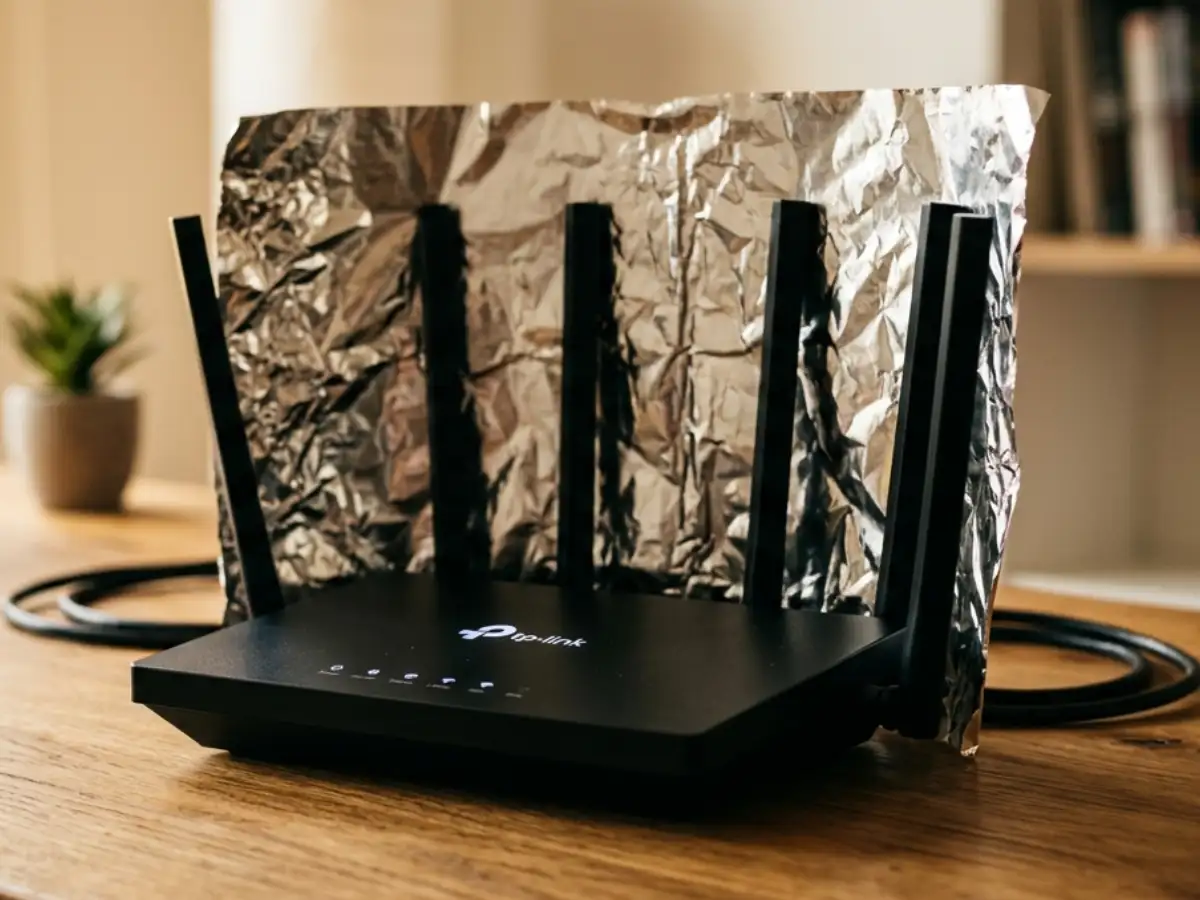
You’ve probably seen it on social media: put a piece of aluminum foil behind your Wi-Fi router and see the dead zones disappear. Sounds like something your dad would forward in a chain e-mail. But here’s the thing, there is real science to it. The problem is that the viral version and the real version are two very different things.
The study that started it all
In 2017, researchers at Dartmouth College set out to test whether aluminum reflectors could dramatically alter how Wi-Fi signals moved through a home. Their system, named WiPrint, employed proprietary software to compute the ideal shape for a reflector depending on the layout of a room. The form was then 3D-printed and covered in aluminum foil.
The results were stunning. TechCrunch’s coverage of the study says the reflectors could boost signal strength by up to 6 dB in target areas, a significant gain, while reducing signal in unwanted directions by up to 10 dB. The $35 reflector that could be built would be better than commercial directional antennas worth thousands of dollars, lead researcher Xia Zhou said.
That's a very interesting finding, but the excitement hides an important detail.
What the study actually tested
The Dartmouth team didn’t try a crumpled piece of kitchen foil jammed up behind a router. They tested reflectors made by an algorithm and printed in a lab, with reflectors precisely shaped. The viral version of this trick, a hand-bent piece of foil, is a crude imitation of that setup.
You are working on a guess when you hand-bend foil and stick it behind your router. Shape is very important. The home testers who have experienced the DIY version tend to report modest gains, in the 10 to 20 percent range, well below the lab results.