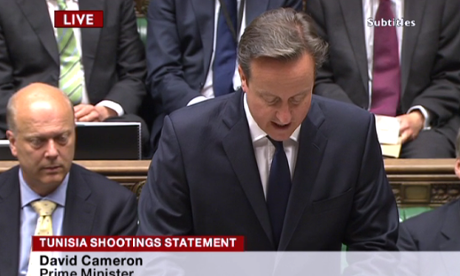
Cameron's statement - Summary
-
David Cameron has said that calling Islamic State Islamic State is “offensive” to many Muslims. He was speaking in response to a question from the SNP leader at Westminster, Angus Robertson, who said that “the time has come in the English-speaking world to stop using Islamic State, Isis or Isil” and that instead government and the media should use the term Da’esh. In response, Cameron went slightly further then he did when he raised this issue on the Today programme this morning. (See 9.16am.) He said Islamic State was an offensive term.
I agree with the honourable gentleman on the use of the term Islamic State. I think this is seen as particularly offensive to many muslims who see, as I see, not a state but a barbaric regime of terrorism and oppression that takes delight in murder and oppressing women and murdering people because they’re gay. So I raised this with the BBC this morning. I personally think that using the term Isil or ‘so called’ would be better than what they currently do. I don’t think we’ll move them all the way to Da’esh, so I think saying Isil is probably better than Islamic State because it is neither, in my view, Islamic or a state.
- He announced that there will be a national one minute’s silence on Friday at 12pm to honour those killed in Tunisia.
- He said that there would be a major training exercise in London over the next two days to test Britain’s preparedness for a serious terrorist attack. Downing Street later said the initiative had been planned in the wake of the Charlie Hebdo murders in Paris.
- He said that it was thought the killer in Tunisa could be part of “an Isil-inspired network”. Tunisian security forces were investigating possible accomplices, he said.
-
Harriet Harman, Labour’s acting leader, mocked Cameron over the apparent vagueness of his EU renegotiation demands. She said:
Of course negotiations are sensitive but it’s evident that even the people you are negotiating with are not entirely clear what you are negotiating for. But nor are the British people you are negotiating on behalf of.
In his statement Cameron said he was looking for “substantive reform” in four areas: sovereignty, fairness, immigration and fairness. He explained:
First on sovereignty, Britain will not support being part of an ever-closer union or being dragged into a state called Europe.
That may be for others, but it will never be for Britain, and it is time to recognise that specifically.
We want national parliaments to be able to work together to have more power, not less.
Second on fairness. As the eurozone integrates further, the EU has got to be flexible enough to make sure the interests of both those inside and outside the eurozone are fairly balanced. Put simply, the single currency is not for all but the single market and the European Union as a whole must work for all.
Third on immigration, we need to tackle the welfare incentives that attract so many people from across the EU to seek work in Britain.
And finally, alongside all these, we need to make the EU a source of growth, jobs, innovation and success rather than stagnation. That means signing trade deals and completing the single market – such as in digital, where the Council made progress towards a roaming agreement that could cut the cost of mobile phone bills for businesses and tourists alike.
That’s all from me for today. I’m not covering George Osborne’s statement about Greece, but Nick Fletcher is covering it on the Greek debt crisis live blog.
Thanks for the comments.
David Cameron’s statement is now over.
Sarah Wollaston, the Conservative MP, asks Cameron if he agrees that the media should reconsider its policy of publishing “snuff video” pictures when attacks like the one in Tunisia take place. They should be showing pictures of the Tunisian people who helped save lives.
Cameron says it is up to media companies to decide what to publish. But he says he really does hope the BBC thinks again about its decision to use the term Islamic State.
Updated
Bernard Jenkin, a Conservative, asks how a promise of treaty change can be made binding.
Cameron says in Ireland they held a referendum on treaty change before it had been ratified. They just had a protocol saying treaty change was coming. So there is a precedent, he says.
Philip Davies, a Conservative, says the EU is undemocratic and its currency is a basket case. Cameron will get next to nothing in his renegotiation. Shouldn’t he just recommend that we leave?
Cameron says he wishes Davies would stop speaking in riddles and say what he means. He disagrees with him, he says.
Jeremy Corbyn, the Labour leadership contender, asks if Cameron accepts that the destruction of so much of Libya’s governnment contributed to the growth of Islamic State.
Cameron says, if Corbyn is asking if he regrets intervening to save lives, he does not. But he does want to build up the capacity of the Libyan government.
David Cameron tells MPs that "4 or 5 plots" in the UK have been prevented by security services in last few months. #Tunisia
— Vicki Young (@VickiYoung01) June 29, 2015
PM in Commons: "the terrorists want us to wipe out the Tunisian tourism industry"
— Faisal Islam (@faisalislam) June 29, 2015
Sir Bill Cash, a Conservative, says other EU leaders are not listening to Cameron. They want more integration. What would it take for Cameron to recommend a no vote?
Cameron says he goes into these talks as an optimist. He thinks other EU leaders are open to the reforms he thinks are necessary.
Shabana Mahmood, the Labour MP, says most British Muslims condemn extremism and are not any better placed to “step up to the plate” and condemn extremism than people like Cameron.
Cameron says Muslims are doing this already. The extremists are taking their religion, and perverting it.
And it is not just those that support violence who we need to confront. “We know who those organisations are,” he says. These are the people who think a Caliphate might not be a bad idea, or who think Christians and Muslims cannot live together. We should call them out, he says.
Henry Bellingham, a Conservative, asks Cameron if he agrees that internet companies like Facebook and Google have privacy policies that are unsustainable.
Cameron says Bellingham raises a good point. He says he does not want to leave a safe space for terrorists to communicate. This will come before MPs, he says.
Crispin Blunt, the Conservative, says Tunisia has been the one ray of light in the Arab Spring. Is there any evidence this attack was coordinated outside Libya?
Cameron says it is too early to know.
Tasmina Ahmed-Sheikh, the SNP MP, asks Cameron to address the challenges families are facing when they try to find out about what happened to relatives.
Cameron says he understands these concerns. But it is important to check, he says. Two people were assumed missing, but turned up in the UK having made their own way home without people knowing.
He says the coroner in Tunisia wants to make sure that no mistakes are made.
Liam Fox, the Conservative former defence secretary, says extremists talk of three types of jihad: of the tongue, of the purse and of the sword. Cameron if he agrees that some Middle East countries are not doing enough. Should we name and shame those helping Isis?
Cameron says Fox is right to say we must challenge Isis with all means possible. Ultimately it will be Western values that prevail.
Angus Robertson, the SNP leader in Westminster, asks Cameron if he agrees that government and the media should stop calling it Islamic State, and call it Da’esh. (See 12.31pm.)
Cameron says the term Islamic State is offensive to many Muslims. He raised this on the BBC this morning, he says. He says using the term Isil or so-called Islamic State would be better. He does not think the BBC will adopt Da’esh.
Andrew Percy, a Conservative, lost a constituent in the attack. Will bodies be brought home as quickly as possible?
Cameron says he can give that assurance. The government will use RAF planes to bring home bodies if that is what they want, he says.
Labour’s Adrian Bailey says three generations of one family have been killed in his constituency. Will Cameron take up Harman’s suggestion for a dedicated task force to help the families?
Cameron says the case of Bailey’s constituents is “heart-breaking”. Every family should have a family liaison officer, he says.
Cameron says the struggle against Islamist extremists will be “the struggle of our generation”.
Cameron is replying to Harman.
He says at the moment the Foreign Office is leading on looking after victims. Other departments may play a role later, he says. He says Harman was right to praise the role played by Tobias Ellwood, the Foreign Office minister.
Cameron says there is a case for using the aid budget in a more coordinated way to help countries like Tunisia.
He says he draws a distinction between resettling refugees from places outside the EU, like Syria, which he supports, and resettling refugees already in the EU, which he does not support.
On his renegotiation, what matters is achieving substantial change, he says.
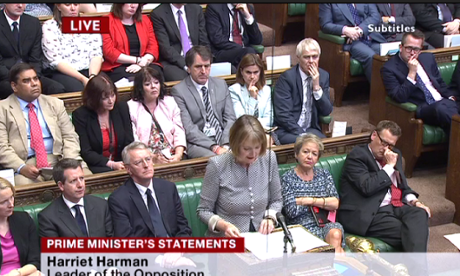
Harriet Harman, the acting Labour leader, is responding for Labour.
She suggests the creation of a specific task force to help look after the interests of victims.
She asks what is being done to boost security in Tunisia.
Is the government doing enough to help individuals and communities to stand up to extremism?
What further counter-terrorism measures are being planned?
Turning to the EU, Harman says the most serious problem is Greece.
She asks for an assurance that the British commitment to rescuing migrants will not diminish with the replacement of HMS Bulwarck by HMS Enterprise.
On the EU renegotiation, she says the people Cameron is negotiating with are not entirely clear what he wants to achieve.
What will Cameron do to keep people informed about the process of negotiations?
Cameron lists the four key points of his EU renegotiation demands: getting Britain out of the single market, boosting the rights of national parliaments and protecting Britain from decisions made by eurozone countries, cutting benefits for migrants, and extending the single market.
These are significant changes, he says.
PM on EU reform - We will put Common Market back at heart of our membership
— norman smith (@BBCNormanS) June 29, 2015
Updated
Turning to the EU summit, Cameron says the EU wants to break the business model that encourages people smuggling. He does not want migrants coming across the Mediterranean to think they can settle in Europe. He says he thinks the resettlement plan will be counter-productive. Britain will not be part of it.
Cameron says within the next few days there will be a major counter-terrorism training exercise in London.
He says on Wednesday new rules will come into force giving public bodies a statutory duty to counter extremism.
Cameron says the Foreign Office has updated its travel advice.
But it is not advising against travel to holiday resorts like Sousse.
This is a decision that was taken at the Cobra emergency committee meeting, he says.
It is important to go on with normal life.
We will not give up our way of life, or given in to terrorism.
He says the Tunisians and Kuwaitis do not want to be cowed by terrorism either.
The mosque attacked in Kuwait was one that tried to bring Sunnis and Shia together, he says.
Cameron says people know about the attack on Friday.
But it is not clear whether the killer was acting as part of a network. Police are searching for accomplices.
He says there is no evidence that the three attacks on Friday, in Tunisia, Kuwait and France, were directly coordinated.
He says the government has more than 50 people on the ground now in Tunisia helping victims.
David Cameron says with great sadness he can say that he can say 18 Britons are now known to have died on the attack.
On Friday there will be a national minute’s silence at 12pm, a week after the attack.
The government will discuss a memorial with the relatives of the victims, he says.
The MPs are starting with a minute’s silence in honour of the victims of the Tunisia massacre.
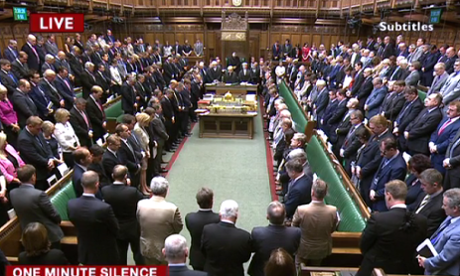
Cameron's Commons statement on the Tunisia massacre and the EU summit
David Cameron is about to make his Commons statement on the Tunisia massacre and the EU summit.
In the light of the Guardian’s leak revealing the limited nature of his EU renegotiation demands, in other circumstances this would have been a tricky fixture for him. But the proceedings are likely to be dominated by Tunisia.
A Labour leadership round-up
Here is a Labour leadership round-up.
-
John Woodcock, a leading figures in the Liz Kendall campaign, has published his blog describing Yvette Cooper and Andy Burnham as “continuity Labour”. I wrote about this in a story last night. In response, a spokesperson for the Cooper campaign said:
When Yvette was housing minister, house building rose to over 200,000 homes a year. She thinks Britain needs to be far more ambitious than that with a plan for new towns and garden cities. If we can’t be ambitious and bold in our policies on housing, high tech jobs, child care, child poverty and the other things Yvette is campaigning on - we won’t meet the needs of the country and we’ll simply be letting families down. We won’t win in 2020 simply by re-running past elections. But nor will we win by simply accepting Tory government plans are the right ones for Britain. That’s why Yvette is setting out ambitious plans, and an optimistic vision for the country, based on enduring Labour values.
And a spokesperson for the Burnham campaign said that Labour’s next leader had to be able to connect with people in every part of the country, to win people back from Ukip and the SNP as well as the Tories, and that Burnham was the only candidate who could do this.
- Kendall has said that Labour should not “recoil” from trying to win votes from the Tories. She made the point in an interview with Progress. Progress has also published interviews with Burnham, with Cooper and with Jeremy Corbyn.
-
Jeremy Corbyn has used a post on the Scottish politics blog Labour Hame to attack the SNP’s record on privatisation, saying it was “not so far from the Westminster consensus”. He also said that, as leader, he would adopt John Smith’s approach to party management.
It must be up to members in Scotland how the party is organised in Scotland. But we need to ensure that we have the policies that pool our shared resources, redistributing wealth and power across the UK. When I was chair of the London Group of Labour MPs in 1993 I met with our then leader John Smith to discuss restoring devolved government to London. He supported that, but naturally argued that devolved government in Scotland was more urgent.
John Smith was a decent man. I didn’t always agree with him, nor him with me, but he was always prepared to listen to different arguments and accept difference within the party. If elected leader, I would aspire to continue John’s tradition to genuinely listen to everyone’s views within the party. That would start with establishing a constitutional convention to resolve those key questions of where power should lie and of lowering the voting age as Scotland did in the referendum.
-
Paddy Power has revised its odds on the chances of Burnham winning after receiving some three-figure bets on him. It said in a news release.
Burnham has pulled away once again with a handful of three-figure bets on him over the weekend seeing him edge away from second favourite Yvette Cooper who has drifted from 11/8 to 13/8 as a result.
According to Political Pictures, a government aide turned up to a meeting today about the Greek crisis with one of his memos on display.
As IDS turns up to Greek crisis meeting with PM and Bank Of England boss his SPAD gives us this info !! pic.twitter.com/HnXFJSPj3D
— Political Pictures (@PoliticalPics) June 29, 2015
Lunchtime summary
- David Cameron has said that Islamist extremists pose an “existential threat” to Britain and promised a “full-spectrum” response. (See 9.16am.) He will be saying more in a statement to MPs at 3.30pm.
- Downing Street has said that the official toll of Britons killed in the Tunisian massacre is now 18. Many bodies have still not been formally identified, though, and the final British death toll is set to reach at least 30.
-
Theresa May, the home secretary, has visited the site of the killing in Sousse and laid flowers as a tribute to the victims. During a short ceremony with fellow interior ministers from Tunisia, Germany and France, there was also a minute’s silence.
- Downing Street has said all Britons injured in the attack still in Tunisia will be returned home within the next 24 hours. Some of those needing treatment are being flown back to the UK on board an RAF C17 plane with “medevac” teams experienced at bringing injured service personnel back from operations overseas.
- May and her French and German counterparts have discussed specific measures to improve security with the Tunisian government.
- Najem Gharsalli, the Tunisian interior minister, has said that 1,000 extra armed guards are being deployed in the country to protect tourists and that armed guards are being stationed inside hotels. (See 1.26pm.)
-
The TUC has called for the tax system to be made fairer following the publication of official figues showing that richest fifth of the UK population contribute 35.1% of their income in tax, compared to 37.4% for the poorest fifth. The full figures are in this ONS bulletin. In a statement Frances O’Grady, the TUC general secretary, said:
There can be no argument for reducing taxes for the richest when they are already contributing a smaller share of their income than the poorest. The government should instead be looking at how the wealthiest can make a fairer contribution to improving the public finances.
Here is some dramatic new footage that has emerged of the Tunisian gunman being pursued through the hotel grounds by a witness.
The remaining 6 British holiday makers injured in the Tunisian terrorist attack will be back in Britain in the next 24 hours as British authorities press the Tunisians to speed up the identification of the remaining dozen or so UK citizens believed to be killed in the slaughter.
A Number 10 spokeswoman said 18 bodies have been identified so far.
The six injured being returned to Britain are likely to return on an RAF plane, but those murdered will be repatriated in a variety of routes following consultation with the families.
She was speaking after a meeting of Cobra chaired by David Cameron focussed largely on the attack as opposed to any wider policy response.
She added the number of British security officials was being increased, but said it was for the Tunisian authorities to lead the investigation, including ascertaining whether the gunman had an accomplice. She would not speculate on whether the Tunisians believed it was a wider organised attack directed by Islamic State.
Security officials are also looking at how British tourists can be better protected in Tunisia.
She added there was no short term plan to change policy despite Cameron’s warning Britain faced an existential threat.
Q: This was well known as a resort popular with Britons. Do you still think they were not deliberately targeted?
Theresa May says there is no evidence that British tourists were specifically targeted. This hotel is particularly popular with British tourists. But other Europeans were here too. There were German casualties, and casualties from other countries too.
Q: What would your general travel advice to Britons be?
May says the travel advice from the Foreign Office has not changed. But the Foreign Office has put more detail on its website. The travel advice is kept under review.
A team is here looking at protective security. They will be making assessments in the coming days.
That’s it. The press conference is over.
I’ll post a summary soon.
Q: Are there any plans to honour the bravery of the hotel workers who protected British lives?
Theresa May, the home secretary, says that is something the government will consider in due course. At the moment there are other priorities.
Q: Has your travel advice for Tunisia changed?
May says the government has sent a team to Tunisia to assess security here. Travel advice will remain under review.
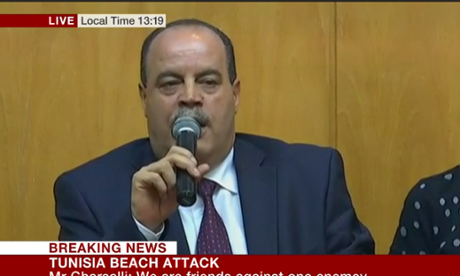
Najem Gharsalli, the Tunisian interior minister, is speaking again at the news conference. He says the government has taken action against extremist political parties.
Tunisia is fighting terrorism because it loves democracy and has chosen democracy. The terrorists are attacking the country because it is democratic. There was no terrorism when it was a dictatorship.
1,000 armed police being deployed in Tunisia, interior minister says
At the press conference Najem Gharsalli, the Tunisian interior minister, is describing some extra security measures the Tunisians are taking.
- Extra armed police are being deployed at beaches, tourists sites and resorts across the country, he says. He says 692 locations will be covered.
- 1,000 extra armed police are being deployed.
- Armed guards are being put on duty inside hotels.
- Reservists are being called up.
Updated
This is from the World at One presenter Martha Kearney.
As Theresa May visits the beach in #Sousse, we hear an eyewitness who says there were 2 gunmen. & new counter extremism powers here #wato
— Martha Kearney (@Marthakearney) June 29, 2015
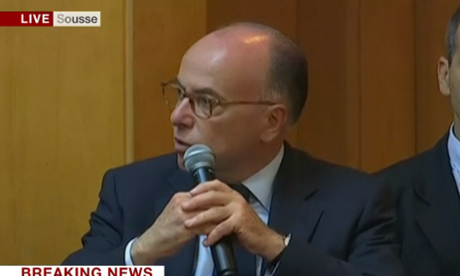
Bernard Cazeneuve, the French interior minister, is talking now.
He expresses his condolences to the relatives of those killed. France and Kuwait were both hit on the same day, he says.
It is time to say we are united; that was the theme of our meeting, he says.
He says there will further meetings in the next few weeks.
As Theresa May said, we are determined to win the war against terrorism, he says.
Thomas de Maizière, the German interior minister, is speaking now. He says he has tremendous respect for the tourists who decided to stay.
Pressekonferenz mit Innenminister de #Maiziere im Hotel Imperial #Sousse pic.twitter.com/EUVbkDnvNE
— Fabian Matzerath (@FabianMatzerath) June 29, 2015
Theresa May, the home secretary, is speaking now.
She says what happened on Friday was a “despicable act of cruelty”.
At least 18 British tourists died, she says. But that number will rise.
She says she has heard the horror stories of those who went through this.
But she has also heard stories of great bravery, such as about the young man who shielded his fiancee, and the staff who protected guests.
She says Tunisia has its first democratically-elected president. Tunisia is a sign of what is possible. She and her interior minister colleagues are determined to fight against the ideology of the terrorists. We are united in wanting to defeat them and to defend our values.
At the meeting they discussed with the Tunisians concrete measures to improve security, she says.
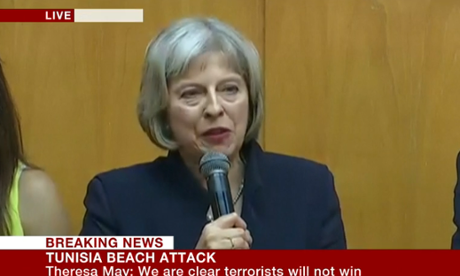
Theresa May speaks with Tunisian, French and German ministers at Sousse press conference
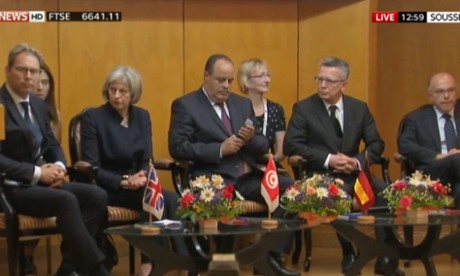
The press conference is starting.
Here is the line-up: from the left, Tobias Ellwood, the UK Foreign Office minister, Theresa May, the home secretary, Najem Gharsalli, the Tunisian interior minister, Thomas de Maizière, the German interior minister, and Bernard Cazeneuve, the French interior minister.
No 10 says 18 British victims of Sousse attack identified, though they expect around 30 in total
— John Ashmore (@smashmorePH) June 29, 2015
My colleague Alan Travis has written detailed article explaining exactly what David Cameron’s “full-spectrum” approach to tackling extremism is likely to involve.
Salmond urges broadcasters to stop using term Islamic State
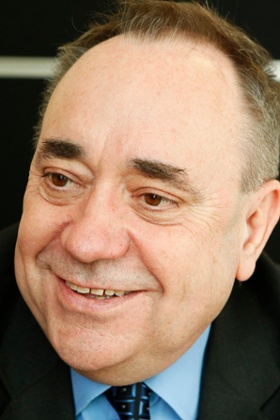
Alex Salmond has backed David Cameron’s call for broadcasters to stop calling Islamic State by that name. (See 9.16am.) Or, to be fair, you could say Cameron is backing Salmond’s call for broadcasters to stop using that name, because Salmond raised this in a column in today’s Courier written over the weekend.
Here’s an extract, from the Press Association. I can’t find the full column online.
We should start by understanding that in a propaganda war then language is crucial.
Any description of terrorists which confers on them the image that they are representing either a religion or a state must surely be wrong and an own goal of massive proportions. It is after all how they wish to refer to themselves.
Daesh, sometime spelled DAIISH or Da’esh, is short for Dawlat alIslamiyah f’alIraq wa alSham.
Many Arabic-speaking media organisations refer to the group as such and there is an argument it is appropriately pejorative, deriving from a mixture of rough translations from the individual Arabic words.
However, the real point of using Daesh is that it separates the terrorists from the religion they claim to represent and from the false dream of a new caliphate that they claim to pursue.
It should become the official policy of the government and be followed by the broadcasting organisations.
Updated
Jeremy Wright, the attorney general, has given his backing to Alison Saunders over her handling of the Lord Janner case. He put out this statement.
I believe strongly in a system where decisions to prosecute are taken by independent prosecutors and not by politicians. I am confident of the independence and the integrity of the director of public prosecutions, Alison Saunders, in making the difficult judgments the job of a prosecutor involves. It is right that we now have a victim’s right to review those judgments, which Alison helped to bring in, and which has operated as it was designed to in this case.
Since Alison Saunders has been DPP, the CPS has prosecuted and convicted more child sex offenders than ever before.
Here’s a video clip from Sky’s Ian Woods.
A minute's silence observed. #TunisiaAttack pic.twitter.com/ORghZBXpLI
— Ian Woods (@IanWoodsSky) June 29, 2015
The Ministry of Defence has just tweeted this.
Personnel at @RoyalAirForceUK Brize Norton loading C-17 to assist with #SousseAttack in Tunisia pic.twitter.com/VWbDw8WjGG
— Ministry of Defence (@DefenceHQ) June 29, 2015
Sky’s Ian Woods has also been tweeting pictures from Sousse.
The beach in Sousse. pic.twitter.com/eh1RkzCYwZ
— Ian Woods (@IanWoodsSky) June 29, 2015
Theresa May and others pay their respects. #TunisiaAttack pic.twitter.com/o7NDdSbk5Z
— Ian Woods (@IanWoodsSky) June 29, 2015
Here are some pictures taken today at the hotel in Sousse where the beach massacre took place.


Theresa May, the home secretary, is at the Imperial Marhaba hotel in Sousse, where the massacre took place on Friday. She is expected to hold a joint press conference soon with her opposite numbers from Tunisia (Najem Gharsalli), France (Bernard Cazeneuve) and Germany (Thomas de Maizière).
These are from Channel 4 News’s Jonathan Miller.
Home Sec Theresa May about to arrive at shrine on beach #Sousse pic.twitter.com/ooVlEN8ei5
— Jonathan Miller (@millerC4) June 29, 2015
Tunisians have put on a massive show of security for visit of Home Sec to #SousseAttack site #c4news pic.twitter.com/GkS9kFkVhz
— Jonathan Miller (@millerC4) June 29, 2015
Theresa May, the home secretary, has arrived in Sousse at the scene of the Tunisian beach massacre, Sky reports.
She is due to hold a press conference there soon.
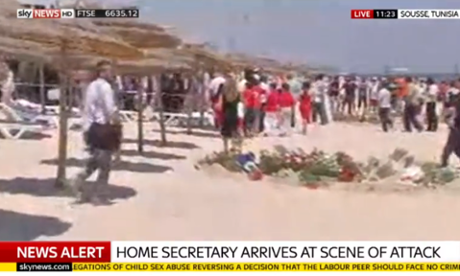
Here’s Rajeev Syal’s story about the CPS announcement about Lord Janner. And here’s how it starts.
The future of Alison Saunders, the director of public prosecutions, will come under intense scrutiny after she confirmed that her previous decision not to charge Greville Janner in connection with child abuse allegations had been overturned.
The ruling means that Lord Janner will face a trial of the facts, where a jury hears the evidence against an individual considered too ill for a full trial. This is expected to be held into the 22 offences allegedly committed in the 1960s, 1970s and 1980s.
The decision follows a review of the case under the CPS victims’ right to review scheme, which allows people to have their case looked at again no matter who in the CPS took the decision not to prosecute.
But politicians have welcomed the CPS decision.
This is from Sajid Javid, the business secretary.
— Sajid Javid (@sajidjavid) June 29, 2015
This is from the Labour MP John Mann.
Janner. Trial of the facts. Opens up many, many issues.
— John Mann (@JohnMannMP) June 29, 2015
And this is from the Green party leader, Natalie Bennett.
It is an indictment of our system that it took so long, but a step forward that Lord #Janner will face trial.
— Natalie Bennett (@natalieben) June 29, 2015
On Twitter David Allen Green, the lawyer and legal blogger, has described the prosecution of Lord Janner as just a “PR prosecution”.
Janner not being "prosecuted" in any meaningful way. Note CPS statement avoids using the word other than in headline http://t.co/YWb5HMz5cb
— Jack of Kent (@JackofKent) June 29, 2015
As the CPS statement says, the most likely outcome of a “trial of the facts” for Janner will be an absolute discharge, not a conviction.
— Jack of Kent (@JackofKent) June 29, 2015
As the CPS originally decided, difficult to see the public interest in prosecuting anybody unable to defend themselves. Remains the case.
— Jack of Kent (@JackofKent) June 29, 2015
This is simply a "PR prosecution" which cannot - legally - lead to a conviction. Misleading to call it a prosecution at all.
— Jack of Kent (@JackofKent) June 29, 2015
https://twitter.com/JackofKent/status/615462357163245568
Fwiw, I am against prosecuting any people unfit to defend themselves, either Janner or indeed the war crimes defendants he pursued.
— Jack of Kent (@JackofKent) June 29, 2015
Joshua Rozenberg, the legal commentator, has written an excellent article for Comment is free on the legal issues that led to the Crown Prosecution Service reversing its original decision and deciding it will now prosecute Lord Janner. He says that the only difference between Alison Saunders, the director of public prosecutions who originally decided Janner should not face trial, and David Perry QC, who effectively reversed this when he reviewed her decision, was over whether or not a trial of facts would be in the public interest. But this is a decision Saunders should be taking, not Perry, he says.
What Perry has now concluded is that a trial of the facts would be in the public interest. There is no disagreement about the likely outcome – which will probably still be an absolute discharge if the case gets that far. But Perry appears to have taken the view that the decision-making process – and the evidence of Janner’s dementia – need to be put to a court for all the world to see. In his view, the long-awaited and much-delayed Goddard child abuse inquiry is no substitute for an adjudication by the courts.
So this comes down to a difference of opinion about what is in the public interest. And even though Perry is a highly experienced and well-respected prosecutor, that’s not a question he is usually asked to consider. Perry has often been briefed to advise on whether there is sufficient evidence to justify bringing specific charges. But decisions on whether a specific prosecution would be in the public interest are normally taken in house by CPS lawyers.
So Saunders has been forced by her own policies to subcontract a judgment that she was better equipped to make.
Rozenberg is also sceptical about whether this case will ever make it to a full hearing anyway.
It will be interesting to see whether the courts allow the case to proceed as far as a trial of the facts. Janner’s lawyers are likely to argue that this would be an abuse of process. And the courts may stop the case if it concludes that the former MP is unfit to plead. Whatever happens, it is highly unlikely that Janner will ever be seen in court – not even at the hearing currently listed for 7 August.
This is what Alison Saunders told the BBC what she would say to those (like Simon Danczuk - see 10.40am) who thought her original decision not to prosecute Lord Janner was such a serious error of judgement that she should resign. She replied:
It was a very finely balanced decision. My concern was not just about making sure that we had the evidence, which we did, but making sure that we took into account what the complainants wanted, hence why contacted the inquiry. I don’t think it’s a decision that I should resign over. It’s one that I took very carefully, and with the victims at the heart of that. That’s why we talked about the victims’ right to review, and I encouraged them to do that.
Simon Danczuk says Alison Saunders should resign over Janner decision
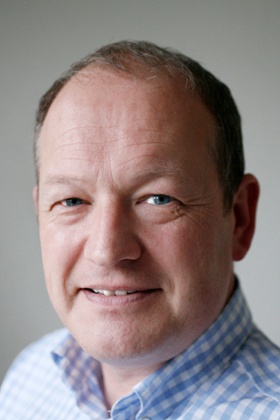
Alison Saunders has said this morning that she will not be resigning as director of public prosecutions. This is what the Labour MP Simon Danczuk told BBC News a few minutes ago explaining why he thought she should go.
I think Alison Saunders has brought the criminal justice system into disrepute, and I don’t say that lightly. This follows on from a number of poor decisions by Alison Saunders, in one particular case, in relation to FGM (female genital mutilation), but also in relation to another decision around journalists. In regard to Lord Janner, her initial decision, [there were] real concerns there. The timing was all wrong, it took her a long time to make the decision. She then announced the decision during purdah, when parliament was not sitting, even though there was a lot of public interest in this. There were problems around conflict of interest, whether she had sat in chambers with Lord Janner, whether one of her advisers was close to one of Lord Janner’s sons. But, most of all, the issue that it was just a cold decision; it did not take into account the alleged victims in this case. There was a lot of public interest in this, and she failed to accept that.
Updated
Liz Dux, a child abuse lawyer at Slater Gordon who represents many of Lord Janner’s alleged victims, has put out this statement about the DPP decision.
My clients are delighted by this decision.
This is a vindication of our efforts to challenge the DPP’s original decision not to charge Janner, which was clearly not in the interest of justice.
Our clients have waited long enough for their very serious allegations to be brought before a court.
They have felt deeply frustrated by the criminal justice system. However, this decision has given them more hope of finally establishing the truth.
It may be long overdue, but we will now look to a criminal court to examine the case and make a finding of fact.
It is now absolutely vital that nothing is done that could prejudice a fair trial.
The Labour MP Simon Danczuk has told BBC News that he thinks Alison Saunders should now resign as director of public prosecutions.
Lord Janner is facing 22 charges. There is a full list on the CPS news release.
The Crown Prosecution Service is also saying an internal report has confirmed that it was a mistake not to prosecute Janner in 1991 and 2007.
The CPS has also received a draft of Sir Richard Henriques’ report which the DPP commissioned on the handling and decision making in relation to previous allegations made against Greville Janner in 1991, 2002 and 2007. It is now being finalised, but it is clear that it will confirm the DPP’s view that the CPS decisions in 1991 and 2007 were wrong as well as concluding that the handling of the case previously by both police and prosecutors was unsatisfactory.
Alison Saunders, the director of public prosecutions, said:
It is a matter of real regret that prosecutions weren’t brought by the police and CPS in the past.
We have brought forward this decision as public speculation on this review has brought damaging and unacceptable uncertainty for the complainants in this case. We have now done what we can to inform the complainants of the outcome of the review and I have offered to meet each of them should they wish.
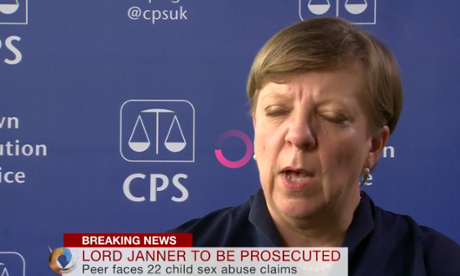
And here is the comment on the decision from Alison Saunders, the director of public prosecutions.
The Victims’ Right to Review scheme has brought a much needed voice for victims of crime and this review shows that any decision can be reversed, no matter who has made it. It is a scheme I helped to bring in and it is a process I fully support and am not above. I requested a non CPS lawyer to advise on this case so that the review would be seen as fully independent. That was the right thing to do, and was a decision I made in the interests of fairness and maintaining public confidence in the criminal justice system.
I have always said that in my view this was an extremely difficult and borderline case because of the strong arguments on both sides. I have also always emphasised my concern for the complainants in this case. I understood their need to be heard, which is why I contacted Justice Goddard to ensure that they could give evidence as part of the public inquiry. However, the review has concluded that this forum, albeit a public one, cannot substitute for the adjudication of the courts. I accept the outcome of the review and will now be bringing this prosecution to allow for that adjudication to happen.
The case is first listed at Westminster Magistrates’ Court on 7 August 2015.
Greville Janner to face child sexual abuse charges, CPS says
Greville Janner will be prosecuted for child sexual abuse claims, the CPS has announced.
Here is the statement from the CPS.
The Director of Public Prosecutions (DPP) Alison Saunders will now bring criminal proceedings against Greville Janner for child sex offences.
This follows a review of the case under the recently introduced CPS Victims’ Right to Review scheme, which allows victims to have their cases looked at again, no matter who in the CPS made the original decision not to prosecute.
In the past year the scheme has meant that more than 200 prosecutions have been brought that would not have been brought otherwise.
In April this year the DPP decided that there was sufficient evidence to prosecute, meaning that, in her view, if there could be a full criminal trial a jury would be likely to convict Lord Janner. However, the DPP considered that it was not in the public interest to prosecute. This was because there was undisputed medical evidence that Greville Janner was not fit to stand trial which meant there could not be a full criminal trial and he could not therefore be found guilty of any offence and because he was not a danger to the public. It was also in light of the fact that the DPP sought assurances that the complainants would have the opportunity to give their account to the public inquiry led by Justice Goddard which has been set up to look at cases which may have been mis-handled in the past.
Without the compelling medical evidence the DPP has made clear that she would have brought a prosecution.
In May, six of the complainants in this case requested a formal Right to Review, and at the DPP’s request, David Perry QC was instructed to provide advice to inform the CPS review of the decision.
The review concluded that it was in the public interest to bring proceedings before the court.
In reaching that conclusion, the review agreed that although there is sufficient evidence to prosecute, it is right to assume that Greville Janner will inevitably be found unfit to plead and therefore not fit to instruct his legal team and not fit to challenge or give evidence in a trial. Therefore the most likely outcome of a “trial of the facts” would be an absolute discharge, which is neither punishment nor conviction.
Tobias Ellwood, a minister at the Foreign and Commonwealth Office, previously told how it took three days for his family to find out that his brother, Jonathan, a teacher, had died in bomb blasts that ripped through a nightclub area in Kuta in 2002.
Yesterday, Mr Ellwood was on the receiving end of criticism from families who were experiencing the same kind of grief and horror as well as frustration at the lack of information about their loved ones more than 48 hours after the gunman struck.
David Cameron says he wishes the BBC stopped calling Islamic State Islamic State. (See 9.16am.) In this Guardian article, Ian Black explains why finding an agreed term for the group has proved difficult.
A Labour general election candidate, Amran Hussain, has been criticised for using a selfie stick to take a picture of himself at the scene of the massacre in Sousse, the Huffington Post reports. Hussain has apologised and says no offence was intended.
Here is some Twitter comment on David Cameron’s interview.
From the Guardian’s Jonathan Freedland
I don't underestimate the threat of Isis, but worry that Cameron flatters it, elevating it too much by branding it "existential".
— Jonathan Freedland (@Freedland) June 29, 2015
From the BBC’s Nick Robinson
What does being intolerant of intolerance involve ? That's the question raised by PM's rhetoric about "the struggle of our generation"
— Nick Robinson (@bbcnickrobinson) June 29, 2015
From the Observer’s Nick Cohen
PM shouts at BBC for calling Islamic State "Islamic State" says it shd be ISIL instead. But ISIL means Islamic State of Iraq and the Levant
— Nick Cohen (@NickCohen4) June 29, 2015
From Huffington Post’s Paul Waugh
PM says I 'got a very good reception’ for brief intervention in the EU summit dinner last Thursday. That's what may worry Eurosceptics most.
— Paul Waugh (@paulwaugh) June 29, 2015
From the Guardian’s Alan Travis
David Cameron hints he is now prepared to blacklist Hizb ut Tahrir and other extremist groups
— Alan Travis (@alantravis40) June 29, 2015
Cameron's Today interview - Summary
Even before the attack in Tunisia David Cameron had made it clear that he intended to adopt a more hard-edged approach to the problem posed by Islamist extremism than he did when he had had to govern in parternship with the Lib Dems. The week after the general election, as he unveiled plans for a counter-terrorism bill including banning orders and disruption orders, he said that for too long Britain had been “a passively tolerant society”. He expanded on this theme in a major speech in Bratislava. And today, in his Telegraph article and his Today interview, he essentially repeated his commitment to what he is now calling a “full-spectrum” approach to the problem.
But some of his language was striking. He also had an announcement to make, and some interesting things to say about Greece and the EU.
Here are the key points.
- Cameron confirmed that Theresa May, the home secretary, and Tobias Ellwood, a Foreign Office minister, are flying to Tunisia today for security talks with government ministers. They would also be visiting Sousse, the site of the attack, to pass on their condolences, Cameron said.
-
He said that Islamic State posed an “existential threat” to Britain and the West. Asked if it posed an existential theat “to the Western world, to us”, he replied: “I believe it does.” He went on:
It is an existential threat because what’s happening here is the perversion of a great religion, and the creation of this poisonous death cult that is seducing too many young minds in Europe, in America, in the Middle East and elsewhere. This is going to be the struggle of our generation and we have to fight it with everything that we can.
- He said an RAC C-17 was being sent to Tunisia to bring back British casualties.
- He acknowledged that identifying victims had in some cases taken some time. “I know it has taken time, but these are very difficult things and we must get them right,” he said.
-
He said he wished the BBC would stop calling Islamic State Islamic State.
I wish the BBC would stop calling it an Islamic State, because it is not an Islamic state. What it is is an appalling, barbarous regime. It is a perversion of the religion of Islam. Many Muslims listening to this programme will recoil every time they hear the words Islamic State. So-called [Islamic State] or Isil is better.
(The Guardian continues to call Islamic State (Isis) Islamic State because that is our agreed house style.)
- He sidestepped a question about a leaked report saying his private view is that it might be better for Greece to leave the euro. Britain wanted a long-term solution, he said.
- He said that Sunday’s referendum would, in practice, be about whether or not Greece remained in the euro.
If the Greek people vote yes, they are voting for the sort of deal that was put forward by the institutions and therefore voting to have that as an option. If they vote no, I find it hard to see how that is consistent with staying in the euro, because I think there would be a very significant default and a very significant problem.
He also said that at a meeting later today he will ensure the “final touches” have been put to plans to assist British holidaymakers and ex-pats in Greece, and to protect wider UK interests, in the case of a default by Athens.
-
He said he got a “very good reception” from EU leaders when he presented his renegotiation plans at last week’s summit.

Updated
Q: If Greece leaves, then the EU will worry more about Britain leaving.
Cameron says Britain brings a lot to the EU. He hopes these matters can be fixed.
Q: You only had 10 minutes to discuss the EU renegotiation at the EU summit on Thursday. The French president nipped off to the loo. Wasn’t that a bit silly?
Cameron says there was a “brief discussion” of the British situation. He got a good reception, because EU leaders know he has a mandate and because he had made an effort to speak to leaders beforehand.
Every journey starts with a singe step, he says.
And, on that profundity, he winds up.
I’ll post a summary soon.
Q: Is it true that you think it would be better in the long run for Greece to leave the euro?
Cameron says Britain’s interests would be best served by having an agreement between Greece and the eurozone that delivers a long-term solution.
Q: So you see Sunday’s referendum as a referendum on staying in the euro?
Yes, says Cameron, but it is for the Greek people to decide.
He says the British government must prepare for every eventuality. It has been planning how to help tourists in Greece if necessary, and what help Britons living in Greece might need.
Q: Some argue if Greece leaves the euro, it would make your renegotiation easier.
Cameron says he has started the renegotiation. That went well at the summit last week.
He says the EU must be flexible enough to work for eurozone countries, and countries outside the euro.
This needs to have “the flexibility of a network, not the rigidity of a bloc”.
Q: Young people from the UK are going to join Isil. In your Telegraph piece you write about reaching out to young people. But they are not listening go people like you.
Cameron says there are practical things that can be done, like arrests.
He says he also wants to see more Imams come out and say these attacks are not being done in their name.
There are extremists who do not support violence, but who, for example, say Christians and Muslims cannot live together. Those views must be challenged too. They are not acceptable. The “gateway into terrorism” of extremist narratives must be closed.
Q: Lady Warsi has said that it is mistake to shut people out, and to refuse to engage with them.
Cameron says he disagrees with Warsi on this. He thinks government should engage, but only with organisations committed to a successful, multi-racial Britain. Having a dialogue with the other groups does not help.
He says President Obama even quoted the Not in my name initiative that British Muslims started approvingly.
Q: What does “not engaging” mean? If that is what these people think, that is what they think.
Cameron says we should not assume that these groups are representative of the whole community.
Q: Isil has a third of Iraq and half of Syria. They are growing in strength.
Cameron says Isil have lost a lot of territory in Iraq. So it is not true to say that their gains are not reversible.
The ‘put your head in the sand’ approach is wrong. If we show unity and resolve, and work with allies, we can beat these people. But it will take extraordinary resolve.
Q: Since September we have launched 300 strikes against Isil. The US have launched 6,000. That’s a pin prick. But it makes us a target.
Cameron says we will be a target anyway.
We have been fighting extremists for 10 years. There have been attacks all over the world. They are striking at our way of life.
Like when we were fighting communism, it is a battle between our values and our narrative, against their values and their narrative, he says.
Q: Shouldn’t we listen to people like Lord Dannatt, the former head of the army, who says the military effort isn’t enough? Shouldn’t we deploy special forces?
Cameron says the government never comments on what special forces do. It is investing in the air strategy. And it is trying to build up the capacity of the Iraqi army.
Just invading a country is not enough. As the UN secretary general has said, a missile can kill terrorists. But it is good government that kills terrorism.
He says President Assad in Syria is one of the causes of Isil. People say we should team up with Assad, but that is exactly the wrong approach.
David Cameron's Today interview
John Humphrys is interviewing David Cameron.
Humphrys starts by saying Theresa May, the home secretary, is going to Tunisia today.
Cameron confirms that. He says May is going out with Tobias Ellwood, a Foreign Office minister. They will meet Tunisian ministers to discuss security.
-
Theresa May, home secretary, flying to Tunisia today for security talks.
He says an RAC C-17 will go out today to help bring back British casualties. It may bring back bodies too.
Q: Does Islamic State pose an existentialist threat to us?
I believe it does, says Cameron. He says he wishes the BBC would not call it Islamic State. Many Muslims would recoil from that. Calling it Isil, or the so-called Islamic State would be better, he says.
Cameron says this will be the struggle of our time.
He says we will beat it because our values are better. But we need a full-spectrum response.
We are the second largest contributor to air strikes against Isis.
But you have to combat the extremist narrative too, he says.
-
Cameron says Islamic State poses existentialist threat to Britain.
Updated
In an article in the Daily Telegraph today David Cameron says the government will counter terrrorism, and the threat posed by Islamic State (or Isis, or Isil) with a “full-spectrum response”. Here’s an extract.
Perhaps the most important thing, is confronting the poisonous ideology that is driving terrible actions like those we saw on Friday.
That ideology stems from an extremist narrative, which hijacks the religion of Islam. It says that the West is bad and freedom is wrong.
It says that women are inferior and homosexuality is evil. It tells people that religious rule trumps the rule of law, that Caliphate trumps nation state.
To defeat this poisonous ideology, we must be clear about why it is so wrong. We must expose and defeat what it is that persuades young people, from Tunisia to Kuwait, from Belgium to Britain, to join ISIL.
When the gunman attacked innocent people spending time with their families on the beach, he was attacking the very things we stand for.
We must be stronger at standing up for our values – of peace, democracy, tolerance, freedom. We must be more intolerant of intolerance – rejecting anyone whose views condone the Islamist extremist narrative and create the conditions for it to flourish.
He’s about the discuss this in an interview on the Today programme.
Later, at 3.30pm, he will make a statement to MPs.
I will be covering both in detial.
As usual I will be covering the breaking political news as it happens, as well as bringing you the best reaction, comment and analysis from the web. I will post a summary at lunchtime and another in the afternoon.
If you want to follow me on Twitter, I’m on @AndrewSparrow