SACRAMENTO, Calif._California Senate Leader Kevin de Leon will announce an audacious bid to challenge fellow Democrat Sen. Dianne Feinstein on Sunday, according to multiple Democrats who spoke to De Leon about his plans Saturday.
The announcement sets the stage for a bitter intraparty battle next year, pitting Feinstein, who epitomizes the Democratic old guard, against a member of the party's ambitious younger generation seeking to climb the political ladder.
Three prominent Democrats told the Los Angeles Times that De Leon contacted them Saturday to disclose his plans, which are expected to be unveiled Sunday. They requested anonymity to speak openly about their conversations.
Attempts to reach De Leon's political advisers were unsuccessful Saturday evening. But confidantes told The Times earlier this week that De Leon was strongly leaning toward challenging Feinstein, who at 84 is the oldest member of the Senate and was first elected to the chamber in 1992.
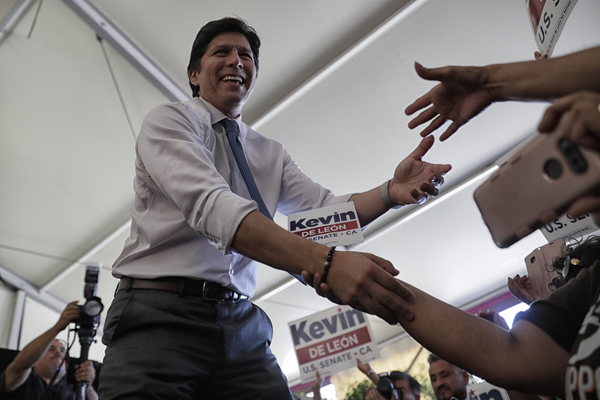
Rumors about De Leon challenging Feinstein crescendoed in recent days, notably after California's senior senator formally launched her re-election campaign for a fifth full term on Monday. Unlike previous years, she has faced heated criticism in recent months from liberal critics who have said her measured approach is no longer representative of a state that has become home to "the resistance" to President Donald Trump and his policies. Feinstein also drew rebukes from members of her party when she called for "patience" with Trump this summer, saying he could develop into a good president.
De Leon faces significant challenges in his effort to unseat Feinstein. She is a well-respected party elder who is among the most powerful Democratic forces in the state and the nation. She is also among the wealthiest members of Congress and could easily self-fund a campaign if she needed to.
But political strategists say that while she enjoys institutional advantages, she can't take for granted that this may be her toughest election since her 1994 re-election campaign. Making her case to younger voters who are unfamiliar with her record as well as the most liberal wing of the party that is hungry for a flame-throwing critic of Trump will be key.
Among De Leon's greatest challenges is likely to be fundraising. As a state party leader, he has cultivated relationships with some of the most prominent donors in the state, but some might be wary of challenging a sitting senator. De Leon also lacks a statewide donor base. And the roughly $3 million he has parked in state accounts can't legally be transferred to a federal race.

The child of an immigrant single mother, De Leon, 50, spent much of his childhood trekking from his humble home in the Logan Heights neighborhood of San Diego to the city's wealthier enclaves, where his mother worked as a house cleaner.
His upbringing would prove influential in shaping the political career that was to come.
He worked on campaigns and for labor unions, and won a state Assembly seat in 2006. In 2010, he moved to the Senate and was elected leader of that chamber in 2014 _ the first Latino to hold that position in more than a century.
In the Capitol, he has embraced high-profile legislative lifts, pushing state-sponsored retirement plans for low-income workers and background checks for ammunition purchases.

He has been a central figure in California's efforts to combat climate change, such as setting aggressive targets to reduce greenhouse gas emissions and extending the state's landmark cap-and-trade program.
But his environmental advocacy has also led to high-profile setbacks. A 2015 proposal to slash petroleum use in the state by 50 percent by 2030 collapsed and this year, his bill to phase out all fossil-fuel use by 2025 to generate energy sputtered in the legislative session's final days.
He also has eagerly embraced positioning California as the heart of the "resistance" against Trump and the federal government.
That posture was most evident in his signature legislation of the year, the "sanctuary state" measure, which limits state and local law enforcement's cooperation with federal immigration officials.