Welcome to the Wednesday, June 10, 2026, Brew.
By: Briana Ryan
Here’s what’s in store for you as you start your day:
- California is the 50th state to begin enforcing expanded SNAP work requirements
- Two candidates who previously represented Maryland's 6th District, and six others, are running in the June 23 Democratic primary
- A fourth vacancy to occur on the Utah Supreme Court this year, and other state supreme court vacancy updates
California is the 50th state to begin enforcing expanded SNAP work requirements
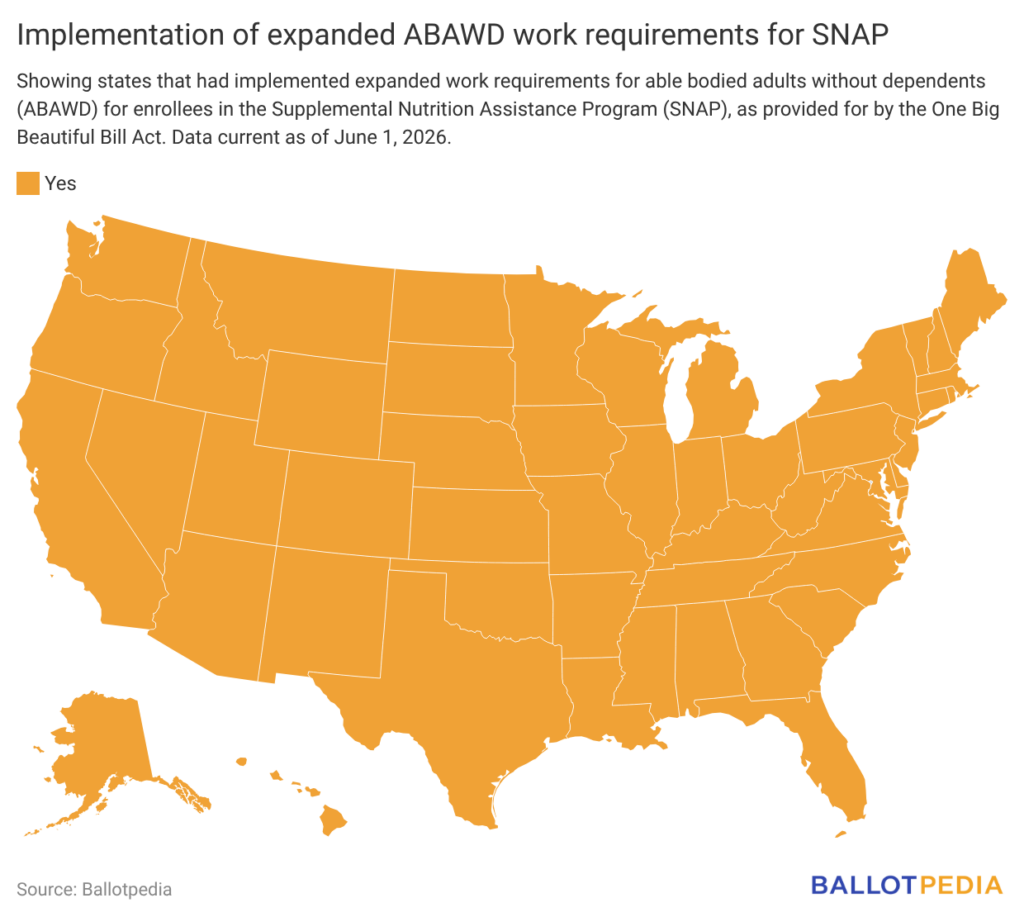
On June 1, California became the final state to implement the expanded work requirements for the Supplemental Nutrition Assistance Program (SNAP). These requirements were enacted on July 4, 2025, as part of the One Big Beautiful Bill Act (OBBBA), completing a national rollout of expanded work requirements for the program. The OBBBA made various changes to SNAP, including expanding work requirements, changing certain noncitizens’ eligibility, and modifying how utility expenses are used to determine eligibility and calculate benefit amounts.
SNAP has two types of work requirements, which are activities that certain recipients must complete to remain eligible for food assistance. These activities generally include work for pay, for goods or services, unpaid work, hours as a volunteer, participation in SNAP Employment and Training or another federal, state, or local work program, or a combination of work and work program hours. The two types of work requirements are:
- General work requirements, which apply to most adult recipients, including able-bodied adults without dependents (ABAWDs)
- ABAWD work requirements, which apply to ABAWDs in addition to general rules
An ABAWD SNAP recipient can only receive benefits for three months during a 36-month period without meeting the ABAWD work requirement, which is 20 hours of qualifying activities per week. The general work requirements include obligations such as registering for work, accepting employment if offered, and participating in assigned training programs, but do not require recipients to participate in covered activities for a specific number of hours per week. However, general work requirements prohibit recipients from voluntarily quitting a job or reducing their work hours below 30 per week without good cause.
The OBBBA expanded ABAWD work requirements by removing exemptions for certain individuals, though it added other exemptions. For more details on exemptions, click here.
Between January and April 2026, Ballotpedia conducted research into state compliance with these and other SNAP-related provisions of the OBBBA. Forty-nine states implemented the new work requirements between Nov. 1, 2025, and April 22, 2026. California was the final state to do so on June 1.
According to the same research, at least 29 states had implemented changes to comply with modified noncitizen eligibility. The OBBBA removed eligibility for SNAP for groups including refugees, individuals granted asylum, and several groups of immigrants who are not lawful permanent residents. Twenty-four states had terminated Heating and Cooling Standard Utility Allowance categorical eligibility, while 33 states had terminated internet cost deductions. Click here for more information about changes to noncitizen eligibility, and here for more on changes related to standard utility allowances.
Debates about work requirements for public assistance include arguments about whether they reduce fraud, alleviate poverty, promote self-sufficiency, and the ability of officials to effectively administer these requirements.
Arguing in support of work requirements, Rachel Sheffield, a former policy analyst at the Heritage Foundation, wrote, “Work requirements serve as a gatekeeper to ensure that those truly in need receive welfare assistance. Benefits are available to those who need them, but individuals who could otherwise find a job are directed toward work. This policy benefits not only taxpayers but also the individuals who are steered toward the job market, where they can build their resumes, skills and connections”
Arguing against work requirements, Heather Hahn of the Urban Institute wrote, “Studies of Medicaid and SNAP have shown that even without work requirements, eligible people lose access to basic health care and food for administrative reasons such as not completing paperwork on time, not receiving notices, or office errors.”
Click here for more arguments about work requirements for public assistance, and here for information on state implementation dates and research into other SNAP-related provisions from the OBBBA.
Two candidates who previously represented Maryland's 6th District, and six others, are running in the June 23 Democratic primary
Eight candidates are running in the June 23 Democratic primary for Maryland's 6th Congressional District, including two candidates who have already represented the District — incumbent Rep. April McClain Delaney (D) and former Rep. David Trone (D).
This primary is one of four in which a former member of the U.S. House of Representatives is running against the incumbent in a district.
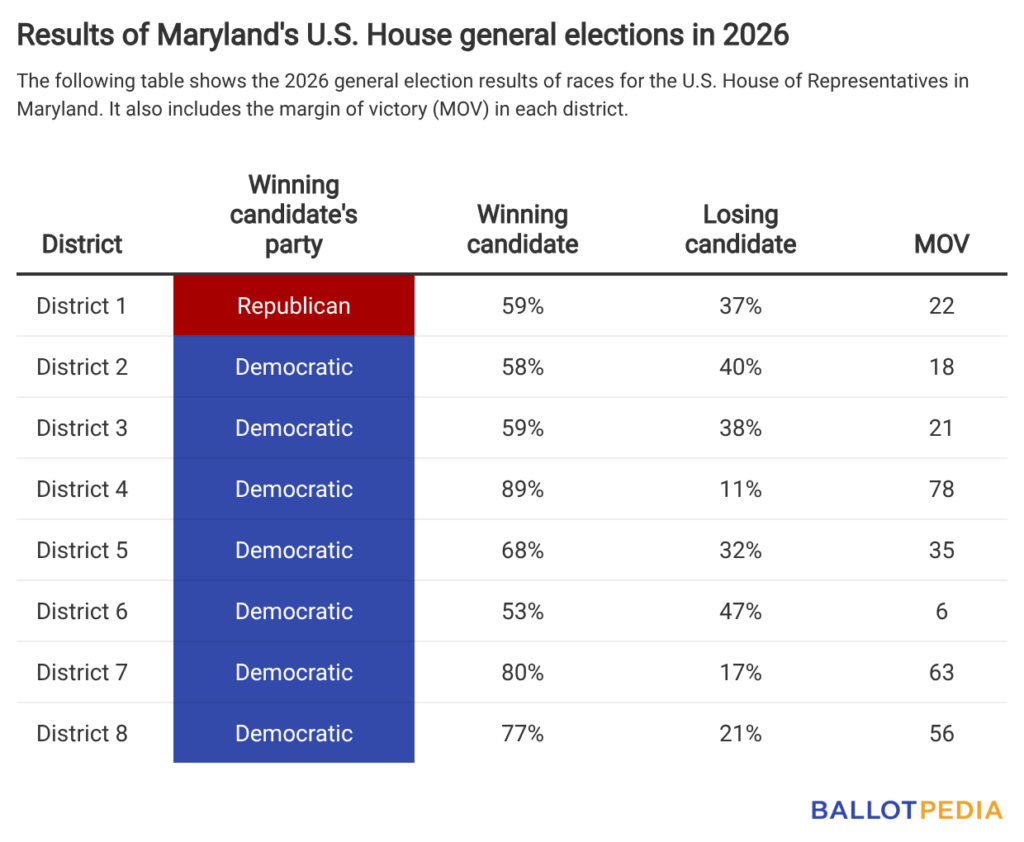
Trone represented the District from 2019 to 2025. In 2024, he did not run for re-election and instead ran in the Democratic primary for the U.S. Senate in Maryland, losing to Angela Alsobrooks (D) 53.4% to 42.8%. In 2024, Trone endorsed McClain Delaney for the 6th Congressional District. McClain Delaney defeated Neil Parrott (R) 53% to 47% in the 2024 general election. In that year's general elections, McClain Delaney won by the tightest margin of any U.S. House candidate who ran in Maryland.
Inside Elections' Nathan Gonzales writes, "With Trone's deep pockets and McClain Delaney being an incumbent, the 6th District could end up being one of the most expensive House primaries in the country." Founder of Total Wine & More, Trone has self-financed his campaigns. In his 2024 U.S. Senate campaign, he spent more than $61 million. In his initial U.S. House election in 2018, he spent more than $18 million. McClain Delaney has also self-financed her campaigns, but to a lesser extent than Trone. In 2024, she spent approximately $4 million on her campaign for the U.S. House.
Where Trone outpaces McClain Delaney in fundraising and spending, McClain Delaney does the same in endorsements. Her notable endorsements include Sen. Chris Van Hollen (D-Md.), Maryland Gov. Wes Moore (D), Rep. Nancy Pelosi (D-Calif.), and every Democrat in the Maryland U.S. House delegation. Trone's notable endorsements included state and local officeholders, including Maryland Senate Majority Leader Nancy King (D).
George Gluck (D), Alexis Goldstein (D), Daniel Krakower (D), Kiambo White (D), and Altimont Wilks (D) are also running in the Democratic primary.
Click here to read more about the Democratic primary for Maryland's 6th Congressional District. Also, if you're a Maryland voter, check out our Sample Ballot Lookup here to prepare for Election Day.
A fourth vacancy to occur on the Utah Supreme Court this year, and other state supreme court vacancy updates
In May, two Utah Supreme Court justices announced their resignations — meaning the Court will have its fourth opening within nine months. Meanwhile, the makeup of three other state supreme courts also changed in May.
Two Utah Supreme Court justices announced their resignations
On May 8, Justice Diana Hagen resigned from the Court after Gov. Spencer Cox (R) and Republican leaders in the Utah Legislature announced they would pursue an investigation into her conduct while in office. Cox appointed Hagen to the Court in 2022. On May 22, Chief Justice Matthew Durrant announced his resignation from the Court effective Aug. 31. Gov. Michael Leavitt (R) appointed Durrant to the Court in 2000.
The resignations follow Cox's signing of SB 134, which increased the number of justices on the Court from five to seven. Click here to read our coverage of this bill in the May 19 Daily Brew.
As a result, Durrant's departure means the Court will have its fourth opening within nine months. Cox has not announced successors for either Hagen or Durrant. However, on June 2, Cox announced that he would appoint Jay Jorgensen and Stephen Dent to fill the newly created seats on the Court.
One Hawaii Supreme Court justice was sworn out as an associate justice and sworn in as chief justice
On May 5, Vladimir Devens was sworn in as chief justice of the Court. Gov. Joshua Green (D) appointed Devens as an associate justice in 2023. Hawaii is one of 21 states with a specific seat for the chief justice, meaning Devens vacated his associate justiceship position the same day he was sworn in as chief justice. Green has not announced Devens’ successor.
Justice-elect waiting to be sworn in to the Louisiana Supreme Court
In the May 16 special Republican primary to succeed Justice William J. Crain on the Court, William Burris (R) defeated Blair Downing Edwards (R) 58% to 42%. Since only Republican candidates ran for the seat, Burris will be Crain's successor without appearing on the general election ballot. Burris has yet to be sworn in.
One Minnesota Supreme Court justice announces resignation after chief justice appointment
On May 19, Gov. Tim Walz (D) appointed Theodora Gaïtas to serve as chief justice of the Court. Minnesota has its own separate chief justice position, meaning Gaïtas effectively announced her retirement as an associate justice from the Court the same day. Gaïtas was appointed to succeed outgoing Chief Justice Natalie Hudson, who announced in April that she would step down in September 2026. Walz appointed Gaïtas as an associate justice in 2024. Walz has not announced Gaïtas' successor.Click here to learn more about this year’s state supreme court vacancies.