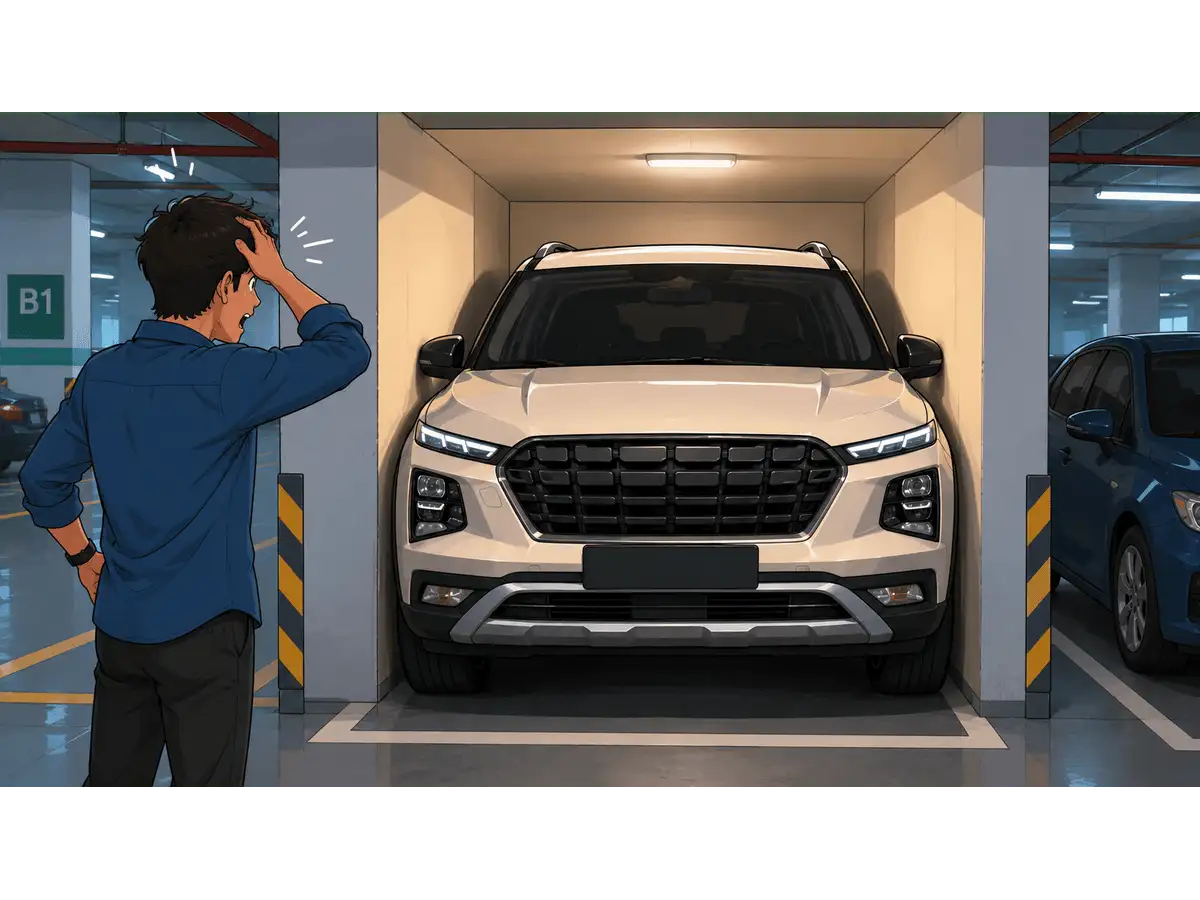
Parking disputes between homeowners and builders have skyrocketed in recent years, thanks to the availability of big cars at affordable prices and the growing variety of vehicle sizes (like SUV, micro SUV, body on frame SUVs).
For example, not long ago, if you had a budget of Rs 15 lakh, your choices were limited to just a few body on frame SUVs. Now at the same price, you can get the Thar, new Duster, Seltos, Carens, Sierra, Creta, Harrier, Scorpio N, Hector, Xuv 7xo and many others. But with the surge in big SUVs, another problem has emerged: parking space.
Recently a homeowner in Mohali faced a similar issue when he claimed that the builder favoured other buyers by allotting them better parking spots while he was stuck with a far off, less desirable space for parking.
So, he complained to the Punjab RERA authority about the situation. He argued that the parking space allotted to him possibly violated the National Building Code (NBC) norms as well.
In his complaint, he cited the National Building Code (NBC) of India guidelines that outlines the minimum dimensions for parking space: 3m x 6m for individual car spots and 2.75m x 5m for common car spaces, with scooter/two- wheeler spaces needing at least 1.25 sq m and bicycle spaces at least 1.00 sq m. He, meanwhile, was given a parking space measuring just 2.2 meter by 4.1 meter, making it impossible for him to park the car in such a cramped space.
However, he lost the case in Punjab RERA.
Also read: Bought a flat but parking too small and far away? Homebuyer filed case but lost in RERA; here’s why
Zahir Tapia, Associate, ALMT Legal, said to ET Wealth Online that the RERA Regulatory Authority expressly recorded that there is no provision in the Real Estate (Regulation and Development) Act, 2016 (“Act”) empowering it to direct a builder to (i) reserve 5% common parking for guests, (ii) allocate an equal number of parking slots to all flat owners, or (iii) prescribe or enforce any particular size/area of parking slots.
The RERA Regulatory Authority also relied heavily on regulatory approvals already in place. They noted that both Occupation Certificate and Completion Certificate had been issued by the competent authority in accordance with the applicable laws and building bye-laws, and the sanctioned plan from GMADA recorded parking details consistent with the details furnished at the time of RERA registration.
Tapia says: “This was treated as proof that the builder had adhered to the approved plan, undermining the allegation that the parking layout was illegal or violative of norms.”
Advocate Rajeev K Jha, Founder & Director, Sarve Permits & Legal Advisory, told ET Wealth Online that there are multiple legal landscapes and judicial precedents governing parking space issues for home buyers.
Also read: Don’t wait till possession: 4 parking checks every homebuyer must do early
Here’s a size table for reference for parking requirements:
| Parking Type |
Standard Dimensions (Meters) |
Standard Dimensions (Feet) |
Typical Suitability |
| Standard Residential | 2.5m x 5.0m | 8.2 'x 16.4' | Hatchbacks and Sedans (Kwid, Alto K10, Amaze, Dzire) |
| Comfortable/ Large | 3.0m x 5.5m | 10' x 18' | Compact SUVs (XUV 3xo, Punch, Kiger, Magnite, Venue, Sonet, etc) |
| SUV/ Premium | 3.0m x 6.0m | 10' x 20' | Large SUVs (Creta, Harrier, Sierra, Seltos, Endeavour, Fortuner, etc) |
| Compact (Reduced) | 2.3m x 4.5m | 7.5' x 14.8' | Only permitted for up to 50% of slots in some states (Punch, Exter, etc) |
Here are some of the legal landscape about parking space:
1. The common area vs. garage distinction:In the Indian legal context, parking spaces are categorized based on their physical structure, which determines whether a developer can legally sell them. The landmark Supreme Court judgment in Nahalchand Laloochand Pvt. Ltd. vs. Panchali Co-operative Housing Society Ltd. (2010) remains the cornerstone of parking law.
-
The ruling: The court held that "open" or "stilt" parking areas are common areas and facilities. Because the cost of common areas is factored into the flat price, the developer cannot sell them separately.
-
The "garage" exception: A developer can only sell a parking space as an independent unit if it qualifies as a "garage", defined as a structure with a roof and walls on three sides.
2. RERA 2016 and transparency: Under the Real Estate (Regulation and Development) Act, 2016, developers are mandated to disclose the number and type of parking spaces in the project.
-
MahaRERA Order No. 54/2024: Recently, the Maharashtra RERA mandated that "size" must include length, breadth, and vertical clearance for basement or mechanized parking.
-
Karnataka RERA (K-RERA) Guidelines: Similar to Maharashtra, K-RERA now requires developers to include the specific parking slot number and dimensions in the allotment letter and sale agreement.
A frequent issue raised is on "encroachment by structural elements." While a slot may be 2.5m wide on paper, the presence of a pillar can reduce the usable width to less than 2.1m.
-
Judicial view: Consumer Courts have increasingly ruled that "insufficient basement space" resulting from pillars constitutes a Deficiency in Service. In the case of M/S New Generation Real Estate (Pvt.) vs. Ramesh Chander Bawa, the State Consumer Commission noted that charging for parking and providing an unusable space is a punishable trade practice.
Critical legal case laws & judgments (judicial precedents):
According to Jha, here are some of the important judicial precedents related to parking disputes:
1. Enforceability of the sale agreement
In Veena Developers vs. Homebuyers (MahaRERA, 2025) case, the developer allotted parking in a different wing than where the buyers resided. The authority ruled this was a violation of the 2021 circular that mandates apartment-linked, numbered parking spaces. The developer was ordered to rectify the allotment within 60 days.
2. Denial of extra car entry
In Anup Mittal (HUF) vs. M/S (Delhi High Court), the court discussed the rights of societies to manage limited parking space. It upheld the society's right to levy higher charges for a 3rd or 4th car to discourage congestion, reinforcing that a home-buyer's right is typically limited to the specific slot(s) mentioned in their registered deed.
3. Mechanized (stack/puzzle) parking
As developers move toward mechanized systems to save space, litigation regarding "headroom" and "weight limits" has spiked.
-
Legal standing: If the mechanized system cannot accommodate a standard SUV (often due to height constraints < 2.2m), and this was not disclosed at the time of sale, it is considered misrepresentation.
4. Daily issues and "aisle width"
Beyond the slot itself, the Aisle Width (the space between two rows of parked cars) is a major issue.
-
NBC guidelines: The National Building Code suggests a minimum of 6m for two-way traffic in basements.
-
The issue: Developers often reduce this to 4.5m to cram in more units. This creates a "turning radius" issue where a resident cannot enter their own 5m slot without a 5-point turn, leading to accidental damage and neighborly disputes.