LONDON - British artist David Hockney, one of the most influential and defining figures in contemporary art, whose paintings captured the world in brilliant colour, has died at the age of 88, his publicist said on Friday.
One of the leading participants in the Pop art movement in the 1960s, Hockney established himself as a globally renowned painter and master draughtsman and kept painting, experimenting and exhibiting right up until his death.
Lauding him as “one of the most important figures in contemporary art in both the 20th and 21st centuries”, publicist Erica Bolton said he died “peacefully at home” in London on Thursday, a month before his 89th birthday.
“His seven-decade career and prolific oeuvre was characterised by his multi-media approach in image making, an intellectual inquiry into the nature of depiction and perspective, and a sustained commitment to celebrating and portraying the world around him,” her statement added.
Britain bestowed the Order of the Companions of Honour on Hockney in 1997, while earlier this year he became one of the few non-French citizens to be awarded France’s highest civilian honour, the legion d’honneur.
Tributes began to emerge within minutes of the announcement.
“His huge achievement was to make serious painting look effortless,” art historian Richard Morris said on X.
“He carried forward one of the most sustained investigations into vision, space and representation by any post-war artist. British art has lost a giant.”
The famous Pompidou Centre in Paris — with which he collaborated for two landmark exhibitions — said he was “unquestionably one of the major figures of contemporary art”. The works he leaves behind remain “dazzling, alive and eternal”, it said.
Yorkshire roots
Born in 1937 in west Yorkshire, in northern England, Hockney trained at the Bradford School of Art in the region and then at London’s Royal College, from which he graduated with a Gold Medal distinction.
A conscientious objector who did his military service as a hospital orderly, Hockney went against the conventions of post-war Britain, realising at an early age that he was gay and that he wanted to be an artist.
“It used to be you couldn’t be gay. Now you can be gay but you can’t smoke. There’s always something,” the lifelong smoker told The Guardian in 2015.
Early works such as “We Two Boys Together Clinging” boldly referenced same-sex relations at a time when they were taboo.
His abstract painting “Doll Boy” — a reference to his crush on the pop singer Cliff Richard — caught the eye of the art dealer John Kasmin, who bought it for 40 pounds.
“I sent him a letter at the Royal College of Art, where he was a student, inviting him to tea,” Kasmin recalled in 2013.
“He had black crew-cut hair and National Health glasses and was frightfully shy and very poor. … I started selling the odd drawing on his behalf for seven or eight pounds.”
Shortly after graduating, Hockney had his first solo exhibition in Kasmin’s gallery. It sold out, and Hockney began to emerge as an iconic figure with his signature bleached-blond mop, round-rimmed glasses and eye-catching sartorial style. (Story continues below)
Making a splash
Hockney moved to California in 1964 and began painting the bright, pared-down, sun-soaked scenes that were to seal his reputation as a major figure in the pop art movement, particularly his 1967 “A Bigger Splash”, capturing the moment after someone has dived into a swimming pool.
In 2018, his iconic swimming pool picture, “Portrait of an Artist (Pool with Two Figures)” sold for $90.3 million in New York, setting a new auction record for a living artist. He was unseated by Jeff Koons’ “Rabbit” a year later.
His jet set life took him from the south of France to Morocco, London, New York and Los Angeles, where he painted portraits of the designers, dancers and artists who were his friends.
By the late 1960s, “he wasn’t in the faintest a shy person”, Kasmin recalled.
“He was already a star living all over the world, mixing in high society, staying in grand hotels — and usually in some sort of emotional turmoil.”
Known for his mischievous humour and charm but also for his occasional plain-spoken combativeness, Hockney enjoyed a wide circle of friends while remaining close to his parents, whom he painted in several memorable portraits.
Always an industrious worker, his oeuvres ranged from stage set design to photography and printmaking.
In the 1980s Hockney invented a kind of photo collage he dubbed “joiners” that used slightly different images to produce a patchwork akin to the cubist painting of his hero Pablo Picasso. (Story continues below)
From Polaroid to iPad
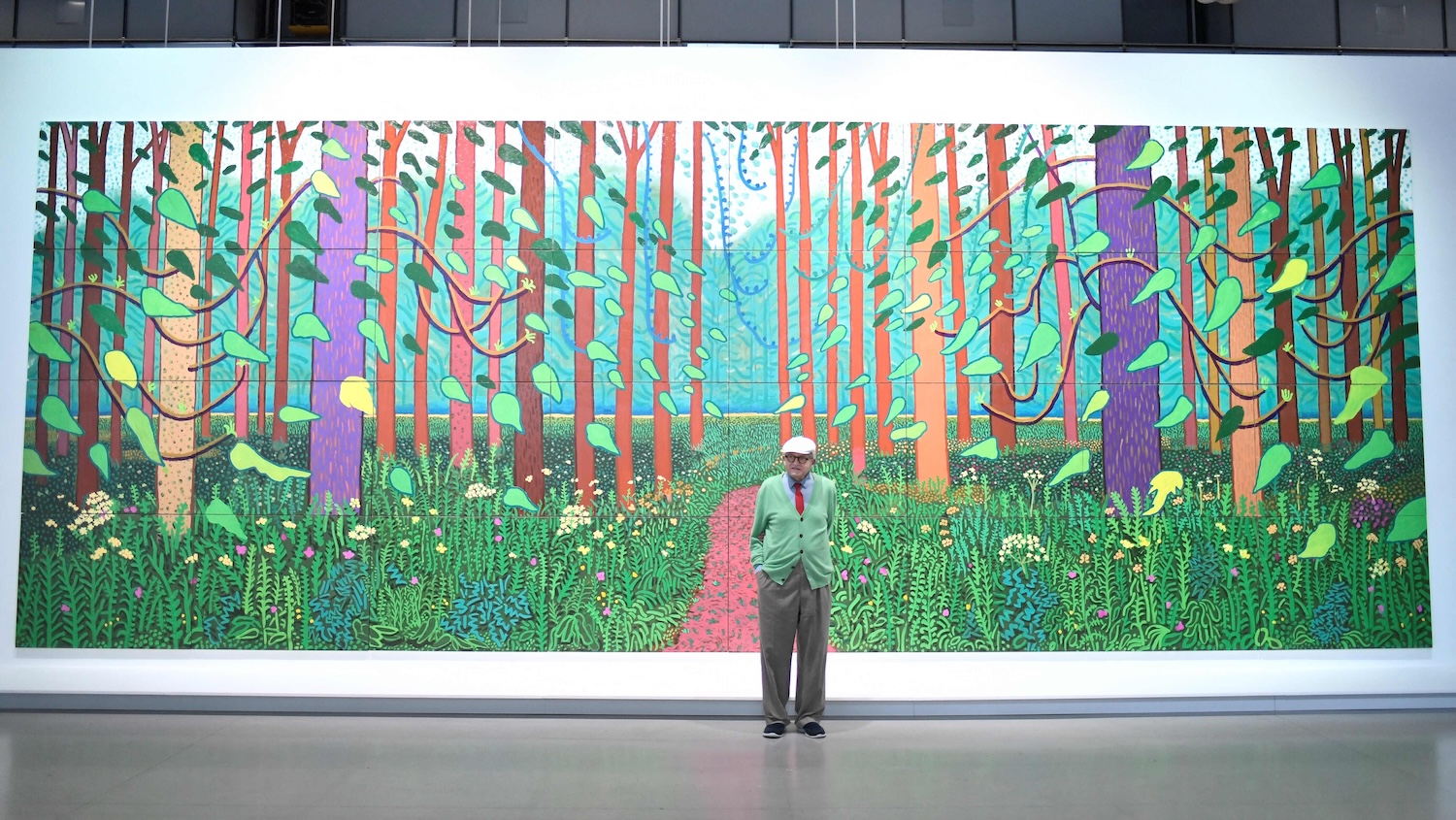
Throughout the 1990s Hockney returned to his native Yorkshire frequently to visit his mother before her death. His visits became longer and he began painting the Yorkshire countryside, reinventing himself as a landscape artist.
A keen adopter of technologies like the Polaroid and video cameras throughout his career, Hockney embraced the Apple iPad in his 70s. Massive prints of the works created on the tablet featured in his 2012 exhibition “A Bigger Picture” at the Royal Academy of Arts, which won mixed reviews.
He returned from the United States to live in east Yorkshire, but a few years later moved to northern France after falling in love with the verdant landscapes that inspired impressionist master Claude Monet.
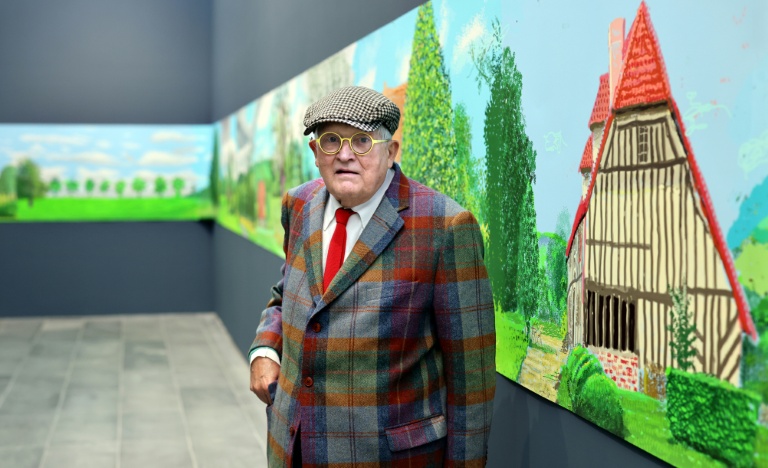
In interviews the dapper artist with his trademark flat cap waxed lyrical about the place where he was locked down during the Covid-19 pandemic.
He embraced the enforced isolation as an opportunity to devote himself to painting the arrival of spring in a riot of bright colours infused with strong light.
“If you look at the world, it’s very beautiful,” he told AFP in October 2021 during a Paris exhibition of his Normandy works.
He returned to London in 2023 to escape “intrusion” in Normandy, where he said people “kept coming round”.
Although increasingly frail and in need of a wheelchair, he was actively involved in the staging of a wide-ranging exhibition of his career in Paris in April 2025.
Hockney is survived by his long-time partner and companion Jean-Pierre Goncalves de Lima, two brothers and “numerous nieces, nephews, great-nieces and great-nephews”, his agent said.