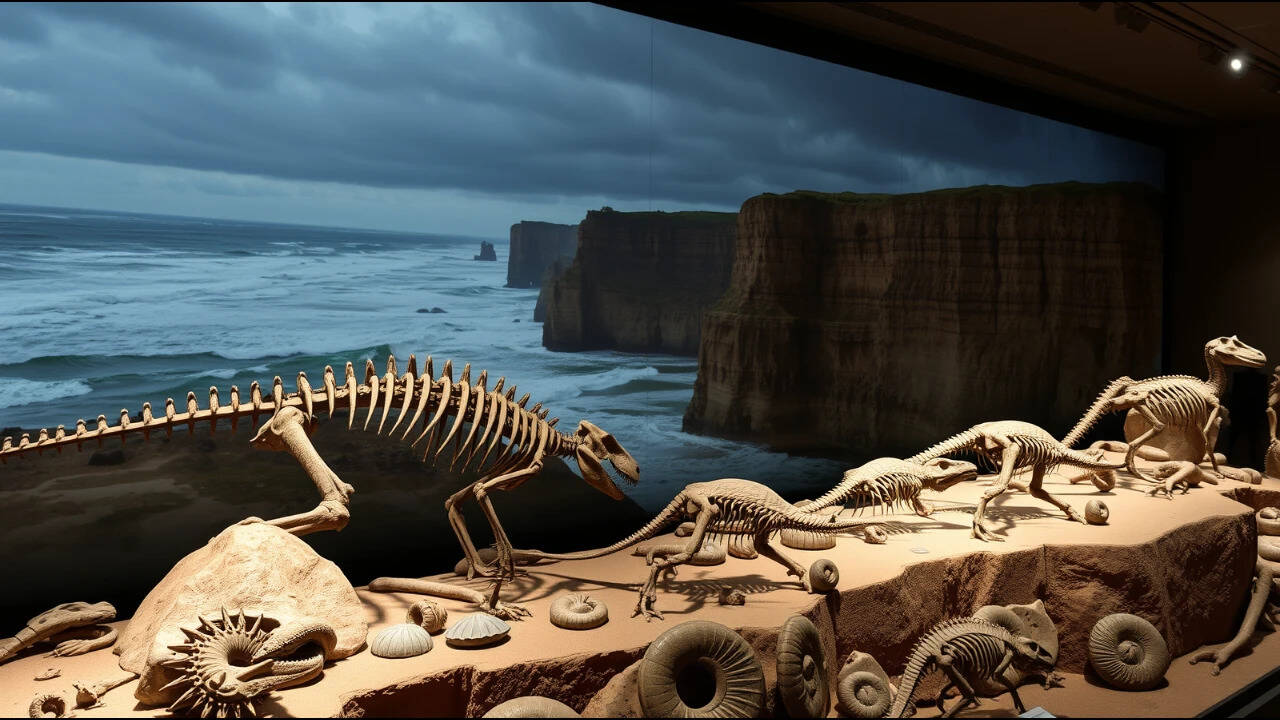
For decades, Dorset-based fossil hunter Chris Moore combed the cliffs and beaches around Lyme Regis and Charmouth, part of England's UNESCO-listed Jurassic Coast, gradually assembling a collection of 318 specimens spanning ichthyosaurs, fish and crustaceans, including fossils that could potentially represent species new to science. Under the region's fossil collecting code, Moore first offered the collection to the Natural History Museum in London and Amgueddfa Cymru, the national museum of Wales, giving British institutions an opportunity to acquire it before it could be sold elsewhere. Neither museum was able to secure the funding required to purchase the collection, which was eventually acquired by the Natural History Museum Abu Dhabi and put on public display there in November 2025. The sale has since prompted concern among British palaeontologists and renewed debate over whether UK museums have sufficient funding to preserve scientifically important fossils discovered on Britain's own coastline.
Get breaking news anytime, anywhere. Download the TOI app now!
Why UK museums could not afford to acquire Chris Moore's fossil collection
According to reporting by GB News, which drew on an investigation originally reported by The Guardian , the Natural History Museum in London told those involved that it did not have funding available for the acquisition when Moore's collection was offered. The museum had reportedly hoped that the specimens could remain in Britain, but the potential purchase involved more than simply finding a suitable exhibition space. Storage requirements, staff time and the practical work of packaging and caring for hundreds of specimens were also considerations for an institution already operating under financial constraints. The offer was made under the voluntary fossil collecting code applying in West Dorset, which gives UK-registered museums a six-month opportunity to acquire scientifically important specimens before collectors can offer them elsewhere. When that period expired without a British institution securing the necessary money, the collection was able to be sold overseas. The episode highlights a difficult reality for public museums: even when institutions recognise the scientific value of a collection, recognising its importance does not necessarily mean having the resources to buy, store and curate it.
How Britain's fossil market has become increasingly difficult for museums to compete in
Moore's collection also illustrates how the international fossil market has changed, with exceptionally important specimens commanding prices that can put them far beyond the reach of publicly funded museums. The Natural History Museum Abu Dhabi has already become a major destination for high-value fossils, including the famous Stan the T. rex, which sold for $31.8 million in 2020 before eventually becoming part of the Abu Dhabi museum's collection. Other dinosaur fossils have also attracted enormous sums on the international market, while wealthy private collectors have increasingly competed with institutions for scientifically significant specimens. Unlike antiquities and many other categories of cultural property, fossils do not face a comprehensive UK export-control system specifically designed to prevent important palaeontological discoveries from leaving the country. The West Dorset collecting code therefore plays an important role in giving British museums the first opportunity to acquire significant finds, but it does not guarantee that they will have the money to do so. In Moore's case, that gap between access and affordability ultimately meant that a collection built over decades on Britain's Jurassic Coast would leave the country.
What the Abu Dhabi acquisition means for Britain's Jurassic fossil heritage
The sale has also exposed a second problem beyond the funding gap at Britain's largest museums: the local institution closest to the fossils says it was never given the chance to acquire them. Lyme Regis Museum, which has nationally and internationally important geological collections and sits at the heart of the Jurassic Coast, said it was not approached by Moore, the Natural History Museum, Museum Wales or any government body about whether it might want to acquire some or all of the collection. The museum's trustees have since argued that significant fossils should receive stronger protection under the same kind of national-heritage mechanisms used for important cultural objects, potentially giving UK museums time to raise money before such specimens can leave the country. The Natural History Museum Abu Dhabi, meanwhile, has said that a large majority of Moore's collection is already on public display in its Mesozoic Gallery. For British palaeontologists and museum leaders, however, the controversy raises a broader question: if fossils found on Britain's own coastline can be sold overseas without the country's museums even being uniformly notified, how can Britain ensure that scientifically important pieces of its geological heritage remain connected to the places where they were discovered? The issue is particularly significant on the Jurassic Coast, where fossils have shaped both modern palaeontology and the identity of communities such as Lyme Regis for more than two centuries. Lyme Regis Museum itself describes the area as a continuing source of new fossil discoveries and houses geological collections documenting that extraordinary history.