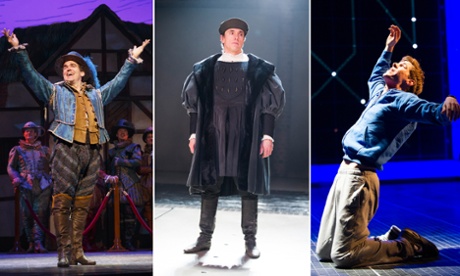
The crowds of US tourists outside Buckingham Palace suggest that some Americans remain oddly obsessed with the monarchy their founding fathers rejected. Yesterday King Henry VIII and Queen Elizabeth II were honoured by the republic’s leading theatre awards as The Audience, with Helen Mirren as the current occupant of Buckingham Palace, and Wolf Hall, in which Nathaniel Parker plays her wife-killing ancestor, received multiple Tony award nominations.
So is this a sort of Broadway Tea Party, a colonisation of New York theatre by invading Brits? The UK presence in this year’s nominations is far too pervasive to be dismissed as a statistical anomaly or a lucky year. In the non-musical categories, when it comes to the awards for leading and supporting actors, direction and set design, half or more of the nominees are British.
The high employability of talent of UK talent is especially evident in the technical sections, where set and costume designer Bob Crowley gets four nominations across three different productions (Skylight, The Audience and An American in Paris) while the lighting designer Paule Constable is recognised for both The Curious Incident of the Dog in the Night-Time and Wolf Hall.
But, while there is inevitably a jingoistic temptation to see these shortlists as proof of a golden age of London and Stratford theatre, it’s also the case that imports are more likely to prosper because the current epoch of Broadway is at best bronze.
It is now so expensive to stage and run a show in New York that the financial risk is mitigated by workshops, regional try-outs and off-Broadway runs that can keep a show in and out of development for many years.
Startlingly, the lyricist Fred Ebb, nominated with composer John Kander for the Broadway premiere of their musical The Visit, has been dead for 11 years. And the Texan playwright Robert Askins, recognised for his religious comedy Hand to God, has written a dozen plays, of which only two have reached production.
So one advantage of imported Brit hits is that they have been developed and proved elsewhere and – perhaps crucially – in a producing system that allows more risk and experimentation.
Many Broadway practitioners will note with envy that two of the successes flown over from London – Curious Incident and Wolf Hall – were underwritten by state subsidy at the National Theatre and RSC respectively. Such was the narrative and technical ambition of these plays that is unlikely they could ever have been developed in a structure where a commercial producer was bearing all the jeopardy.
Young actors in the UK also receive more direct teaching and experience in theatre than in the more screen-biased American drama schools. As a result, Britain has become a sort of experimental studio for Broadway.
Admittedly, yesterday’s shortlists are as much a triumph for the British novel as for UK drama: Curious Incident and Wolf Hall, though skilfully adapted by Simon Stephens and Mike Poulton respectively, are notable because they’re so original on the page.
One original script for theatre, though, should also be noted. One key test of a dramatist is whether their works revive successfully and David Hare’s Skylight gets Tony nods for a second time, two decades after its first New York production was nominated – further evidence that British theatrical power is not a blip.