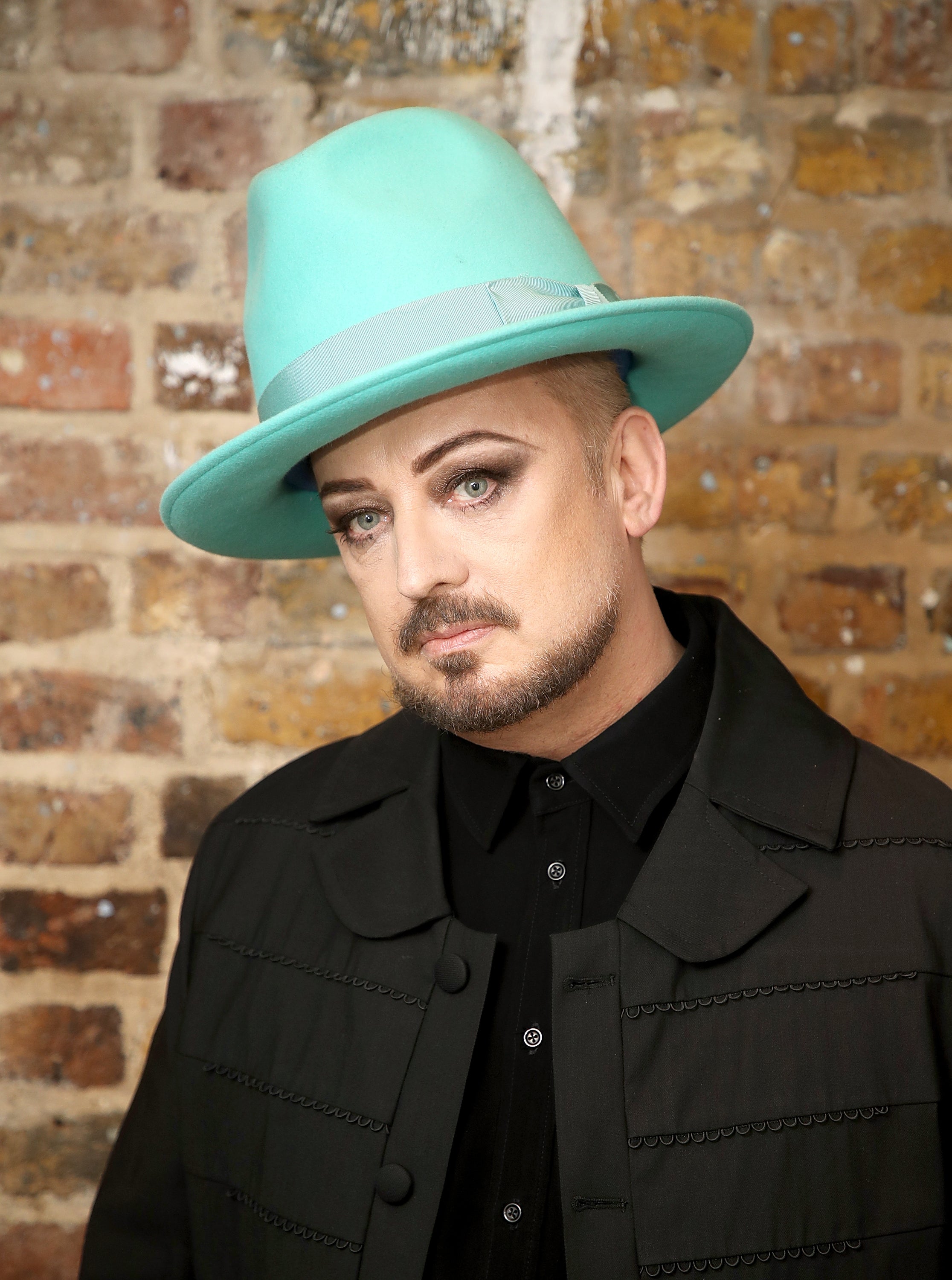
Boy George has quit Andrew Lloyd Webber’s production of Jesus Christ Superstar, days before he was due to perform, after a fierce backlash to his pro-Israel song.
Earlier this week, the singer, 65, released a track defending the country’s military action in Palestine and denying that a genocide is being carried out in Gaza.
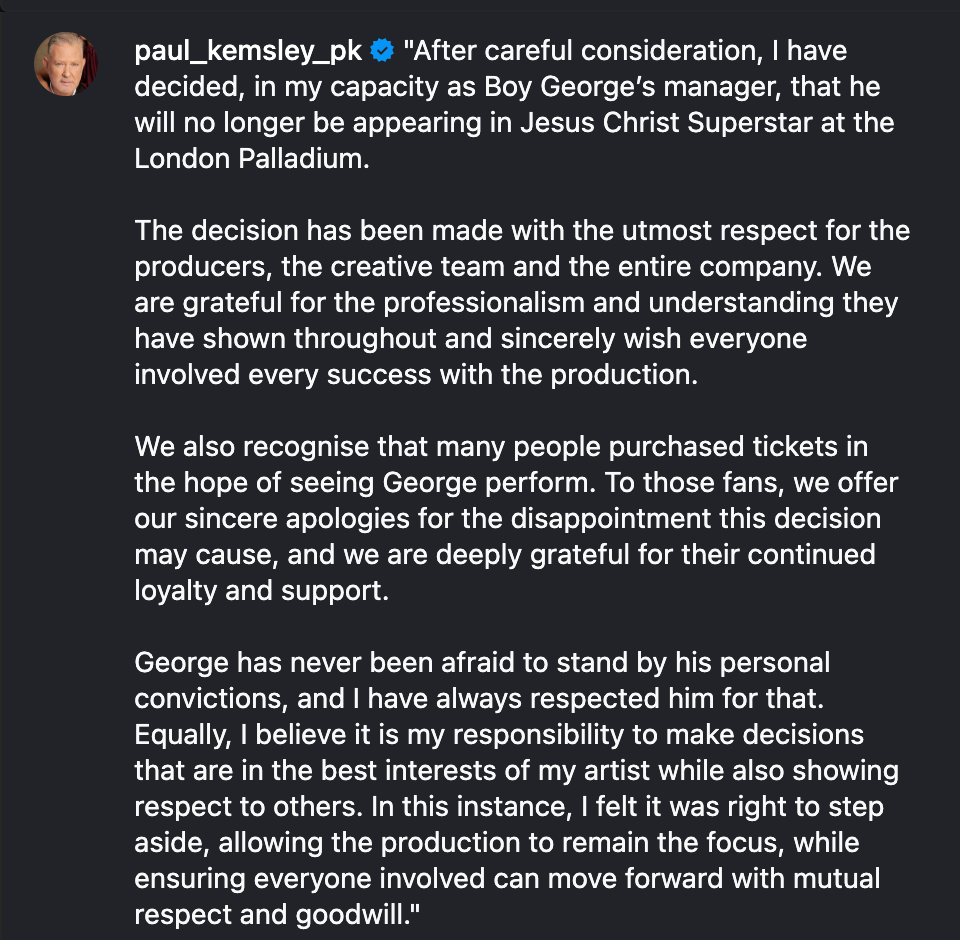
His manager, Paul Kemsley, said he decided to pull Boy George from the West End musical, currently on at the London Palladium, in the wake of the furore so as not to distract from the production. He was set to play King Herod – a one-song cameo role that’s being rotated – from 3 to 15 August.
“The decision has been made with the utmost respect for the producers, the creative team and the entire company,” Kemsley wrote on Instagram.
“We are grateful for the professionalism and understanding they have shown throughout and sincerely wish everyone involved every success with the production.”
He added that “George has never been afraid to stand by his personal convictions, and I have always respected him for that”, but added: “Equally, I believe it is my responsibility to make decisions that are in the best interests of my artist while also showing respect to others.
“In this instance, I felt it was right to step aside, allowing the production to remain the focus, while ensuring everyone involved can move forward with mutual respect and goodwill.”
Addressing the singer’s fans who had bought tickets, he said: “We offer our sincere apologies for the disappointment this decision may cause, and we are deeply grateful for their continued loyalty and support.”
The track in question was posted to the singer’s social media accounts this week with the Hebrew title, “עוד נרקוד”, along with its English translation, “We Will Dance Again”. It features the opening lyrics: “You say genocide, I say war/ When you’re attacked, that’s what the army’s for/ Does it get ugly? You bet it does/ When I know you wanna kill every last one of us.”
The phrase “We Will Dance Again”, which Boy George sings on the chorus, has been used by Israelis to express hope in the wake of the 7 October music festival attack by Hamas.
Elsewhere on the track, which is set to a reggae-pop beat, Boy George criticises the pro-Palestine movement, including musicians who have condemned Israel for its actions: “You condemn, with selective memory/ Musicians holding flags, mouthing like sheep/ Propaganda fuelled by the internet feels so weak.”
The track does not appear to be available on streaming platforms.
Last September, a two-year United Nations investigation found that Israel has committed genocide in Gaza, citing the bombardment that has killed over 73,000 Palestinians since the war started, the forced displacement of most of the two-million strong population, and the destruction of the healthcare system as well as the blocking of essential food, water, aid and electricity that has led to famine.
The commission also referred to the “use of starvation as a weapon” along with the torture, rape and sexual assault of Palestinian detainees, and environmental destruction. Israel’s foreign ministry called the UN report “distorted and false”.
Last month, another independent UN inquiry found that Israel was continuing to commit genocide by targeting children, a report branded a “libellous sham” by Israel.
In May 2026, Boy George said he did not have an opinion on the country ahead of his performance with San Marino for their 2026 Eurovision Song Contest entry.
When he was asked about the boycott by countries including Spain, Iceland and the Netherlands over Israel’s continued inclusion, he said: “I have many Jewish friends, whom I’ve known since I was 15 or 16 years old,” he responded. “Are people asking me, as someone with principles, to turn my back on my Jewish friends? That is not going to happen – it will never happen.”

Boy George, who is not Jewish, said he has worn the Star of David “from the beginning of my career” and that he felt “very connected to the Jewish people”. He added: “I’m not necessarily connected to Israel. I don’t really have an opinion on that. But the mission of music is to unite people.”
In an interview with The Telegraph, he reaffirmed his support for his Jewish peers. “Over the years, it’s become a really personal thing,” he said. “It doesn’t mean that I don’t have compassion for Palestinians, it doesn’t mean that I agree with what's going on in Israel, but I am always going to defend the people that I love.”
His song has been met with fierce condemnation from many on social media. Martyn Ware, the founder of pop bands the Human League and Heaven 17 and a former friend of Boy George, called the song an “overtly pro-genocide, anti-Palestinian piece of musical propaganda…” He wrote: “George, you should be ashamed.”
Patrick Clanton, who co-starred with Boy George in a Broadway production of Moulin Rouge, wrote: “Y’know, I used to defend his performance in our show, but f*** it. He was a terrible performer and I was embarrassed to be in the show with him. Boy, Bye!”
One long-time fan commented on Instagram: “I never imagined I’d be unfollowing Boy George after years of admiring him, but here we are. To release a song that, in my view, dismisses or downplays the immense suffering of Palestinians at a time when so many civilians have been killed, displaced and traumatised is something I simply cannot support.”
Boy George’s fellow pro-Israel supporters thanked him for the song, with one claiming it brought “tears to my eyes”.
Boy George became known as the colourful frontman of Culture Club in the Eighties, releasing hit songs such as “Karma Chameleon” and “Do You Really Want to Hurt Me”.
In 2008, he was sentenced to 15 months in prison for assault and false imprisonment after he “chained” then-26-year-old Audun Carlsen to a wall. He pleaded not guilty at the time.