The Florentine Renaissance weaver of floral fantasies Sandro Botticelli is a magical artist. Just to look at his masterpiece the Primavera is to have your spirits lifted, as if he knows how to release pleasure-giving chemicals in the human brain by particular combinations of colour and form.
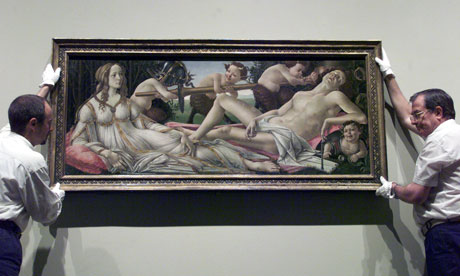
The question is, how literal is the magic in Botticelli's art? Are his paintings allegories, or entertainments, or something more – how shall we say this – practical? A fascinating new idea about Botticelli's alluring idyll Venus and Mars in London's National Gallery gives an old debate a contemporary twist. According to art historian David Bellingham, a strange plant pawed by a young satyr who plays about, clad in the discarded cuirass of Mars, at the bottom right of the panel, is a specimen of the hallucinogenic Datura stramonium, also known as "poor man's acid". According to this latest theory the pacified and disarmed war god Mars has actually been drugged by Venus, deity of love, who reclines wide awake and clothed beside his slumberous nude form.
This is not the first attempt to interpret Venus and Mars as something more tangible and efficacious than just a visualisation of Greek myth. In the past, the hermetic magical thought of the Florentine intellectual Marsilio Ficino was adduced by the Warburg Institute scholars EH Gombrich and Frances Yates to see Botticelli's paintings as "talismans": magical artefacts designed to actually exert benevolent effects on the beholder.
Personally I think both theories are very plausible. Botticelli's paintings do suggest real magic, real eroticism – they have an occult quality. Nor would it be surprising if the Medici court circles who supported his art at this time (Venus and Mars was painted about 1485) were taking love drugs. Such potions were well-known and were taken seriously in the Renaissance – you can see an aphrodisiac bottle decorated with snogging lovers in the Renaissance galleries at the V&A. Those same galleries boast a Florentine mirror from this period that has a Medici emblem and is emblazoned with Venus and Mars – associating the theme with actual bedrooms, not just classicist studies.
Love is a drug, and Botticelli painted its effects with rare conviction. It would hardly be surprising to find a hallucinogenic on the shelves of his art's life-giving pharmacy.