
Generation X spent three decades being defined by its own indifference—the “slacker generation,” too disengaged to bother with the culture wars being fought around it. Baby Boomers, meanwhile, are the generation that actually got the deal the American Dream promised: cheap houses, pensions, a stock market that mostly went up. Neither group was supposed to be the one lying awake over money.
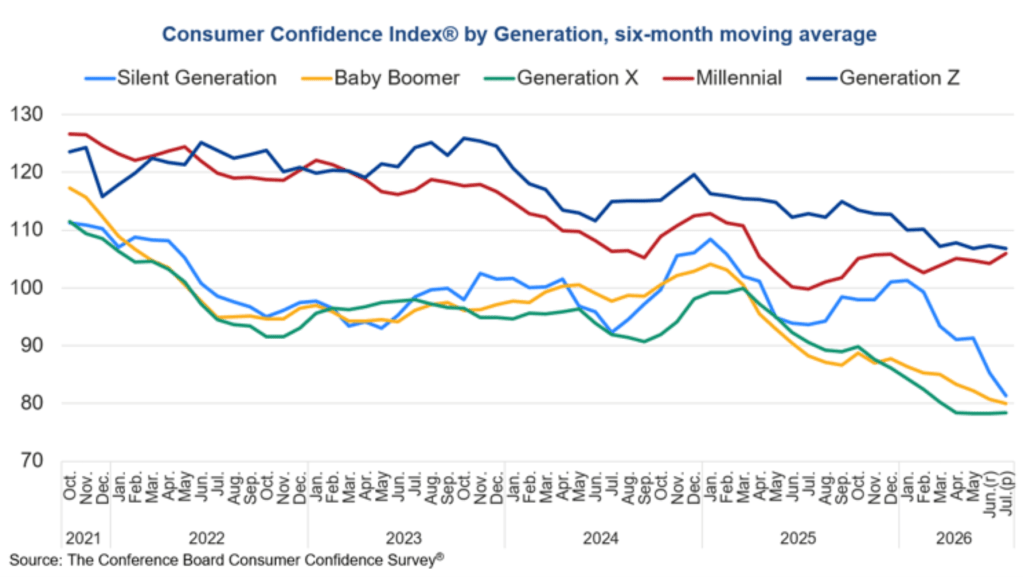
And yet: Gen X now has the lowest consumer confidence of any American generation, a six-month average of 78 points on the Conference Board’s Consumer Confidence Index—its worst reading in at least four and a half years. Boomers aren’t far behind, at 83, also their lowest since October 2021. Both have been sliding steadily since early 2025. Meanwhile, Gen Z and millennials—the generations popularly cast as burned out, doomer-pilled, and priced out of adulthood—have held their confidence roughly steady at around 110 points, respectively.
The sandwich generation is being squeezed from both ends
Gen X’s anxiety isn’t a mood; it’s structural, and it’s better documented than the Conference Board number alone suggests. This is the first generation of Americans hitting their 50s while simultaneously managing aging parents’ care and dependent kids’ expenses, at the exact life stage psychologists call the bottom of the U-shaped happiness curve.
The numbers back up the squeeze: 70% of Gen Xers say they fear running out of money more than they fear death, higher than millennials (66%) or boomers (61%). Nearly half—44%—say they aren’t confident they can save enough for retirement, worse than millennials (35%) or boomers (40%). A 2024 Northwestern Mutual study found Gen X believes it needs $1.56 million to retire comfortably but has saved an average of just $108,600—a $1.45 million gap. And in a CFP Board survey, 95% of Gen Xers said their financial regrets have already cost them real money, with 59% reporting stress and 40% reporting anxiety directly tied to it.
Boomers: wealthy on paper, anxious in practice
It’s not just the sandwich generation struggling. Baby boomers make up 20% of the U.S. population and hold 31% of the country’s wealth, or about $85 trillion in assets, but that massive sum isn’t equally distributed among the generation. Pew Research Center found that in 2022, the top 10% of Boomer households held 71% of the generation’s wealth, creating a lopsided effect where a handful could comfortably retire, while most have few financial resources for the next chapter of their lives. Nearly one-third of Americans 55 or older have no retirement savings, and of those with savings, about half have less than $100,000 in their accounts, according to a GoBankingRates survey.
For that chunk of older Americans, there’s plenty of reason to be worried about making finite financial resources last. Boomers and the Silent Generation in particular face rising healthcare costs as a result of living longer, and still have to afford groceries just on retirement funds, according to Morgan Ward, professor of consumer behavior at Emory University’s Goizueta Business School
“When the time horizons are shorter, you’re more sensitive to these swings because you know that you want to be able to access your money,” Ward told Fortune. “You can imagine that if there’s a really negative swing, you don’t have the time to wait for the market to recover.”
An AARP report published in June found home care inflation rose 7.9% in the last five years, nearly double the rate of overall inflation and triple medical inflation, meaning that for many households, the cost of long-term care outpaced income. For example, nursing home costs soared 25% between 2019 and 2024, while household income for those over 65 grew 22% over the same period.
Why Gen Z and millennials aren’t rattled
While older generations may be concerned with making sure their assets can last them the course of their lifetime, young people are just beginning their investment journeys, with more than half of Gen Z learning about investing before entering the workforce, compared to 20% of Boomers, according to 2024 World Economic Forum survey data. Gen Z and millennials have amassed a record $3.1 trillion in holdings.
Their interest in the stock market comes as buying a house remains out of reach for many, with home prices skyrocketing 235% since January 2000.
“For younger adults who despair about ever being able to buy a home, investing in financial markets can be a great way to save until they can afford one,” Chen Zhao, the head of economics research at Redfin, told Fortune.
Ward explained that despite being unable to attain traditional markers of economic success such as home-buying, Gen Z is able to find financial empowerment elsewhere, not just through investing, but paving the way for their own careers. The generation of digital natives has a distrust of authority and skepticism toward traditional paths of education, engendering an entrepreneurial spirit, she argued. A Bank of America Institute report published last month found Gen Z is “disproportionately” contributing to a boost in business growth, with Gen Z business applications growing about 66% year-over-year as of June, about the same as millennials, Gen X, and Boomers combined.
“You are not completely reliant anymore on a big company hiring you and then you retire in 35 years with a gold watch,” Ward said. “I think people feel a little more self-reliant.”
It doesn’t hurt that more young people are also living at home after college, relieving pressure to make rent or pay for other expenses, Ward added.
Where pessimism remains
That’s not to say younger generations are without economic anxiety. Gen Z’s AI adoption has basically stalled over the last year, with the generation growing more sour on the technology as discourse over its ability to automate entry-level jobs continues. According to an April Gallup poll, Gen Z’s excitement around AI fell 14 percentage points to 22%, and anger toward AI increased nine percentage points to 31%.
Moreover, Gen Z adults looking to buy a home are having to conceive that it may be a fantasy, with 34% of the generation worried they may not be able to ever afford a house, and 31% postponing the purchase because of financial pressures, per Northwestern Mutual’s 2026 Planning & Progress study.
But young people’s confidence—and older generations’ apprehension—of the economy may be completely separate from job prospects and inflation, argued Francesco D’Acunto, a finance professor at Georgetown University. Gen Z has already weathered a pandemic are grappling with the impact of a war and technological revolution.
“Precisely because their expectations already start from a relatively pessimistic baseline, additional negative news (such as geopolitical tensions or inflation) tends to move their short-term expectations less,” D’Acunto told Fortune in an email. “In a sense, they have already priced in a difficult future.”
On the other hand, Baby Boomers in particular, though faced with their own times of war and economic hardship, entered the housing market in the 1970s when inflation surged and made home-buying an appealing investment. They reached the financial milestones set for them, meaning during this period of economic volatility, they’re “more sensitive to bad economic news,” D’Acunto argued.
Sure Gen Z and millennials can feel lousy about the economy, but they may be able to more easily adjust their expectations knowing for years they may face uphill economic battles.
“Gen Z may be more pessimistic overall,” D’Acunto said. “But older generations may be more easily surprised.”