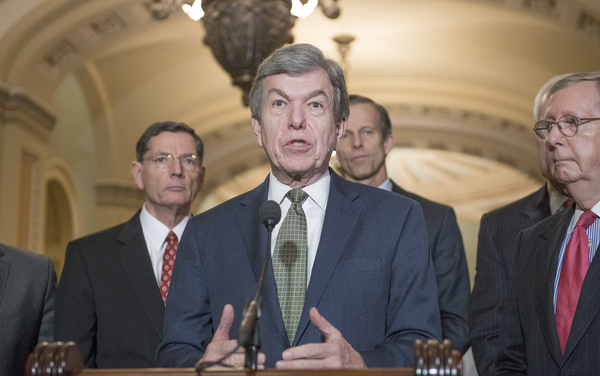
WASHINGTON _ As a first phase of a Senate Intelligence Committee investigation draws to a conclusion, Sen. Roy Blunt said Thursday he believes that the Russians had only a "marginal" effect on the 2016 elections that did not affect any outcomes.
He said in an interview Thursday that the Senate Intelligence Committee on which he serves should have recommendations on how to combat future meddling attempts by the March 20 primaries in Illinois.
Two days after the heads of the nation's top spy agencies told the Senate Intelligence Committee that Russia continues to sow discord and attack confidence in the nation's elections, Blunt, R-Mo., said he is confident that the administration of President Donald Trump is doing what is necessary to deal with the threat.
Democratic colleagues on the committee had complained that Trump did not seem concerned about the problem, and they criticized what they saw as a piecemeal approach to confront it.
"We cannot confront this threat, which is a serious one, without a whole-of-government response when the leader of the government continues to deny that it exists," said Sen. Angus King, I-Maine.
Blunt, the only St. Louis-area member on either congressional Intelligence committee, was asked whether he believed that Trump was taking the issue seriously.
"His agencies certainly seem to be," Blunt replied. "So when the president says the Russian investigation ... all he is talking about is collusion. If anybody thinks the Russians actually impacted the outcome of the election they just don't have the facts. The Russian involvement is unacceptable, but it is really pretty marginal."
Blunt accused Democratic critics of trying to have it both ways by criticizing Trump for not being more outspoken on Russian election influence while warning him to stay away from investigations into Russian meddling and whether or not his campaign colluded with the Russians.
"There is a lot of inconsistency on this and sort of the political point of the moment being made, and frankly most people, including me, are getting pretty tired of that," Blunt said.
In a public hearing this week, Democrats focused on National Intelligence Agency Director Dan Coats' assertion that there was "no single agency in charge" of the government's response to Russian meddling. Sen. Mark Warner, D-Va., said that meant the government had "no plan."
Senate Intelligence Committee Chairman Richard Burr, R-N.C., said the committee was likely to issue its report on Russian influence before primaries begin this year. Blunt said he expected that before the March 20 Illinois primaries.
"We don't want to see the actual election-day process itself impacted," Blunt, a former Missouri secretary of state, said. "Nobody believes that happened in 2016, and we need to take steps so that people have confidence so that it also won't happen in 2018. And it will be good to see that part of the report out."
He said that the report is likely to recommend ways to further guarantee the accuracy of election counts, including paper trails to verify computer-counted results.
But Blunt said he had no idea when a broader investigation of special counsel Robert Mueller would finish. That one has already produced indictments and guilty pleas, and has been an almost daily topic in the Trump White House.
Asked if he believed Trump's assertion that there was no collusion between the Trump campaign and the Russians, Blunt said: "My view continues to be that the (Trump) campaign had one asset, which was a candidate that understood the moment and (was) not very capable of anything much more complicated than that.
"I would be surprised that they were capable of collusion with the Russians because I don't think they were capable of collusion with the Republican National Committee," Blunt said.
Blunt said he had not been aware of reports before their publication in The Kansas City Star this week that there was evidence that Russian actors attempted to foment online discord in University of Missouri protests in 2015. The newspaper quoted a paper by an Air Force officer blaming Russians for starting an online rumor that the Ku Klux Klan was coming to campus. It was repeated on social media by Missouri Students Association President Payton Head, who later apologized after police called the reports false.
Blunt said, "I have read all the campus things about Missouri that have come to my attention" and that it "turned out that most of them" were not credible. He also alluded to Russian social media agitation after the shooting death of Michael Brown by a Ferguson police officer.
"Black Lives Matter would be sort of something that started, in my view, after Ferguson, and that was clearly one of the things the Russians were talking about," Blunt said. "I think it is important to understand here ... that the Russian activity in the election didn't usually mention any candidate, and tried to create a sense that the whole process somehow wasn't working the way it should.
"Some of it is anti-Trump, a lot of it is probably anti-Clinton," Blunt said. "But in the broad context of things it is fairly minimal in its impact, but still offensive."