Beyond the prehistoric standing stones of the Boleigh Pipers and Merry Maidens circle, the church tower of St Buryan dominates the skyline. The bus from Penzance arrives punctually and, in the morning sun, the time of day is clearly shown on the slate sundial above the church porch.
Within the spacious interior sunlight sparkles on the font of Ludgvan granite and enhances the original colouring on the 16th-century rood beam carved with foliage, birds and other beasts.
South of the village, within sight of the sea and three whirling wind turbines, plastic-covered fields are enclosed by hedgebanks topped with the yellow and white of gorse and blackthorn blossom.
Plastic was laid down at the time of planting to protect early potatoes, which are almost ready for harvesting. In one field a gang of about 30 workers roll back the perforated sheets to reveal triple rows of healthy potato plants growing in the sandy soil. The unwieldy sheets then have to be bundled and dragged off for disposal.
The footpath passes granite stiles, wayside crosses and a farmstead of holiday lets where lounger chairs face the sun and await the next visitors. Bullocks are turned out on pasture, and glossy rye grass is ready for the first cut of the forage harvester.
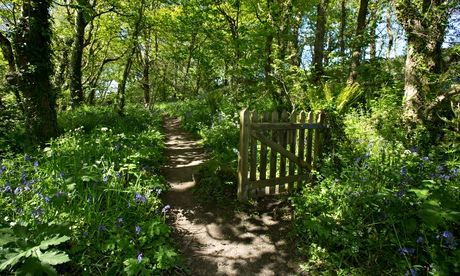
Beneath Boskenna, sycamores and oaks shelter the mossy gully of St Loy. In the shade, close to the sound and smell of the sea, flower primroses with bluebells, ferns, tall sorrel and red campion. A garden with magnolias and exotic tree ferns extends to the edge of the cove where a jumble of boulders slows progress along the coastal path towards the lighthouse at Tater Du, and more distant Lamorna.
Between the granite headlands and most exposed cliff-land, where thrift is now in flower, are the manmade terraces, which were renowned for early crops of daffodils, as described in Derek Tangye’s Minack Chronicles.
Survivors of those narcissi merge with bluebells, violets, bracken and thickets of frothy blackthorn. Most of the daffodils are already withered but later varieties, like ornatus, with its pheasant-eye centre and white petals, are still recognisable.
Twitter @GdnCountryDiary