
Coin miners (see below) enlist others to help them mine virtual currency by temporarily "borrowing" others' computers to harness more processing power.
Coin mining is a hot topic because of the recent virtual currency boom, but a series of operators who have installed mining programs on their websites have undergone police investigations over charges such as fraudulently directing the sharing or storing of electronic records. In these cases, coin mining programs have been judged "viruses," but some technology experts oppose this definition. Why?
Legality issues
In March this year, a 30-year-old web designer in the Tokyo metropolitan area was summarily prosecuted by the Yokohama District Public Prosecutors Office for the crime of storing a virus and ordered to pay a fine of 100,000 yen. The previous autumn, he had installed a program for coin miners called Coinhive on the music site he operated. The program was judged to be a virus.
"I never suspected it was illegal," he said.
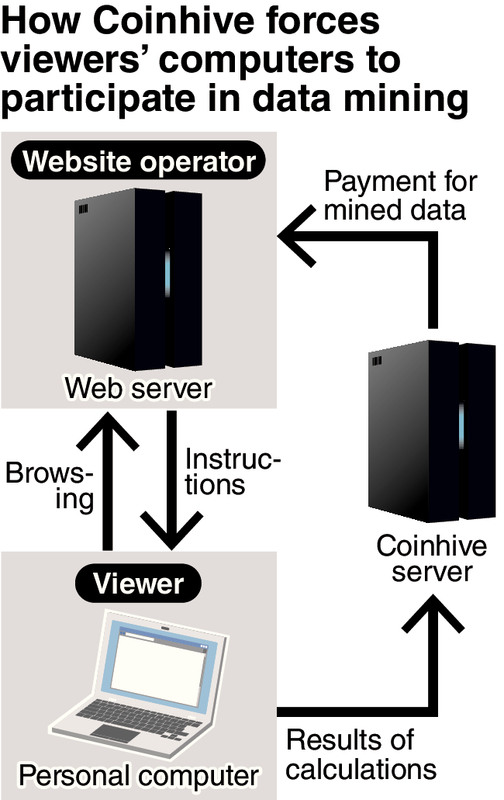
Coinhive was released by Argentine engineers last September. When a dedicated program is set up on a website, it causes viewers' browsers to perform calculations for mining and sends the calculation results to a Coinhive server. About 70 percent of revenue from the mined data goes to administrators, and 30 percent to developers.
The development team calls it "a new revenue model to replace advertising," and even UNICEF has adopted the method to solicit broader support in the form of donations. However, since the CPU of the viewer's computer is used for mining, the computer's processing speed slows down depending on the utilization rate setting. Also because the program at first lacked a function for acquiring viewers' consent, it was criticized for forcing unsuspecting users to assist in data mining.
In response, the police departments of Kanagawa, Miyagi, Tochigi, Ibaraki and other prefectures began investigating the program starting late last year. Five website administrators have been identified so far and are being investigated on charges of sharing and storing viruses, and a court has already issued summary orders in some of the cases. The Kanagawa prefectural police declined to comment, citing the ongoing investigations.
The 30-year-old web designer who received a summary order was unconvinced that he had broken the law and requested a formal trial. Takashi Hirano, the defendant's lawyer, argues the program does not fall under the category of "illegal activities, such as destroying viewers' personal computers or stealing information."
'Same as advertisements'
Some technology experts doubt Coinhive is illegal because it uses the same mechanism as advertisements that are commonly employed by regular websites today.
Both send instructions to the viewer's browser via a simple JavaScript program embedded in web documents on the site. For example, if a person browses a site that features Facebook's "Like" button, their browser information will automatically be sent to Facebook even if they never click "Like."
This information exchange is also directed by JavaScript. The only difference between JavaScript and Coinhive is that the former instructs the viewer's computer to provide information, while the latter instructs it to provide processing power for calculations.
An office worker in his 20s who uses Coinhive expressed misgivings, saying: "If this is illegal, advertising should also be illegal. I was interested in virtual currency services and have used them before, but now I'm scared to use new technology."
Determining 'fraud'
What is a virus and what is a legal program? The difficulty of drawing the line was highlighted during deliberations for the bill on revising the Penal Code, which established virus-related crimes in 2011.
The Penal Code defines a virus as "giving an illicit directive" to another person's computer to "prevent them from making intended actions or forcing them to make unintended actions ... without legitimate reasons." Concerning what makes a directive "illicit," however, the Justice Ministry only points out it should be "judged from the viewpoint of whether or not it is socially acceptable based on its function."
"What I was concerned about has occurred," said senior reasearch scientist Hiromitsu Takagi of the National Institute of Advanced Industrial Science and Technology. He had attended the House of Councillors Judicial Affairs Committee deliberations on revising the Penal Code.
"Using the viewer's CPU to perform calculations without permission is said to be problematic, but the CPU is used for viewing general content, too," Takagi added. "Video advertisements may use more of the CPU's power than Coinhive. I can't understand why this is suddenly being treated as a crime."
However, Hisashi Sonoda, a professor at Konan University Law School who specializes in criminal law, believes that using Coinhive is "in the gray zone, but bordering on illegal."
"Even if it is a commonsense technique for technical experts, ordinary users wouldn't be able to imagine that their personal computers are being used like a tool for others, and wouldn't want them to be used that way," he said, adding, "It is hard to say that this is socially acceptable."
Regarding the argument that Coincheck uses the same mechanism as online adverstisements, he said, "Online advertisements have also spread without users understanding the actual situation, and advertisements that acquire information without permission are bordering on illegal."
However, he points out that in times when innovative technologies and services appear rapidly, the possibility increases that such technologies cannot be immediately integrated into society, and that judging whether they are illicit becomes more and more difficult.
"In order to avoid being judged as illicit, I think there's no alternative but to carefully explain things to users and to proceed after obtaining their consent," he said.
-- Coin miners
Obtaining virtual currency in return for participating in the calculation of virtual currency transactions is called mining. Coin miners borrow the processing capacity of others' computers because high-performance computers are needed to calculate transacations. Outside of the gray area of installing a program on a website that instructs viewers' computers to perform calculations, there are also clearly illegal techniques such as third parties tampering with a website to embed instructions and sending mining programs directly by email.
Read more from The Japan News at https://japannews.yomiuri.co.jp/