
The European Commission recently levied a massive fine against Google, a leading IT company based in the United States. The ruling held that the company has abused its dominant position through its Android operating system software for smartphones. Looking into the points on which the European Commission recognized violations of EU competition law reveals both the sophistication and the weaknesses of Google's open source strategy.
Rapid expansion
The Android operating system is open-source, released under conditions that allow anyone to use it free of charge and to modify it freely.
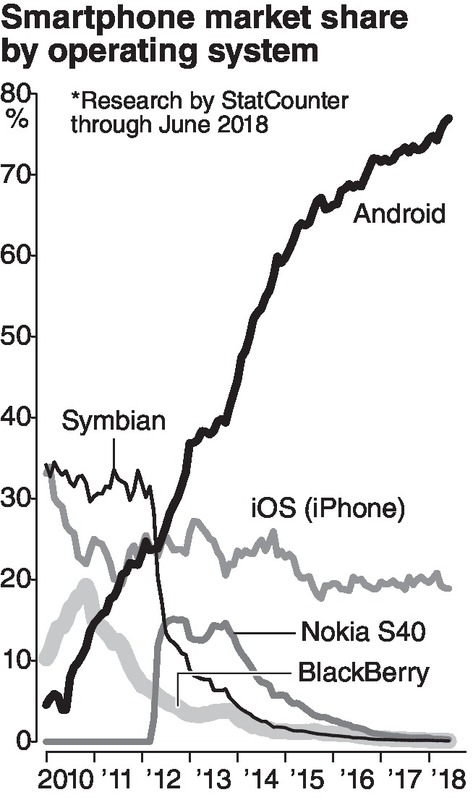
For some time after smartphones began to proliferate around 2008, a number of types of operating system (OS) software competed around the world. However, beginning around 2012, shipments of Android devices rose sharply, and they now account for about 80 percent of the world's smartphones. One factor behind that victory has been the open-source strategy. An executive of a handset manufacturer said, "What's appealing is that the OS can be used free of charge, and can be modified to match the design of the smartphone."
However, Google does not directly profit from releasing the OS free of charge. Some mechanism for collecting earnings is needed. Accordingly, the company made games and a variety of other apps that run on Android devices available in principle through the Google Play virtual store alone. The Google Play Store app serves as the entrance to the shop; without this app, the smartphone is no more than a mobile phone. Handset manufacturers must, with Google's consent, load the Google Play Store app onto their handsets.
Pressuring manufacturers
One of the points on which the European Commission found Google to be in violation of EU antitrust law was the mandate that manufacturers bundle Google's Search app and its browser app on smartphones, as a condition for loading the Play Store app. The search and browser apps are sources of advertising income for Google. It became clear that Google, while spreading its OS by allowing its use free of charge, was pressuring manufacturers by holding the Play Store hostage.
At the same time, it became evident that the open-source strategy -- with modifications to the Android OS allowed -- carries certain risks for Google. If the ability of apps to run depends on the smartphone model, compatibility among Android handsets is lost.
As countermeasures, Google sets standards for modification of programs, and approves models that clear the standards as official Android handsets.
Issues in China
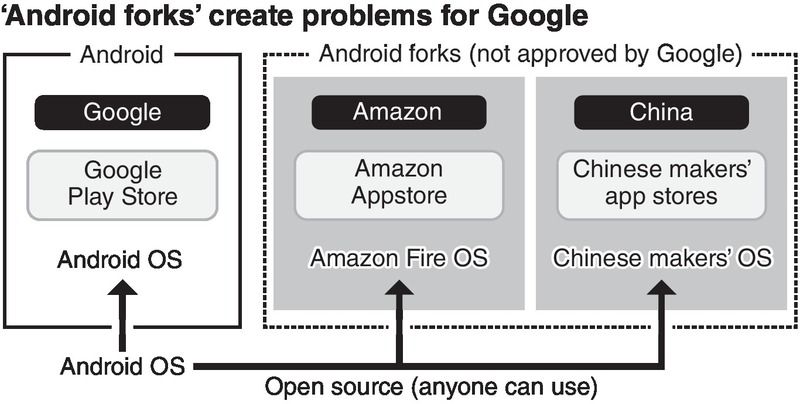
Modifying the Android OS without Google's approval is allowed, which has led to the existence of proprietary operating systems. These unapproved operating systems are known as "Android forks," a term that refers to the splitting of the OS like the tines of a fork. A typical example of a fork is Fire OS, developed from Android OS by U.S.-based online retailer Amazon.com, Inc. The OS is used on tablets and other devices sold by Amazon, with apps available for download from Amazon's store.
China is also a world of Android forks. In China, the Play Store is unavailable because it is blocked by the Chinese government. Chinese manufacturers create handsets domestically using operating systems unapproved by Google, and multiple Chinese companies operate proprietary app stores.
Another point judged illegal by the European Commission was Google's prohibiting manufacturers of Android handsets from selling handsets using Android forks. Google, unable to ignore Android forks, had taken forceful measures.
In response to the decision by the European Commission, Google Chief Executive Officer Sundar Pichai expressed concern in his blog over the appearance of multiple Android forks: "Without rules around baseline compatibility, open-source platforms fragment, which hurts users, developers and phone makers."
Market not self-regulating
According to survey firm StatCounter, the current global market share of Android handsets is about 77 percent. On mobile devices, Google's Search app has about a 94 percent share. The power to stop the web from being painted in Google's colors may not be found in the marketplace.
Google is a company that actively collects its users' activity history through its OS and apps. There is an ongoing debate on whether such a company should occupy the "dominant position" throughout the world. If the marketplace itself does not hold the power to restore balance, the strict application of antitrust measures is significant, and the European Commission's decision can be viewed as a necessary action.
(From The Yomiuri Shimbun, Aug. 11, 2018)
Read more from The Japan News at https://japannews.yomiuri.co.jp/



