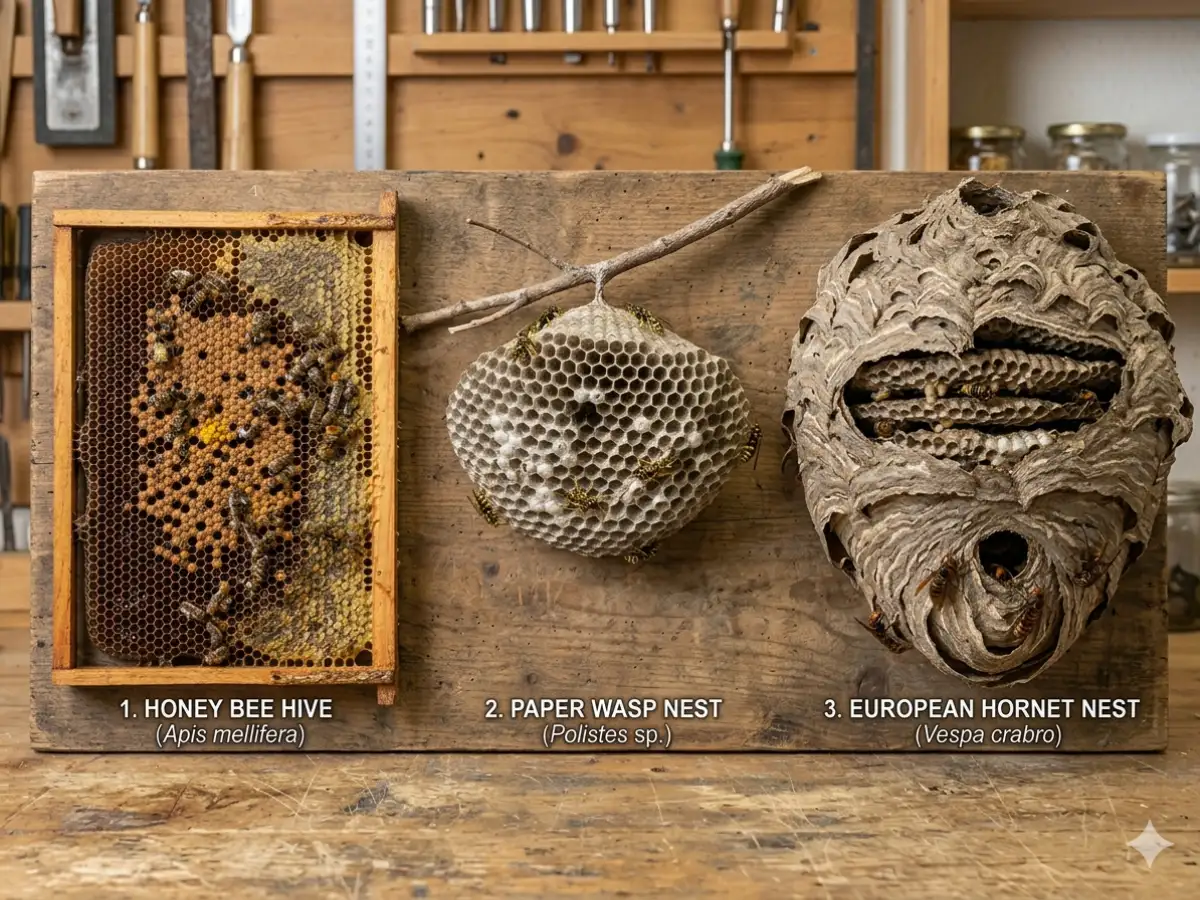
An unusual nest suspended below a roof line or hidden in a backyard bush may not seem dangerous at first sight. However, as explained by Michigan State University Extension, identifying whether the nest is of bees, wasps, or hornets should precede removal efforts.
Why? Simply because the nature of these insects is different, as is their mode of nesting and their reaction when threatened.
As experts from Michigan State University Extension point out, the safe thing to do is to identify the type of nest carefully from afar. This could easily provoke aggression in the highly defensive wasps and hornets.
Why identification matters before removal
Not all nests are created equal in terms of danger posed. While bees have an ecological value as pollinators and are usually docile unless provoked, wasps and hornets tend to be quick to defend themselves against any threats to the nest.
As per information from the CDC/NIOSH on stinging insects, one should avoid swatting at these insects since such behavior is likely to attract an attack on their part. Furthermore, individuals may experience life-threatening anaphylactic shock if they have any sort of venom allergy.
This means that nest identification takes on greater significance.
What the nest itself can reveal
One easy-to-spot clue is the nature of the nest. Paper wasps and hornets construct paper nests using chewed-up bits of plants. The nests are usually gray, layered, light, and constructed on the roof eaves, shrubs, and tree branches.
In a study published in the Insects journal, it was mentioned that a paper nest is a clear marker for the presence of wasps and hornets. As compared to bees, an exposed paper-like nest is likely to be a wasp nest.
It is also important to look at where the nest is. In a clinical review by the National Center for Biotechnology Information, it is mentioned that yellowjackets and hornets typically make their nests either underground, in shrubs, or in trees. Thus, open ground areas in lawns or pathways could indicate a nest of wasps beneath.
Honey bees do not nest in paper structures but tend to aggregate inside walls and hollow spaces in trees.
Why does bee behavior differ from wasp behavior
The behavior of these insects could also offer an essential clue. In accordance with the NCBI clinical review, honeybees are less aggressive until they are provoked. On the contrary, wasps and hornets are defensive creatures when it comes to protecting their nests. Moreover, they can sting several times in a row.
This difference should be considered because homeowners typically respond similarly to both species. According to experts, it could be dangerous for people. Once the nest starts showing heightened activity when a person approaches, one needs to leave immediately instead of inspecting the area closer.
Furthermore, Michigan State University Extension highlights that wasps and hornets are predatory creatures that feed on various other insects, such as bees.
Why the wrong guess can become dangerous
The risks escalate following the sting. In the review in Deutsches Ärzteblatt International, it was noted that a barbed stinger from bees will continue injecting venom following the attack. On the other hand, wasps have stingers that will retract back when they sting, and hence they can sting more than once.
In such a scenario, it means that an individual will not know whether they are dealing with a honey bee, a yellow jacket, or another stinging insect. Mistaken identity will make one underestimate the likelihood of further stings or may fail to closely monitor symptoms for a reaction.
Moreover, identification of the insects is less straightforward than most individuals think. Research findings reported in the Annals of Allergy, Asthma & Immunology showed that many individuals cannot identify the stinging insects and their nests accurately, for instance, paper wasps or bald-faced hornets.
How to judge the real risk around a nest
The problem is not confined to the type of insects. The location of the nest also matters. A nest placed close to a doorway, garden pathway, playground, or lawn boundary poses the risk of accidental disturbance.
As mentioned in the mortality report from the CDC on deaths due to stings of hornets, wasps, and bees, there were 1,109 deaths recorded in the US from 2000 through 2017 due to stinging insect bites. Although fatalities are rare, it shows that under certain conditions, stinging insects can become deadly hazards.
In addition, the CDC/NIOSH advises individuals not to use fragrant substances outside since such odors may entice insects. Moreover, wearing protective clothing and maintaining composure near airborne insects will minimize the possibility of attack.
The safest response starts with distance
This advice comes up time and again whenever experts discuss dealing with an unknown nest – stay away from it.
A visual examination can give some hints about whether it may belong to bees, wasps or hornets. However, experts stress that it is dangerous to jump to conclusions based on visual information alone.
This is the reason why experts advise taking your time rather than acting quickly. If you notice a papery-looking nest located under the eave of the building, a hole in the ground near a walkway, or even abnormal behavior of insects near shrubs, treat this situation carefully without any immediate steps.
The best strategy is not to act immediately but wait and see if this nest needs to be destroyed or not.