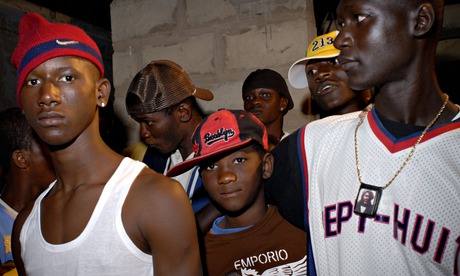
Saturday night in Dakar, Senegal. Youths from outlying suburbs such as Pikine and Guédiawaye are busy reinventing hip-hop. In April, Paris’s Banlieues Bleues festival set aside a whole evening to proclaim that “Dakar is Rap”, celebrating this high-voltage scene that has started airing its views on politics, anything from problems with the water supply to the trial on corruption charges of Karim Wade, son of former president Abdoulaye Wade.
In the centre of the capital, a step away from Université Cheikh Anta Diop, club band Orchestra Baobab, launched in 1970, is on at the Must, an upmarket venue. They play a tight set of Afro-Cuban numbers well suited to the audience, who dance with elegant precision. A little up the coast, the Pointe des Almadies is congested till dawn, with a string of western-style clubs.
Earlier on in the afternoon we found Dieuf-Dieul de Thiès rehearsing in a garage in the Ouakan district, now overshadowed by the 49m tall bronze African Renaissance monument, an extravagant project hatched by ex-president Wade.
In the street kids were playing football, impervious to the fun inside. Dieuf-Dieul de Thiès, another 1970s band, was founded by guitarist Pape. It started a trend for Senegalese sounds, blending jazz, Mandinka, Afro-Cuban and Mbalax (meaning “rhythm” in the Wolof language) influences.
Dieuf-Dieul de Thiès are on the Dakar-based Teranga Beats music label. It is the brainchild of Adamantios Kafetzis, a Greek who landed up here in 2003 and fell in love with African music, in the days when the notion of African rebirth was still a distant dream.
Kafetzis grew up in the Pangrati neighbourhood of Athens, home to an Ethiopian community. He was a regular at the city’s African clubs, dancing to Congo rumba and Nigerian Afrobeat. One day he bought the African part of a big collection of LPs and really caught the bug. He soon forgot about art school and started looking for real rarities.
His fate was sealed in Thiès, a rail hub inland from Dakar, when he met Moussa Diallo. “The owner of several well-known clubs – Bambou and Sangomar – he liked to record their material,” Kafetzis explains.
“His family showed me into a room full of tapes.” Teranga Beats has not yet released a great deal – seven records since 2010 – with no samplers, just top quality, unpublished tracks by artists such as Royal Band, Dieuf-Dieul and Idrissa Diop.
“The problem with Senegalese music is that it was trapped between Afro-Cuban and Mbalax,” Kafetzis adds. “In fact the country has diverse traditions, drawing on Serer, Fula and Casamance influences (ethnoreligious, linguistic and geographic).
“But very little material has been recorded. The same is true of their griot story-tellers, most of whom are women. There are very few public records here. I can’t even find period photos for illustrating covers. They say the negatives have been lost. The radio has kept very little, and the television’s even worse.” Just a few lone figures, such as the late producer and founder of Syllart Records Ibrahima Sylla, have saved part of the country’s recent musical history, though disregarding the rights of performers.
Yet a line in the national anthem, penned by poet and former president Léopold Sédar Senghor, proclaims: “Pluck all your koras and beat the balafons” (a kind of wooden xylophone). He had his own official griot storyteller, Yandé Codou Sène. A leading Serer singer with a powerful voice, she was a favourite on Radio Senegal. Thanks to Youssou N’Dour, now a minister and adviser to President Macky Sall, something of the old magic has survived. He recorded a magnificent album, Gainde: Voices from the Heart of Africa, with her in 1996.
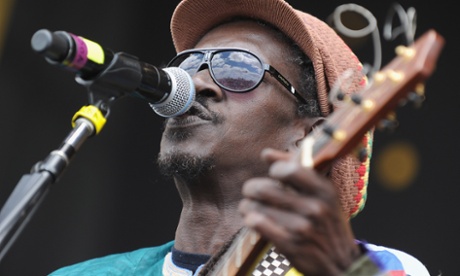
Resuming our tour of the more unusual Dakar clubs, we stopped at Le Relais for a cup of tea with singer Cheikh Lô. As a member of the Muslim Baye Fall brotherhood he must wear dreadlocks and a big, plaited leather necklace, to protect against evil. Le Relais has been around for quite a while, launched in 1947 on the road to Ouakam, where the French military was once based. It has managed to resist the rising tide of strict religious observance. The bar is stocked with an impressive array of spirits, as well as serving Gazelle beer. Just outside is one of the capital’s last baobab trees. The club is run by a retired colonel, Charles Gueye, yet another of the president’s special advisers. There is plenty of room here and, as the landlord explains, “it hosted all the opposition parties, including the Y’ En A Marre [fed-up] movement against President Wade”.
In the yard outside, Lô rolls a cigarette and says: “Africa has taken over all the continents. If we forget that, Boko Haram will win.” He has just finished recording a number with Brazilian singer Flavia Coelho and the French accordion player Fixi. It will be on his next album, due out this month. “Remembrance is a weapon,” he adds. A point the rapper Matador, who was a guest at Banlieues Bleues, must have had in mind when he started his first band in 1992. He called it Wa BMG 44, a reference to the Senegalese fusiliers killed in the Thiaroye massacre. Repatriated after the liberation of France in 1944, west African troops mutinied at a camp near Dakar in protest at poor conditions and problems with pay. They were shot by French colonial forces.
The percussionist Doudou N’diaye Rose returns to the idea of transmission in his preface to Musique Sénégalaise, by Papis Samba, one of the few books to focus on the history of west African music, published earlier this year. Rooted in ritual and rites of initiation, Senegal’s first band, La Lyre Africaine, was formed in 1948. It used to rehearse in the basement of Dakar’s Sandaga market.
Then came what were known as the “GV” records (derived from their catalogue number), which featured Afro-Cuban music. Published by EMI, the earliest copies had arrived in the late-1930s, imported by Cuban and Liberian sailors and sold in Brazzaville and Léopoldville by Greek grocers, many of whom hailed from Egypt.
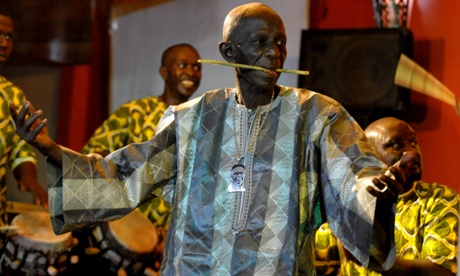
“At the time I responded to this tendency to forget our own music by staging free drumming concerts,” Rose, 86, says. With regard to the Senegalese brand of rap, he points out that “its form is exactly the same as the tassou [the traditional meter used by griots], so it hasn’t really borrowed from abroad at all, it’s rooted here. Of course, to appreciate that, you need to be familiar with the tradition.”
Much remains to be done, however. We visited the Théodore Monod Museum of African Art (formerly known as the IFAN Museum of African Arts)in its art deco premises. The building was lavishly restored in 2008 and a new curator was appointed to head the museum, but over the past five years a thick layer of dust seems to have accumulated there.
This article appeared in Guardian Weekly, which incorporates material from Le Monde