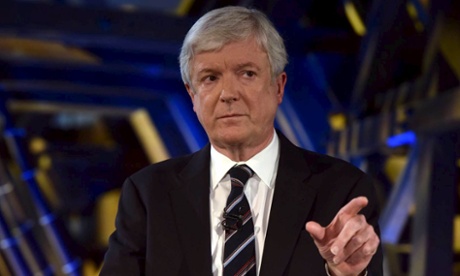
BBC director general Tony Hall has defended his “shotgun” funding deal with the government in which it took on the £700m cost of funding free TV licence fees for over-75s, saying it was a better deal than the one struck by his predecessor Mark Thompson five years earlier.
In a robust exchange with MPs on Tuesday, Hall said that he did not consider resigning over the issue but a senior member of the BBC Trust, Richard Ayre, said he did contemplate quitting over the extra financial burden imposed on the corporation.
John Nicolson, SNP MP and member of the Commons select committee on culture, media and sport, accused Hall of “rolling over” in his negotiations with the government and told him his staff regarded it as a “huge defeat”.
Hall told the committee: “I didn’t honestly directly think of resigning, that’s not what I see my job as.
“My job is to fight for and win the best deal I possibly can for the BBC. To resign and walk away might have made me feel good but my job is to battle for the BBC and get the BBC we all want.”
Thompson and the BBC Trust threatened to resign in 2010 when the BBC was first faced with the prospect of paying for free licence fees for the over-75s, which was ultimately not part of the funding deal with the then coalition government.
But it did take on a range of new funding responsibilities, including the BBC World Service and Welsh-language channel S4C, among many others.
Hall said: “The last deal was worse than this deal. We had a flat licence fee deal imposed on us, we had to absorb £500m of costs, absorbing the World Service, BBC Monitoring, £150m for broadband, city [local] TV and S4C.
“It was a considerably worse deal last time than the deal we have come to with the chancellor this time.”
In sometimes strained exchanges Hall confirmed the chancellor and secretary of state had presented the BBC with a fait accompli by withdrawing funding for free licence fees for the over-75s.
He admitted it meant “big, big cuts” and said the 20% cost savings that the BBC will now embark on would be hard to achieve.
Ayre, a former deputy chief executive of BBC News, said the latest deal was “three of the best” compared with “six of the best” in 2010, when he was one of the trust members who had threatened to resign.
He said he had again considered resigning over the issue during the latest round of negotiations, but decided it would not have been in the best interest of licence fee payers on the even of charter renewal and a wide-ranging debate about the future of the BBC.
“The word deal has been used a lot. This wasn’t a deal, it was a decision of government,” Ayre told the committee. “If you were given six of the best last time and only three of the best this time they both hurt.”
“Did some of us consider resigning? Yes we considered it … My view was it would not be appropriate and my job was to stay and fight on behalf of a strong BBC.”
BBC management is planning to reveal details of a further £100m in savings before Christmas and after its official response to the government’s green paper on 8 October.
Further job cuts are likely following the announcement of 1,000 middle management job losses in July.
In exchanges which made it clear he doubted some BBC statements (in particular over the so-called “luvvies’ letter” and cost issues) committee chair Jesse Norman, chair of the media, culture and sport select committee, described the corporation’s strategy over the green paper as “tantric”, “dribbling out” bits of information.
Hall responded: “I don’t know whether it’s tantric.”
Proceedings were briefly interrupted while Hall discussed the BBC’s plans to expand the World Service, by a protester who held up a piece of paper with two website addresses and appeared to put his hand on Hall’s shoulder, telling him: “You have made some very serious mistakes.”